
Best Ambient AI Scribe Solution - Top Picks
Ambient AI reduces clinician workload by automating documentation seamlessly in the background. Explore its benefits, top tools, and how to implement it effectively in your workflow.
Is documentation work currently following you home after the workday ends?
It’s a common problem as healthcare's growing complexity increases the number of clinical and revenue cycle tasks. Fortunately, you can reverse this trend by leveraging ambient AI technologies to reduce the documentation burden.
This post explores the best ambient AI scribes available today and how to choose the right one for your organization.
TL;DR - Best Ambient AI Scribe
Here’s a quick rundown of the ambient AI scribes we’ll cover in this post:
DeliverHealth’s InstaNote
Commure
Solventum Fluency
Microsoft Dragon Copilot
Fathom AI Notetaker
What is Ambient AI in Healthcare and How Does It Work?
Ambient AI in healthcare is a capability that allows tools to work in the background of a clinical setting without the provider’s active participation.
In the case of ambient AI scribes, the solutions listen during patient-provider encounters and convert the conversations into clinical notes in real-time.
The solutions work by leveraging the following core features:
Automatic Speech Recognition (ASR): Using acoustic and language models, ASR technology converts spoken language into written text in real-time. It helps produce raw transcripts, not clinical notes.
Clinical extraction features: To identify the clinical context of the transcript, ambient AI scribes use Natural Language Processing (NLP) and Large Language Models (LLMs) to understand clinical intent.
Clinical note generation: After the encounter ends, the solution uses the contextual clinical understanding to draft structured clinical notes. You can then review the draft, make any necessary edits, and sign it off.

Benefits of Ambient AI For Clinicians and Health Systems
Ambient AI technologies can streamline clinical operations and strengthen financial performance.
Let’s explore the benefits they offer clinicians and health systems:
Benefits for Clinicians
By taking over the bulk of the manual process of creating clinical notes, ambient AI benefits clinicians in the following ways:
Reduced cognitive load: Typically, a clinician has to juggle listening to the patient, asking the right questions, and charting in real-time (or taking mental notes to chart later). With ambient AI handling charting, you can focus fully on the patient during a visit, significantly reducing your cognitive load.
Better patient interactions: The positive consequence of fully focusing on your patients during visits is a markedly improved patient experience. Your patients can share more useful information when they feel heard, enabling you to improve care quality through deeper engagement.
Reduced documentation time: Because clinical notes are generated automatically as conversations happen, time spent charting during or after work hours is reduced significantly. Much of what you’ll have to do will involve minimal editing of the AI-created notes.
Benefits for Health Systems
Most of the benefits of AI-driven documentation solutions for health systems are due to the administrative and operational efficiency they help achieve.
Here are some of the key benefits for clinics, hospitals, and large health systems:
Better revenue performance: Automating charting with streamlined processes helps improve documentation quality. As a result, coding and other downstream RCM activities become more accurate, leading to better revenue performance.
Faster billable turnarounds: Ambient AI helps shorten the time between an encounter and claim submission by finalizing clinical notes as soon as an encounter ends. Also, because documentation is better structured, there are fewer delay-causing coding queries.
More scalable operations: Once you deploy an ambient AI solution in a health system, you can scale it across specialties or locations without proportional increases in operational costs. Also, it can help you maintain consistency in documentation standards as you scale.
Key Differences That Set AI Scribe and Ambient AI Scribe Apart
Early AI scribes focused on dictation and transcription workflows. Advances in AI then enabled the introduction of ambient technologies to improve workflow efficiency.
The workflows differ in the following key ways:
Traditional AI scribes use manual prompts while ambient AI uses passive listening.
Traditional AI scribes are deployed reactively post-visit, while ambient AI proactively captures interactions in real-time.

How to Choose the Right Ambient AI Scribe Solution
You want to choose a solution that aligns with your current workflows and integrates well with your existing tech stack.
Below are the key factors to consider:
EHR integration: Interoperability is essential for embedded workflows that automatically push generated clinical notes into your EHR. Ensure the ambient AI scribe can integrate seamlessly with your system of record (EHR/EMR).
Specialty support: Does the scribe understand the nuances of your specialty well enough to create accurate and compliant notes? Go with a vendor that supports your specialty and mixed-specialty organizations.
Proven deployment: Ambient AI has been around long enough for vendors to test it in diverse healthcare settings. As such, it is best to prioritize solutions with a verifiable track record of successful real-world implementations.
Security and compliance: You’ll be dealing with sensitive patient data. An AI scribe that doesn’t prioritize security and compliance can expose you to significant compliance risks. Look for encryption, role-based access, and secure integration features.
Best Ambient AI Scribe - Complete List
Let’s now explore the top ambient AI scribes that have been successfully deployed nationwide across a wide range of healthcare settings:
1. DeliverHealth’s InstaNote
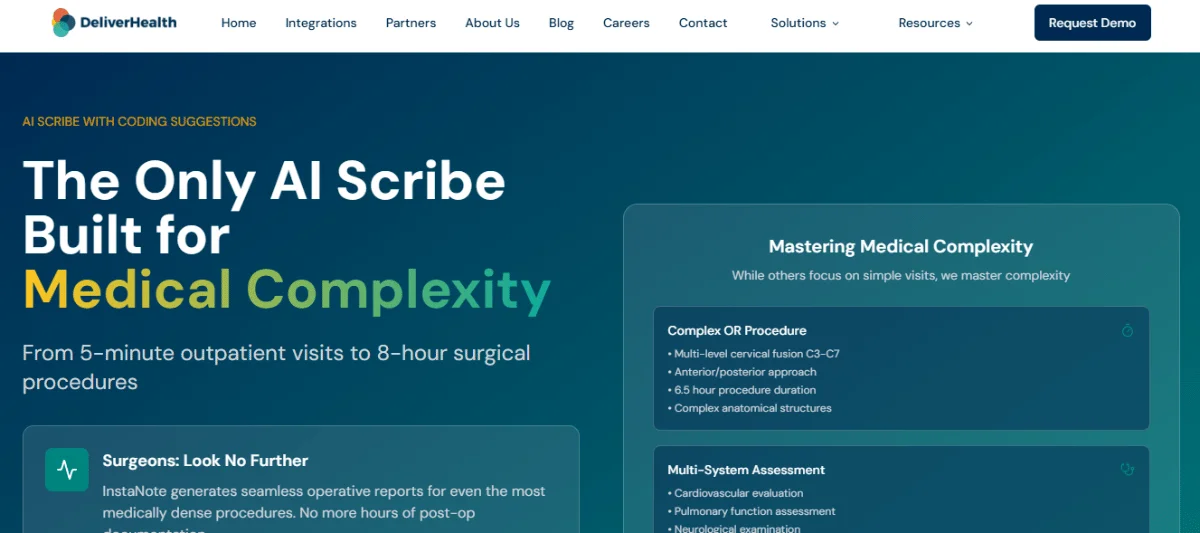
InstaNote is an enterprise-grade ambient AI documentation solution that automatically turns your patient conversations into clinical notes in your preferred format.
It supports both inpatient and outpatient settings. It has been deployed across over 100 specialties, including orthopedics, internal medicine, cardiology, behavioral health, and pediatrics.
You can use the following core capabilities to improve documentation:
Ambient and dictation workflows to support both real-time and post-visit charting.
Outputs that include coding suggestions at the point of care.
Structured note creation that’s specialty-appropriate.
Integration with InstaCode, our AI-powered coding solution that’s designed to increase coding accuracy and capacity.
InstaNote integrates with popular EHRs, including Epic, Haiku, Athena, PACE, eClinicalWorks, Allscripts, and ModMed. The solution supports quick and easy onboarding for immediate use with no training required.
Explore InstaNote to see how it generates accurate, structured clinical notes instantly.
2. Commure
Commure’s ambient AI can help you automatically capture clinical interactions and generate structured documentation. It supports multiple care environments, covering both inpatient and outpatient care.
The company offers its solution in tiers for different documentation intensities, with basic features being:
Ability to create specialty-aligned notes.
Ability to surface relevant documentation and medical coding cues.
Native EHR integration, allowing you to run it within your existing EHR environment.
The enterprise-grade solution supports both dictation and ambient workflows.
Because the lower tiers operate largely as a documentation layer, it may not be a good fit if you want a system that integrates directly into revenue cycle workflows.
3. Solventum Fluency
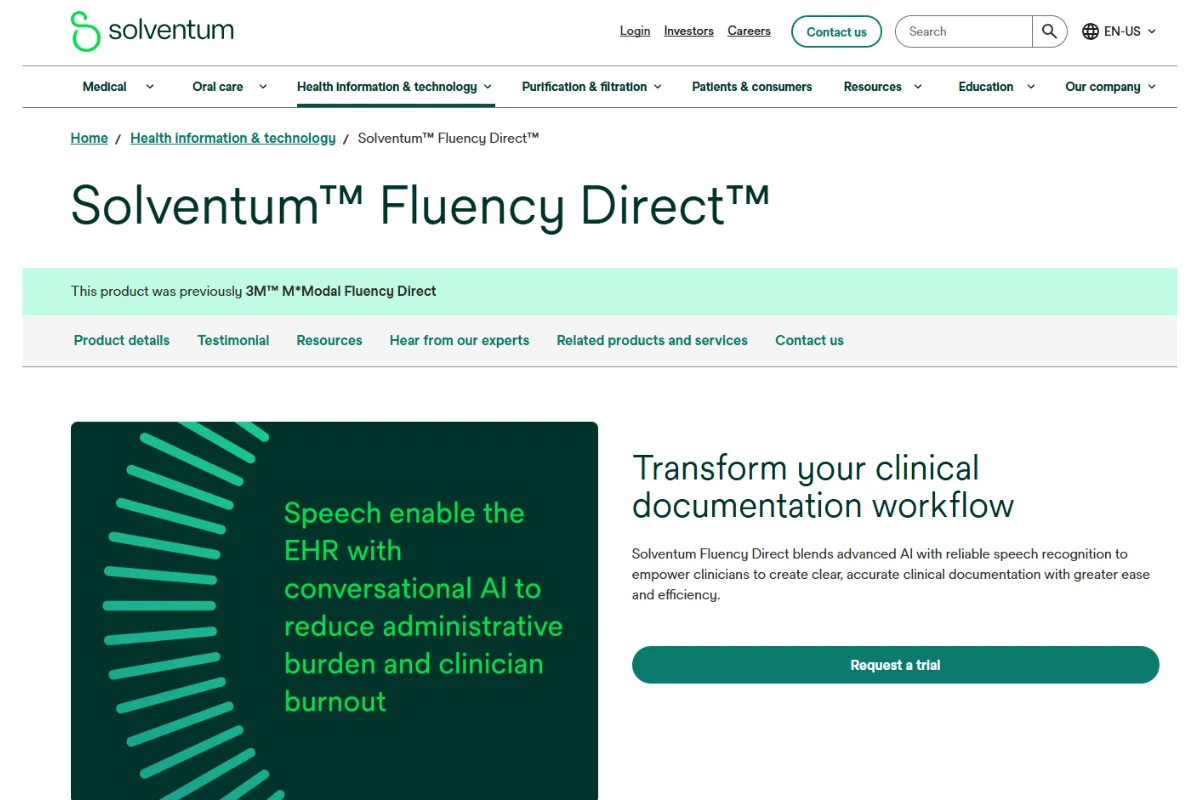
Solventum’s ambient AI scribe can help you stay engaged during patient interactions by automatically capturing your clinical interactions and transforming them into structured documentation.
The platform has the following capabilities:
Support for both dictation and ambient workflows.
High context awareness for specialty-specific notes.
Provision of third-party medical references to enable accuracy and complete citations.
That said, Solventum offers its documentation capabilities modularly (Fluency Direct, Fluency Align, and traditional transcription), and you may have to pay for different components. It may not be a good fit if you don’t want documentation costs to increase significantly as your operations get more complex.
4. Microsoft Dragon Copilot
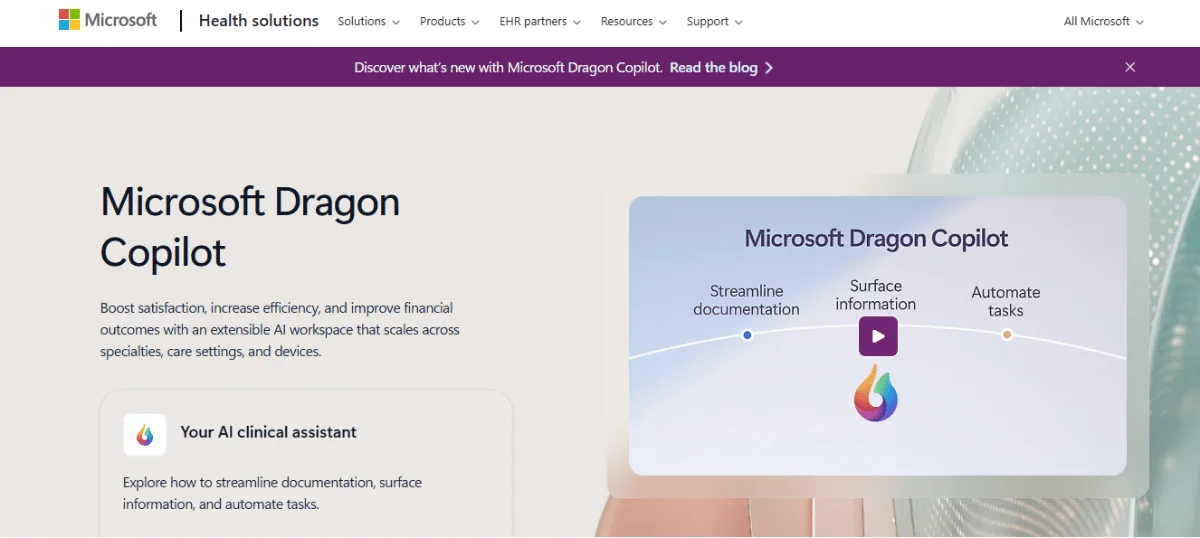
Dragon Copilot helps streamline documentation and automate repetitive tasks, enabling you to focus on patient care.
Its key feature is the ability to capture conversations and orders in the background and automatically convert them into customizable clinical notes.
Other features include:
Ability to surface information from notes, transcripts, and third-party medical references.
Ability to automate tasks such as clinical evidence summaries, after-visit summaries, and referral letters.
Because its core strength is mainly as an AI clinical assistant for documentation, it may not be a good fit when you want a system that spans documentation, coding, and revenue optimization.
5. Fathom AI Notetaker
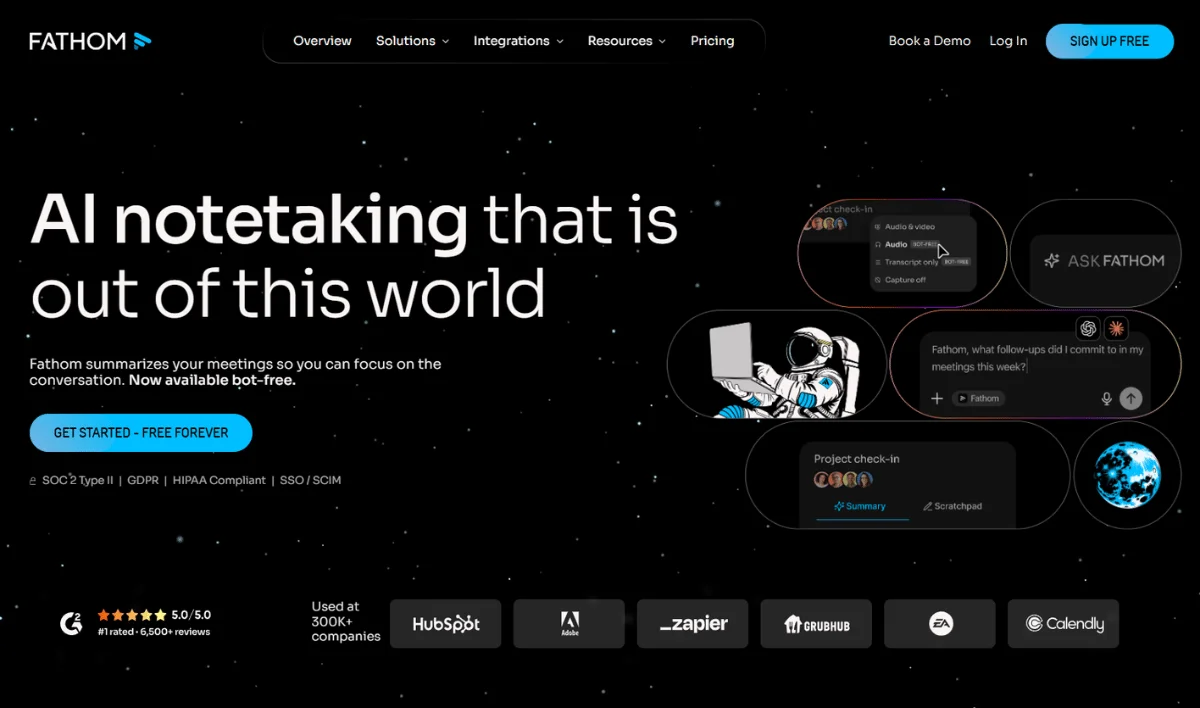
Fathom is an AI-powered solution that summarizes online meetings so you can focus on the conversation.
While not designed solely for healthcare settings, it may suit you if you’re looking for a simple scribe to summarize telehealth conversations for manual post-encounter review.
It has the following key features:
Automatic note-taking and summarization
Workflows to support team collaboration
Integration with Slack, Gmail, Asana, Zoom, and Microsoft Teams
It may not be a good fit if you want a solution that supports both in-person and telehealth encounters. Also, because it is not designed specifically for healthcare, it may not be a good fit if you want a solution that aligns notes with coding logic.
Steps to Implement Ambient AI Scribe In Your Workflow
So, how can you make the transition to ambient workflows without disrupting your existing processes?
Consider the following roadmap:
Choose the right vendor: Assess your current documentation gaps and identify the vendor that can help you close them. For instance, if you want a hands-free approach to both documentation and coding, you can go with DeliverHealth, as we automate both with InstaNote and InstaCode.
Define your deployment strategy: Do you want to run a pilot program first, or can you have a full rollout from the outset? You can have a full rollout if your team consists of “tech-forward” clinicians.
Integrate with the EHR: To make ambient AI a seamless part of your workflows, integrate it with your EHR to facilitate information flow, maintain a single record, and support downstream coding and billing.
Get patient consent: It’s best to request patient consent before using the ambient AI scribe during patient encounters. Script how this consent will be requested, but allow your team members to adapt it to their style.
Roll out and review performance: With the systems in place, you can proceed with a rollout while monitoring changes in documentation time and accuracy, as well as revenue recovery. You can use the performance insights to refine workflows over time.
Frequently Asked Questions (FAQs)
Looking for more information about Ambient AI scribes? Here are answers to some of the common questions we get:
What is the Main Difference Between Ambient AI and Generative AI in Healthcare?
The difference lies in their roles.
Ambient AI captures patient conversations in real time, while generative AI produces new clinical notes and summaries based on ambient listening.
What Role Does Ambient AI Play In Revenue Cycle Management?
Ambient AI operates at the point of care, helping you capture the clinical notes needed for downstream RCM activities, such as coding and billing.
Additionally, because ambient AI scribes can provide cleaner, better-structured clinical notes, they help optimize RCM by reducing delays associated with high coding queries.
What Limitations Do AI Scribes Have Compared to Ambient AI Platforms?
Traditional AI scribes have the following limitations compared to ambient platforms:
They have limited sensor inputs and rely solely on narration and dictation workflows.
They typically have limited integration with RCM tools, leading to disconnected workflows.
They may have limited clinical intelligence, making it hard to infer clinical context.
What Impact Does Ambient AI Have on Clinician Burnout and Patient Experience?
Ambient AI reduces clinician burnout by reducing documentation time. Also, there’s a lower cognitive load during patient encounters as the clinician doesn’t have to juggle charting and listening to the patient.
The patient experience improves because the clinician can focus on fully listening and asking questions, rather than typing.
Conclusion
Ambient AI scribes can help you remove friction at the point of care while improving documentation quality.
Better documentation has a knock-on effect on all downstream RCM activities, leading to better revenue performance. Nonetheless, you must still ensure the documentation workflows align with your other RCM workflows.
It’s for this reason that we focus on streamlining both documentation and coding at DeliverHealth. InstaNote, our industry-leading ambient AI documentation solution, serves coding suggestions at the point of care.
We built it for medical complexity, allowing you to use it to ambiently create documentation for both simple consultations and complex operating room procedures.
Request a demo to see how we cut documentation time in half with our AI-powered solution.
Stay Updated
Subscribe to our newsletter for the latest healthcare AI insights and company updates.