

Best AI Scribe for Physicians - Top 5 Reviewed
As documentation demands grow, AI scribes are becoming essential tools for modern physicians. Explore top solutions, key features, and how to successfully implement an AI scribe.
Are you currently spending several hours each workweek on charting?
The extensive, repetitive documentation tasks can make you feel like you are spending more time on your device than with your patients. Fortunately, you can now leverage AI scribes to automate clinical note-taking during both in-person and telehealth consultations.
In this post, we’ll compare the top solutions to help you identify the best AI scribe for physicians that can meet your unique clinical requirements.
TL;DR - Best AI Scribe for Physicians
Below is a quick rundown of the top medical scribe companies and solutions we’ll cover in this post:
DeliverHealth’s InstaNote
Microsoft Dragon Copilot
Abridge
Suki
Nabla

What is an AI Scribe and How Does it Work?
An AI scribe is a digital assistant that can listen in on your conversations with patients and automatically generate compliant documentation in real-time.
The goal of deploying such a technology in your practice is to reduce the time you spend on manual charting, which is one of the biggest time-consuming tasks in a modern clinic.
So, how does it work? An AI scribe will typically process your provider-patient conversations using the following capabilities:
Automatic Speech Recognition (ASR) to convert the audio into text
Natural Language Processing (NLP) to separate clinical facts from small talk
Large Language Model (LLM) transformation to structure the facts into documentation
To ensure clinical accuracy, the workflows usually include a human-in-the-loop element. Once the AI scribe drafts the medical notes, you should review, edit, and sign them.
Why are AI Scribes Critical for Physicians?
Without a deliberate effort to streamline it, paperwork can consume a significant portion of your working hours.
In fact, a study evaluating the allocation of physician time in ambulatory practice found that for every hour a doctor spent talking to a patient, they spent nearly 2 hours on documentation.
Fortunately, you can use AI-powered solutions to solve this administrative burden.
It’s a critical operational choice because reducing the burden can help you:
Reduce burnout: AI scribes can significantly reduce your cognitive workload and the hours you spend on administrative tasks, helping you manage physician burnout. For instance, a study across 6 healthcare systems reported that 30 days of ambient AI scribe use reduced burnout prevalence from 51.9% to 38.8%.
Enhance patient experience: Without an AI scribe, some doctors chart in real-time during patient visits. This approach can make the patient feel like you’re talking to your device rather than to them. With ambient AI scribing, you can maintain eye contact throughout the interaction.
Additionally, using AI to streamline documentation can enhance your clinic’s operational and financial health by reducing down-coded visits.

How to Choose the Right AI Scribe for Your Practice
The right AI scribe for your practice will mostly depend on your specific workflows and the technology you already have.
Consider evaluating potential candidates based on the following factors:
EHR integration: Does the tool integrate with your current Electronic Health Record (EHR)? Seamless EHR integration with an AI scribe is important to avoid data silos.
Ambient workflows: The AI scribe should be able to record natural conversations with ambient workflows. Ideally, the scribe should have both ambient and dictation workflows.
Specialty considerations: Some AI scribes may perform well in closely aligned specialties, e.g., psychiatry and neurology, but underperform in others. Confirm if the AI scribe can reliably handle the contextual requirements of your speciality.
AI Scribe Comparison - Top 5 Solutions at a Glance
We’ve analyzed the best AI scribes for physicians that integrate with many popular EHRs and can work well in a variety of clinical settings.
Below are the top 5 solutions we believe you should consider when you want a medical-grade, HIPAA-compliant AI scribe:
1. DeliverHealth’s InstaNote
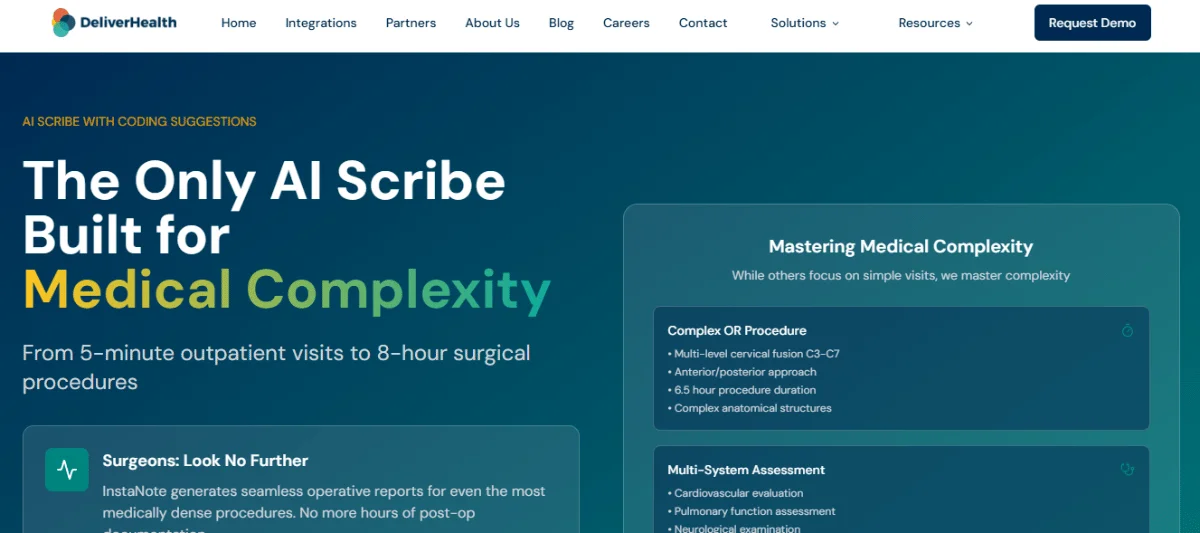
InstaNote is an AI-powered solution designed by DeliverHealth for a wide range of documentation needs, from routine outpatient visits to complex surgical procedures.
It handles the heavy lifting of documentation for you by combining 5 key capabilities:
Advanced speech recognition capabilities to capture every detail of your patient encounters with medical specificity, without “filling in the blanks” with unsaid details.
AI clinical intelligence to understand the specific clinical context of your specialty.
Automated clinical note structuring to organize the information into your organization’s preferred clinical note formats.
EHR interoperability to ensure a seamless flow of information from the AI scribe to your existing system of record.
Coding suggestions to deliver real-time documentation and boost revenue integrity.
The enterprise-grade solution is currently deployed across more than 800 healthcare systems, with more than 60,000 providers already using it to reclaim their time.
These deployments are driving real returns on investment, with $50K+ annual savings per physician, 2.5 hours daily time savings, and 95% physician satisfaction.
Ready to join the thousands of providers who have reduced their clinical documentation burden with DeliverHealth’s InstaNote?
Request a demo to see how InstaNote can transform your documentation workflows.
2. Microsoft Dragon Copilot
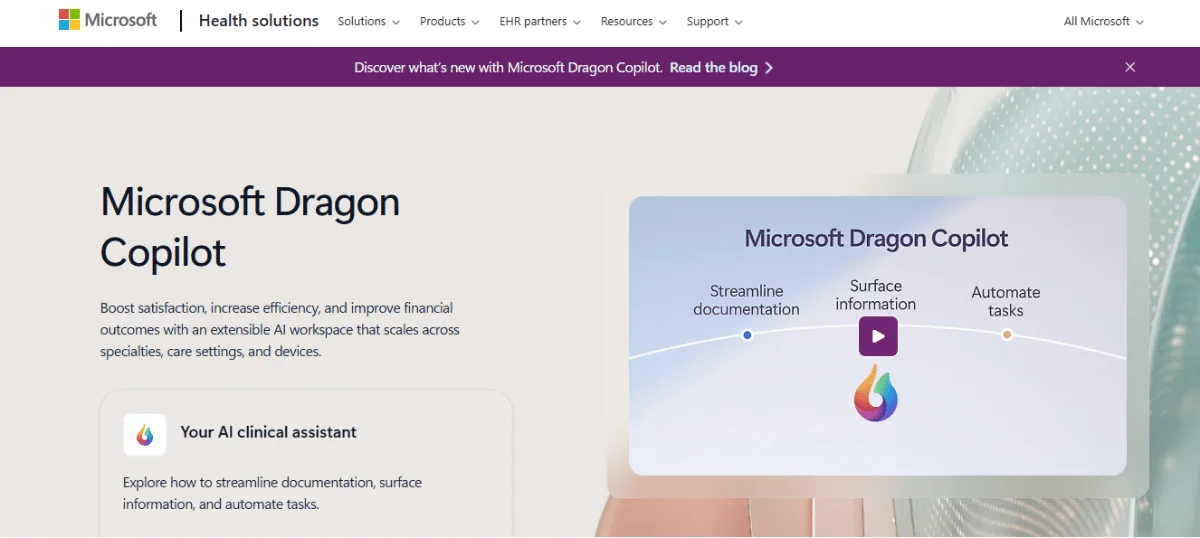
Microsoft’s Dragon Copilot is an AI clinical assistant with ambient listening features that you can deploy in both in-person and telehealth encounters.
The AI assistant can help you in the following areas:
Streamlining documentation by ambiently capturing multi-party, multi-lingual conversations and automatically converting them into specialty-specific notes.
Surfacing information from your own notes and transcripts or third-party sources.
Automating routing tasks relating to coding suggestions, after-visit summaries, clinical evidence summaries, etc.
It’s an enterprise-grade platform that can work in large health systems. It also integrates directly with popular EHRs.
It may not be a good fit if you want flexibility beyond ambient AI workflows, such as hybrid workflows.
3. Abridge
Abridge is an enterprise-grade AI scribe used by large health systems and hospitals.
The platform has the following key features:
Ambient documentation that lets you have natural conversations while it converts facts into structured documentation.
Built-in auditability, which lets you verify the accuracy of specific AI summaries by highlighting the text while the tool provides the corresponding source evidence.
Ability to dynamically integrate data from previous patient encounters and clinician preferences.
The platform also integrates with popular EHR systems, including Athena and Epic.
Because it is designed for enterprise health systems, it may not be a good fit for you if you run a smaller practice or hospital.
4. Suki
Suki is an AI assistant that supports both ambient AI documentation and proactive voice commands for tasks like pre-charting and EHR data retrieval.
Suki’s key features include:
Ambient order staging, which lets you generate and stage an order by simply talking to the patient. You remain in control of the process and can accept, edit, or reject any prescription order before it is forwarded to the EHR.
Voice-enabled editing, which allows you to use natural language commands to edit your drafts.
Voice-enabled pre-charting, which allows you to get ahead on charting by getting Suki to generate pre-charted content through dictation.
It integrates with popular EHR systems, including Epic, Athena, Oracle Health, and Meditech.
As an AI-first ambient AI scribe, it may not be a good fit if you need robust hybrid workflows.
5. Nabla
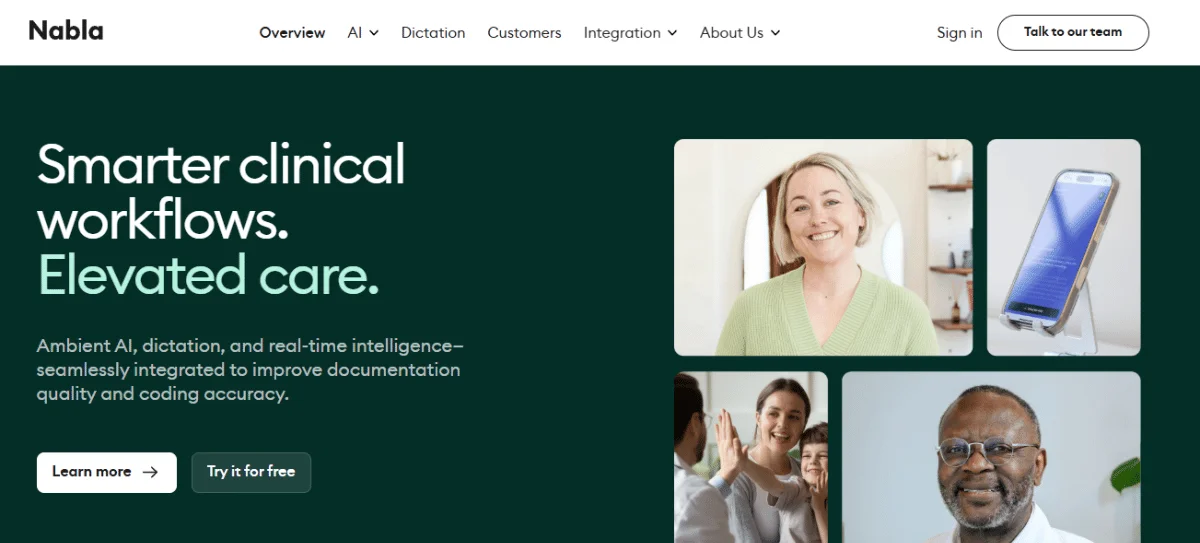
Nabla utilizes ambient AI listening, dictation, and clinical nudges to help clinicians streamline documentation across a wide range of specialties.
You may consider Nabla for the following reasons:
Compatibility with most popular systems, including Altera, Athena, Epic, Cerner, and NextGen Healthcare, letting you seamlessly integrate the AI scribe with your existing EHR.
Supports most clinical settings, including inpatient and outpatient care and telehealth encounters.
Offers sufficient customization options that include custom instructions as well as custom note formatting.
With deployments in roughly just 150 healthcare organizations, it may not be a good fit if you want to prioritize AI scribes that have been tested more extensively.
What to Expect During the Medical Scribe Implementation Process
It is not enough to just choose a good AI scribe for your practice; you must also get the implementation right.
Typically, after selecting a suitable vendor, the implementation process involves the following key steps:
Defining Key Performance Indicators (KPIs) to determine what success looks like.
Technical integration involves setting up hardware (tablets or clinic-owned phones), integrating with your EHR, and configuring user logins.
A testing phase, so you can test your workflows and refine templates.
Depending on the results of the testing phase, you can proceed with a full clinical roll-out.
For a smooth implementation, you should ensure:
Workflow configuration: The vendor should offer customization options to ensure the AI scribe is compatible with your unique workflows. You should also account for your narrative style and the different encounter types you have, e.g., new patients, follow-ups, chronic management, etc.
Staff training: Get everyone aligned by training your staff on any new workflows, the etiquette surrounding ambient listening, consent management, and data integration.

Frequently Asked Questions (FAQs)
Let’s now answer some commonly asked questions about AI for medication documentation:
How Accurate are AI Scribes For Medical Documentation?
Recent trials and studies indicate that accuracy metrics vary across platforms.
Therefore, it is best to use a reliable platform that has been tested across a wide range of settings. That said, you must review each AI-generated documentation for missing clinical details, summarization errors, and AI hallucinations.
Do AI Scribes Integrate Directly With My EHR System?
Yes, the best AI scribes for physicians now offer direct integration with popular EHR systems like Epic, eClinicalWorks, and Athena.
How Much Time Can Physicians Realistically Save With An AI Scribe?
The amount of time you can save depends on your proficiency with the tool and your current documentation burden.
With DeliverHealth’s AI-powered solutions, you can reduce documentation time by 75%, which can yield 2.5 hours of daily time savings.
Are AI Medical Scribes HIPAA Compliant?
Yes, most AI scribes built for use in clinical settings are HIPAA-compliant.
Nonetheless, consider having additional internal procedures, such as role-based access controls, to protect patient data.
Conclusion
Streamlining and automating documentation can go a long way toward helping you reclaim your time for more essential tasks, such as patient consultations. By automating charting using an AI scribe, you’ll finally have the time and space to be fully present during both in-person and virtual consultations.
However, streamlining charting is only half the battle. You must also streamline coding to achieve true clinic efficiency.
That’s why at DeliverHealth, we run InstaNote alongside InstaCode, our AI-driven coding solution that’s designed to help you improve accuracy, productivity, and financial performance.
Connect with us to see how we can help you streamline documentation end-to-end, from charting to coding and revenue cycle workflows.
Stay Updated
Subscribe to our newsletter for the latest healthcare AI insights and company updates.