
Cardiology CPT Coding - A Complete Guide for Billing Teams
Accurate cardiology CPT coding is essential for maximizing reimbursements and reducing claim denials. Explore key cardiology codes, modifiers, documentation tips, and how AI is transforming coding workflows.
Your healthcare system bills tens to hundreds of cardiology encounters per day. Many are denied or underpaid due to mismatched codes, modifiers, and ICD-10 links.
The problem is that cardiology has more procedure codes per encounter than any other specialty, with rules that change every coding cycle and modifiers that work differently for each code family. Audit risk grows with every interpretation, modifier, and ICD-10 link.
You can avoid these problems by using the right solution for medical documentation, thereby improving coding accuracy.
In this guide, we'll discuss the most common CPT categories, the modifiers payers expect, and typical ICD-10 pairings. We'll also discuss how AI has changed CPT coding in cardiology for billing teams.
Core CPT Code Categories in Cardiology
The American Medical Association’s (AMA) cardiovascular CPT range covers codes 92920-93799.
Cardiology billing codes also draw from cardiac surgery (33000-33999), nuclear cardiology (78451-78499), CCTA (75571-75574), and E/M visits (99202-99215).
The map below covers the cardiovascular Current Procedural Terminology (CPT) codes most outpatient and interventional teams use:
CPT Category | Code Range | Common Procedures |
|---|---|---|
Interventional cardiology | 92920-92998 | PCI, PTCA, stent placement, angioplasty |
ECG and EKG services | 93000-93050 | Routine ECG, interpretation only, tracing only |
Ambulatory cardiac monitoring | 93224-93272 | Holter, event monitors |
Echocardiography | 93303-93356 | Transthoracic echo, TEE, stress echo |
Stress testing | 93015-93018 | Complete test, supervision, interpretation |
Cardiac catheterization | 93451-93572 | Right heart cath, left heart cath, coronary angiography |
Electrophysiology | 93600-93660 | EP studies, ablation, device programming |
Remote cardiac monitoring | 93228-93229, 99457-99458 | MCT, RPM management |
Cardiac device interrogation | 93279-93299 | Pacemaker, ICD, loop recorder |
Cardiac rehabilitation | 93797-93798 | Supervised, unsupervised |
Each category has its own audit traps. Let's walk through the categories below.
ECG and EKG CPT Codes
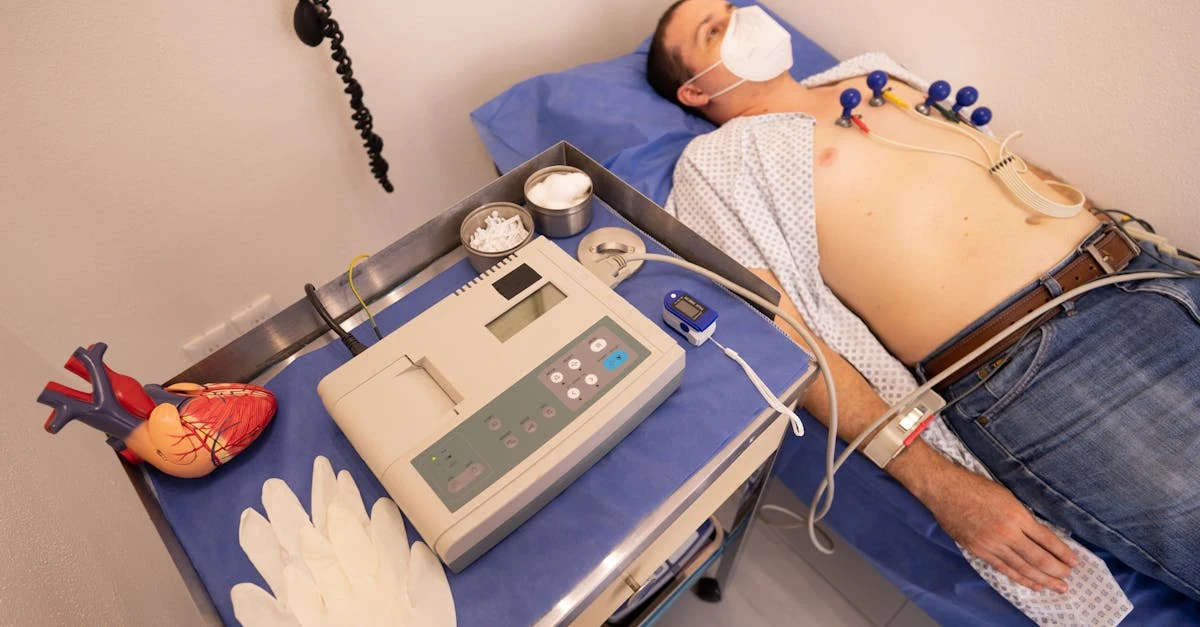
The ECG and EKG family is one of the most-billed code groups in cardiology.
The codes within the family are split between technical work (running the tracing) and professional work (the cardiologist's interpretation and report).
Some code series carry this technical-versus-professional split inside the code set itself (the ECG range works this way), while other diagnostic code families rely on modifiers 26 and TC to separate the two components at the claim level.
For any EKG CPT code workflow, the cardiologist's interpretation and report must be a distinct, signed narrative authored by the reading physician, rather than a copy of an automated reading or another clinician's read.
Echocardiography CPT Codes
The echocardiography family covers transthoracic, transesophageal, congenital, and stress echo studies.
Within each subcategory, the code chosen depends on what the study actually examined and how it was performed: study scope, use of Doppler, whether the patient was at rest or under pharmacologic stress, and the specific anatomy being assessed.
A complete echocardiography CPT codes workflow holds the code you choose accountable to the documentation, including the components performed, the rationale for the study, and a signed read authored by the interpreting cardiologist.
Stress Test CPT Codes
Stress test coding tracks who performed each component of the test (the supervision, the tracing and monitoring, and the interpretation and report). Each component can be billed by a different provider when the work is split.
A stress test CPT code has to match the work the provider actually did, with documentation that supports the role of each provider involved.
Cardiac Catheterization CPT Codes
Cardiac catheterization is the high-complexity end of cardiology coding, with primary catheterization codes, coronary intervention codes, and a layer of vessel modifiers (such as LD, LC, and RC) that identify the artery where the intervention occurred.
The same intervention performed in a different vessel may carry a different code or a different modifier, and additional vessels in the same encounter are coded under their own rules.
Cardiac catheterization CPT codes rely heavily on the operative note: pre-procedure diagnosis, vessel-by-vessel detail, and post-procedure findings influence the final code set.
Electrophysiology CPT Codes
Electrophysiology combines diagnostic and therapeutic services into one session. Under this system, EP studies fall under 93600-93612, while ablation procedures fall under 93650-93657, and pacemaker or ICD interrogation fall under codes 93288-93299.
AFib (Atrial Fibrillation) ablation codes 93656 (comprehensive EP evaluation with pulmonary vein isolation) and 93657 (add-on for further ablation in the same session).
When a diagnostic EP study leads to ablation in one session, both codes apply with documentation that traces the path from diagnosis to therapy.
The 2026 CPT cycle brought in new remote interrogation codes for cardiac contractility modulation. It also moved baroreflex activation therapy interrogation to Category I codes, replacing the previous Category III range. EP coding rewards a complete operative note for every ablation.
Remote Cardiac Monitoring and RPM Billing Codes
Remote cardiac monitoring remains one of the fastest-growing areas in cardiology billing. The area covers ambulatory monitoring, remote physiologic monitoring (RPM), and implanted device monitoring, such as pacemakers and ICDs.
Each pathway comes with its own combination of technical, professional, and management components. Each pathway also requires separate documentation for patient consent, time logs, device specifications, and FDA-cleared hardware.
New updates reflect how quickly this category continues to evolve.
The 2026 update cycle expanded remote cardiac monitoring billing further to include new RPM codes for shorter monitoring windows and lighter-touch management.
Remote cardiac monitoring billing ranks among the highest-scrutiny areas in Centers for Medicare & Medicaid Services (CMS) and Medicare Administrative Contractor (MAC) audits.
The audit risk in this category remains among the highest in cardiology because consent, device, and time documentation must be maintained in the record.

E/M Codes in Cardiology Billing
E/M visits go along with procedure codes in much of cardiology, with outpatient codes for new and established patients, and a separate set for inpatient encounters. The current process for selecting codes follows the 2026 E/M guidelines, with medical decision-making (MDM) complexity or total visit time as the basis.
The cardiology E/M codes an encounter qualifies for depend on the documented complexity of problems, the data the provider reviewed, and the risk of patient management decisions. They don’t depend on the specialty of the provider or the procedures performed in the same date range.
Cardiology CPT Modifiers, the Non-Negotiables
Let’s now explore a short list of cardiology CPT modifiers every coder needs:
Modifier 25 for Same-Day E/M: Append modifier 25 when a separately identifiable E/M service is performed on the same day as a procedure, and the documentation supports the E/M as separately identifiable. The modifier is not a default add-on. An E/M billed alongside a procedure without independent justification carries compliance risk.
Modifier 26 for Professional Component: Modifier 26 reports the cardiologist's professional interpretation and report.
Modifier TC for Technical Component: Facilities append TC to report equipment, supplies, and technician services.
Modifier 59 for Distinct Service: Use 59 to flag two services as separate when NCCI rules would otherwise bundle them, and documentation supports the two procedures as being separate and distinct.
Vessel Modifiers LD, LC, and RC: Each vessel modifier identifies the coronary artery the procedure code represents. LD is used for the left anterior descending, LC for the circumflex, and RC for the right coronary.
Modifier 51 for Multiple Procedures: Sometimes appended to secondary procedures in the same session for reduced payment.
Modifier rules in cardiology evolve every cycle, and each modifier carries documentation requirements that the chart has to support before the modifier can be appended.
ICD-10 Code Pairing for Cardiology Claims
Every CPT code billed has to link to an ICD-10 (ICD-10 — International Classification of Diseases, 10th Revision) that establishes medical necessity. Mismatched pairs are among the top 3 causes of cardiology denials.
The cardiology ICD-10 codes include:
I10 (hypertension)
I25.10 (atherosclerotic heart disease)
I48.91 (atrial fibrillation)
I50.20 (heart failure)
R07.9 (chest pain)
Z87.39 (cardiovascular history)
Payers now use AI to flag CPT-to-ICD-10 mismatches before adjudication, which means the diagnosis code chain has to support medical necessity for every procedure billed rather than just the primary service.
ICD-10 Code | Description | Common CPT Pairings |
|---|---|---|
I10 | Essential hypertension | 93000, 99213-99215 |
I25.10 | Atherosclerotic heart disease, native artery | 93458, 92928, 93015 |
I48.91 | Atrial fibrillation, unspecified | 93656, 93228, 99214 |
I50.20 | Unspecified systolic heart failure | 93306, 93015, 99215 |
R07.9 | Chest pain, unspecified | 93000, 93015, 93306 |
Z87.39 | History of cardiovascular disease | 93294, 93296, 99213 |
How to Maintain Documentation Quality and CPT Code Accuracy
Most cardiology coding errors begin in the clinical note. When the note skips vessel specifics, test components, or E/M distinctness, the coder lacks the detail to assign the right code. The result is a downcode or an unbilled service.
Here’s how to keep your documentation quality high:
Capture Vessel Detail at the Procedure: Ensure you record the correct vessel-specific details because cath reports work best when each vessel treated appears on its own line, with LAD, LCX, or RCA labels in the operative note.
Identify the Physician For Each Service Component: Ensure your stress test records name the physician who supervised separately from the one who read, with timestamps for each part of the service.
Document Full MDM On Every E/M Visit: Ensure you follow the 2025 E/M guidelines to the letter. Providers should document a detailed narrative of the patient visit that supports the complexity of all problems addressed, the data reviewed, and the risk of patient management decisions.
Sign a Distinct Read For Every Test: ECG and echo interpretations should be the cardiologist's own narrative read based on what's authored at the time of review, and identifiably distinct from any automated reading or read generated by another clinician.
Autonomous clinical documentation tools capture clinical detail at the point of care, which closes those gaps before a coder sees the note.

How AI Is Changing Cardiology CPT Coding
Cardiology has high procedure volumes per encounter, where manual coding usually misses billable secondary procedures. Modifier errors, unbundling, and thin documentation are the main causes of denial patterns.
AI changes the workflow at the 3 critical points below.
Autonomous Coding For Routine Cases: Modern AI platforms handle high-confidence, lower-complexity cardiology encounters end to end, returning explainable code outputs with full audit trails. Industry benchmarks place 40-70% of typical case volumes in this category, with accuracy at the engine level reaching 95% on high-confidence work.
Referring Complex Coding Cases to Humans: AI can refer coding that requires intensive judgment to human coders. Your certified coders review the relevant chart and apply payer-specific rules before finalizing the code set. This routing can include decisions that touch on ambiguous documentation, interventional cath labs, vessel-specific modifiers, EP combinations, and more.
Agentic AI For the Wider Workflow: The new phase of medical coding artificial intelligence does more than assign codes. You can use AI agents that reason across documentation, payer rules, and historical outcomes before a claim leaves the system.
The benefits of AI-driven documentation play out across both inpatient and outpatient cardiology.
As a healthcare technology company that provides AI-powered solutions, DeliverHealth brings clinical documentation and medical coding into one workflow for over 60,000 providers across 800+ health systems.
We connect medical documentation directly to coding through confidence-based routing and continuous audit, which is more than what standalone documentation or coding tools offer.
Your health system gets a workflow that catches issues before claims leave your system, and that has humans review cases when AI confidence thresholds are low.
Here’s how we enhance your medical coding experience:
Fewer Coding Errors Through Confidence Thresholds: InstaCode routes each case to the AI engine or coder best suited to handle it.
Built-In Quality Checks From SmartAudit: SmartAudit catches unbundled Doppler, missing vessel modifiers, and absent 25 across each case.
Clean Notes For Cleaner Codes: InstaNote captures ambient multi-speaker conversation or direct dictation, then surfaces coding suggestions based on the structured note your cardiologist signs.
Enterprise Security Backed By HITRUST i1: Our eSOne platform, which carries InstaNote, holds HITRUST i1 certification for healthcare data security.
Explore DeliverHealth's documentation-to-coding workflow.
Common Cardiology Billing Errors and Denial Causes
Most cardiology denials stem from a documentation gap, a modifier miss, or a bundling error.
The following patterns often repeat across practices:
Common Error | Code Involved | Root Cause | Prevention |
|---|---|---|---|
Billing complete stress test when only interpretation performed | 93015 used when 93018 applies (misuse) | Documentation unclear on physician role | Document the specific components performed |
Unbundling Doppler from echo | 93306 billed with 93320 or 93325 (wrong combination) | Coder unfamiliar with bundling rules | Review NCCI edits for echo codes |
Missing vessel modifier on PCI | 92928 used with no LD, LC, or RC | Operative note lacks vessel detail | Require vessel specification in cath report |
Missing modifier 25 on E/M with procedure | 99213-99215 and 93000 used on the same day | Billing system does not auto-append | Set modifier 25 rule in claim scrubber |
Remote monitoring billed without consent | 99457 or 99458 used with no consent on file | Consent never captured at enrollment | Require RPM consent before billing cycle |
If your cardiology team deals with thousands of encounters monthly, these patterns can translate into mid-revenue cycle problems and real revenue loss.
Besides having experienced human coders, you’ll need a reliable autonomous coding solution to reduce mistakes.

Frequently Asked Questions (FAQs)
Let’s wrap up the guide with the questions people usually ask about cardiology CPT coding:
What CPT Code Range Covers Cardiology Procedures?
The primary range for cardiovascular procedures is 92920-93799, covering ECG, echo, stress, EP, and rehab.
Cardiology billing also draws from cardiac surgery (33000-33999), CCTA (75571-75574), E/M (99202-99215), and nuclear cardiology (78451-78499).
A single encounter often pulls codes from multiple ranges.
What Is the Difference Between CPT 93015 and 93018?
CPT 93015 covers a complete cardiovascular stress test (one provider supervises, traces, and reads).
CPT 93018 covers interpretation and report alone, used when a cardiologist reads the tracing without supervising the test.
Billing 93015 for an interpretation-only service is a top billing error in cardiology.
When Should Modifier 26 Be Used in Cardiology?
Modifier 26 reports the cardiologist's professional interpretation and report on a diagnostic service when the cardiologist did not own or operate the equipment used for the test.
Modifier 26 applies to code sets that do not already have a technical-versus-professional split built in (such as echo, stress, and cath imaging codes). For code sets like ECG, the split is built into the code itself, and modifier 26 is not used.
TC is used in hospital outpatient settings. The facility bills TC for the technical side.
What ICD-10 Codes Are Most Commonly Used in Cardiology?
The most frequently paired ICD-10 codes in cardiology include I10 (essential hypertension), I25.10 (atherosclerotic heart disease, native artery), and I48.91 (atrial fibrillation). I50.20 (heart failure) and R07.9 (chest pain) are also common.
Every CPT code billed must pair with an ICD-10 that establishes medical necessity for that service.
What Are the Billing Requirements for Remote Cardiac Monitoring?
Remote cardiac monitoring covers MCT codes 93228 and 93229, plus RPM codes 99457 and 99458 for management.
The CMS requires documented patient consent and FDA-cleared devices. You also need at least 20 minutes of management per cycle with live patient communication, as well as time logs at every audit cycle.
How Does Documentation Affect Cardiology Coding Accuracy?
Your healthcare organization’s documentation determines whether coders can assign the right CPT codes. All your medical documentation must be complete and accurate.
If you have gaps such as missing vessel detail, absent ECG interpretation language, or unclear physician presence during stress testing, your coders usually have to downcode, drop services, or submit claims that are denied on audit.
Conclusion
For accurate cardiology CPT coding, your healthcare system needs complete documentation that supports each code. Denied stress tests, bundled echo claims, unmodified coronary procedures, and rejected remote monitoring claims have one thing in common. The gap between what happened clinically and what made it into the medical note is usually wide, leading to problems like these.
You can use AI documentation and coding tools to close the gap by tying clinical encounters to claims in real-time.
DeliverHealth steps in to fill the gap as a dedicated AI solutions provider for the medical documentation and coding sector.
Our confidence-based routing, SmartAudit on every case, and HITRUST i1 certification ensure your organization experiences improved accuracy, speed, and revenue integrity.
Stay Updated
Subscribe to our newsletter for the latest healthcare AI insights and company updates.