
Coding Compliance Software - Top Tools and Smart Tips
Accurate medical coding is critical for compliance, revenue integrity, and audit readiness. Discover leading coding compliance tools, essential features, and implementation tips.
Healthcare revenue teams lose millions each year when inaccurate codes slip through the cracks. Nearly 3 in 4 organizations now report a rise in claim denials, most of which are traced to incomplete or incorrect codes.
That's where coding compliance software steps in. These tools catch errors before claims go out, automate edit checks against payer rules, and give your team a defensible audit trail when reviews come around.
In this article, we'll compare the best coding compliance software options and help you find the right fit for your team.
TL;DR — Best Coding Compliance Software
Here's a quick look at the top compliance coding tools on the market:
Software | Key Features |
|---|---|
InstaCode | Autonomous AI Coding with SmartAudit, Confidence-Based Case Routing, Straight to Bill Workflow, NCCI Edit Validation |
CRS+ | ICD-10/CPT Expert Logic Pathways, DRG Grouping, Advanced Compliance Checks |
Nym Health | Clinical Language Understanding (CLU), Zero-Intervention Autonomous Coding, Transparent Audit Trails |
Fathom | Deep Learning Code Assignment, High Encounter Automation Rate, Broad Specialty Coverage |
CodaMetrix | Contextual Coding Automation (CMX CARE), Enterprise-Scale Workflow Unification, Coding Denial Reduction |
Maverick AI | Real-Time Point-of-Care Coding, CodePilot Documentation Intelligence, 85%+ Direct-to-Bill Rate |
Commure | End-to-End Ambient-to-Coding Pipeline, Autonomous CPT/ICD-10/Modifier Assignment, Revenue Cycle Automation |
We'll cover each of these in detail further down.

Interactive Quiz - How to Choose the Right Coding Compliance Software
You can find your ideal coding compliance software in about 2 minutes with our free assessment quiz.
All you have to do is answer 5 focused questions about your care setting, coding method, compliance exposure, audit history, and tech environment.
Based on your answers, you'll receive a custom software profile, a DeliverHealth product fit analysis, capability scores, and a vendor evaluation checklist.
Each step in the quiz narrows down the right platform category for your team. Walk through the 5 steps below to understand the process:
1. Select Your Care Setting and Specialty
In this step:
Indicate where your team codes and which specialty or service line you handle most. Your care setting is the most critical input because inpatient Diagnosis-Related Group (DRG)/Procedure Coding System (PCS) tools, and outpatient Current Procedural Terminology (CPT)/Evaluation and Management (E&M) compliance platforms serve very different purposes.
You'll choose your primary care setting (inpatient, outpatient, or both) and your primary specialty from a list that includes primary care/family medicine, multi-specialty group, hospitalist/internal medicine, general surgery/surgical specialties, orthopedics/musculoskeletal, cardiology/cardiovascular, oncology/hematology, behavioral health/psychiatry, radiology/imaging, and other specialties.
Your specialty tells the quiz which Natural Language Processing (NLP) vocabulary and compliance rules a platform must cover for your team.
2. Describe How Your Team Codes Today
Indicate how your coders handle their workload right now. Your current level of automated support determines which platform tier fits your workflow, and how much change your team will need to manage during rollout.
For instance, a team that reviews every chart manually will need a different tool category than a team that already uses AI-assisted or autonomous coding.
3. Measure Your Compliance Exposure
In this step, you will need to set two sliders:
The first captures your current coding accuracy rate on a scale of 60% to 100%, benchmarked against the American Health Information Management Association (AHIMA) quality standard of 95%+.
The second captures your Medicare and Medicaid share of payer mix on a scale of 0% to 100%.
If you have a high Centers for Medicare & Medicaid Services (CMS) exposure and below-benchmark accuracy, your audit risk from the Office of Inspector General (OIG) and Recovery Audit Contractor (RAC) is higher.
The quiz uses both figures to surface the compliance features your team needs most.
4. Report Your Audit History and CDI Status
Show whether a Medicare Administrative Contractor (MAC), RAC, OIG, or commercial payer has audited your team, and then select the current status of your Clinical Documentation Improvement (CDI) program.
Your answers here determine whether you need an audit-defense-first platform or an accuracy-first tool, and whether a standalone coding solution or a combined CDI and coding platform makes more sense for your workflow.
5. Confirm Your EHR, Scale, and Workflow Complexity
In this final step:
Select your primary EHR (Epic, Oracle Health/Cerner, Meditech, NextGen/Allscripts, athenahealth, eClinicalWorks, or an in-house system), pick your team size (small with under 10 providers, mid-size with 10 to 100, large with 100 to 500, or enterprise with 500+)
Then, identify the number of separate systems in your billing and coding workflow.
You can choose from 1 to 2 systems where the EHR handles most of the workflow, 3 to 4 systems with an EHR plus Practice Management (PM) + clearinghouse + encoder, 5+ systems with a complex ecosystem and multiple integration points, or "unsure" if you haven't mapped your full billing technology stack yet.
EHR compatibility and team size tell the quiz your realistic platform tier, deployment model, and whether a mid-market or enterprise-grade solution fits best.
Once you finish all 5 steps, enter your first name, last name, work email, organization name, and job title to unlock your results.
Ready?
What Is Coding Compliance Software?
Medical coding compliance software is a specialized tool that helps healthcare teams assign accurate billing codes with full adherence to federal, state, and payer rules.
Compliance in medical coding has become a core part of the revenue cycle for providers of every size. Your coders, billing specialists, and revenue cycle leaders can rely on these tools to identify errors before claims leave your organization.
These tools are essential because they automate edit checks, flag inaccurate codes in real-time, and create audit trails your team can lean on during payer reviews and government audits.
How It Differs from Standard Medical Coding Software
Standard coding software helps your team look up and assign codes. A coding compliance solution goes several steps further.
Here’s how:
Pre-Claim Error Checks: Compliance tools actively flag errors, modifier issues, and record gaps before your claim goes out. Standard tools only help you search for codes.
Refreshing Regulatory Rules: Coding compliance solutions pull in real-time changes to NCCI edits and payer-specific rules throughout the year. Basic tools usually update once a year.
Audit Trail Records: Compliance software records every decision, edit, and override to ensure the audit trail is defensible. Standard tools lead to less defensible audit trails because they typically log only the final code without timestamps, user details, or override reasons.
Denial Risk Scores: Compliance solutions analyze your historical claim data to predict which claims carry higher denial risk, while basic tools treat every claim the same way.
Confidence Score Routes: Compliance solutions assign a score to each chart and send uncertain cases to human reviewers before claims reach payers. Standard tools lack this scoring layer and treat every case the same way, regardless of complexity or risk level.
The Cost of Coding Errors and Audit Failures
Besides triggering denied claims, inaccurate codes can drain your revenue in different ways.
Medical Economics' State of Claims report confirms that denial rates have climbed year over year, driven largely by coding errors and incomplete records.
The rework cycle hits hard, too. According to the MGMA, it costs $25.20 to rework a single denied claim, and more than half of those claims are never resubmitted. You spend hours on corrections instead of dedicating the time to clean submissions.
A failed audit only compounds the damage.
Your organization faces recoupment demands, penalties, and added scrutiny on future claims if an audit reveals inconsistent code assignments or missing documentation.
Without automated compliance checks, these gaps grow as payer rules, code updates, and CMS guidelines change every year.

Essential Features of Coding Compliance Software
Your healthcare compliance needs will vary by size and specialty mix, but any tool you evaluate should have several key capabilities.
Let's see what matters most:
Real-Time Edit Checks: Your software should validate codes against NCCI and payer-specific edits before claims leave your system, where errors are cheapest to fix.
Regulatory Update Feeds: Your tool should pull in the latest ICD-10, CPT, and HCPCS changes automatically, which eliminates manual effort for your team.
Automated Audit Trails: Every code assignment, edit, and override should generate a timestamped log that your team can pull during reviews and audits.
Confidence-Based Case Triage: The best audit tools for healthcare assign a confidence score to each chart, allowing high-confidence cases to proceed while uncertain cases go to experienced coders.
Denial Pattern Analysis: Ensure your preferred software can track your denial patterns over time and surface root causes such as modifier errors, gaps in medical records, or payer issues.
Your tool should also connect to your EHR to ensure clean data flow from clinical records to code assignment and claim submission.
Top Coding Compliance Software Solutions - Comparison
Let's get into the details to see how each tool in our list approaches compliance and reduces regulatory risks:
1. DeliverHealth’s InstaCode
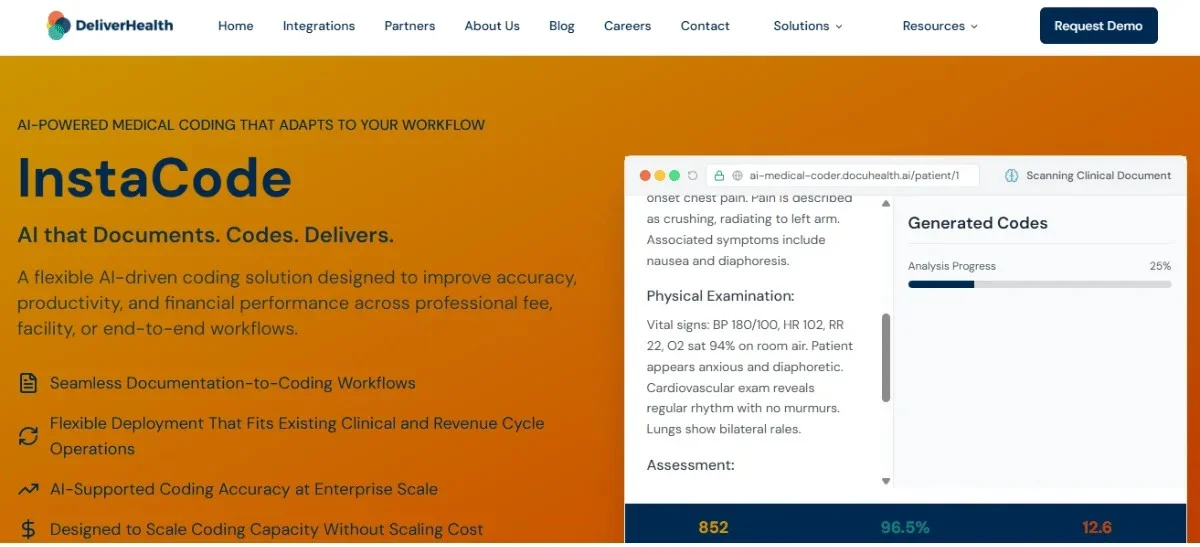
DeliverHealth’s InstaCode is an autonomous medical coding software solution that routes cases to the best-suited AI engine or human coder based on confidence thresholds.
Where traditional coding tools require a human to review every chart, InstaCode handles routine cases through a straight-to-bill workflow and escalates only complex cases.
DeliverHealth trained its LLMs on the largest supply of medical notes available, with 150,000 audio hours per month of human-curated records.
The company’s partnership with Google Cloud extends the AI further with Google's Gemini model, which gives InstaCode the broadest medical vocabulary of any comparable LLM on the market.
Rule-based tools rely on static logic trees, whereas InstaCode understands clinical context and specialty-specific terminology at a deeper level.
InstaCode has SmartAudit for quality assurance, which catches discrepancies before anything reaches payers. Combined with the real-time AI scribe and coding pipeline, the full workflow moves seamlessly from clinical documentation to code assignment and, finally, to billing in one auditable system.
Here's how InstaCode delivers on coding compliance:
Accuracy through Autonomous AI: InstaCode uses NLP and generative AI to analyze clinical records and assign codes without delay, reducing rework across the entire revenue cycle.
NCCI Edit Validation and Medical Necessity Checks: The solution validates code pairs against NCCI edits and flags medical-necessity gaps before encounters are fully cleared, reducing denial risk at the source.
Quality Checks with SmartAudit: Every coded chart undergoes an automated quality check that verifies compliance with standards before encounters leave the system.
Organization-Specific Compliance Rules: InstaCode adapts to each organization's unique coding guidelines, payer-specific requirements, and specialty workflows. The adaptation offers a level of personalization and flexibility that rigid, one-size-fits-all tools cannot match.
Revenue Speed with Straight-to-Bill: High-confidence cases move directly to billing without human review, accelerating the reimbursement timeline.
See how DeliverHealth can simplify your coding compliance workflow.
2. Solventum’s CRS+
Solventum's CRS+ bundles CodeFinder, DRGfinder, and Advanced Analyzer into a coding reference system built for large hospital networks. The tool carries decades of coding logic and relies on coder expertise more than on autonomous AI.
Here's how CRS+ supports coding compliance:
ICD-10/CPT Expert Logic Pathways: The tool guides coders through structured decision trees to reach the most accurate code for each diagnosis and procedure.
DRG Grouping and Validation: The solution verifies inpatient DRG assignments against clinical documentation to reduce misclassification and underpayment.
Advanced Compliance Checks: CRS+ flags coding conflicts and regulatory exceptions using built-in edit logic before submitting claims.
3. Nym Health
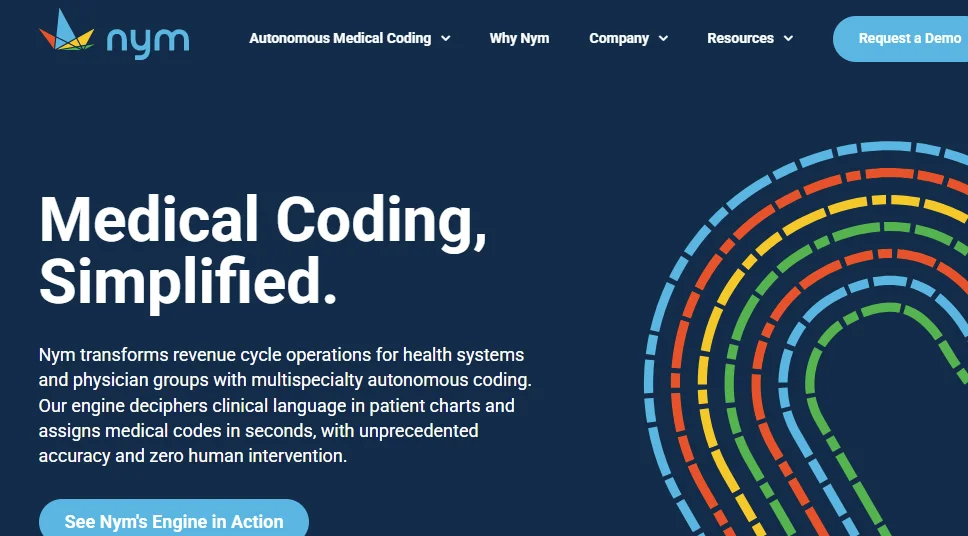
Nym Health's autonomous medical coding engine uses proprietary Clinical Language Understanding (CLU) technology to translate provider notes into accurate billing codes in seconds.
The engine currently supports six specialty areas and service lines across inpatient and outpatient settings, including emergency medicine, radiology, outpatient surgery, outpatient visits, inpatient professional services, and urgent care.
Here's how Nym Health supports coding compliance:
Transparent Audit Trails: Nym generates audit-ready documentation for every code assigned, including supporting clinical evidence and references to the guidelines the engine used during code selection.
Autonomous Code Assignment: The engine reports high coding accuracy rates and processes encounters autonomously, which eliminates overtime costs and reduces reliance on contract coders.
Continuous Regulatory Updates: Nym's compliance and clinical teams implement ICD-10, CPT, and payer-specific guideline changes directly into the engine, ensuring coding practices stay current without manual retraining.
4. Fathom
Fathom is an autonomous medical coding solution that automates code assignment across a broad range of medical specialties based on natural language processing and deep learning.
The company reports high average automation rates, which means the AI completes coding for the vast majority of encounters with minimal human involvement.
Here's how Fathom supports coding compliance:
Deep Learning Code Assignment: Fathom's AI reads the complete clinical documentation after a patient's visit and autonomously assigns ICD-10 and CPT codes. The platform deals end-to-end with routine charts and routes complex cases to human reviewers.
Guideline Change Management: The solution quickly reflects coding guideline updates across the organization, reducing delays and inconsistencies that come with large-scale manual retraining.
Documentation Insufficiency Flags: Fathom flags incomplete or insufficient documentation early in the workflow, helping organizations catch issues that would otherwise lead to denials or compliance gaps downstream.
5. CodaMetrix
CMX CARE, from CodaMetrix, is a contextual coding automation solution built for large health systems. The platform unifies data from multiple clinical sources to deliver autonomous coding across a growing range of specialties and sub-specialties.
CodaMetrix serves over 500 hospitals across 27 states. The platform was originally developed at Mass General Brigham and integrates directly with Epic.
Here's how CodaMetrix supports coding compliance:
Contextual AI Coding: CodaMetrix uses the full clinical record. Instead of using fragmented data points, the platform aggregates notes, dictation, and lab results to assign codes with more contextual awareness.
Reducing Coding-Related Denials: The platform has been shown to meaningfully reduce coding-related denials by addressing root causes, such as documentation gaps, before encounters move to billing.
Enterprise Workflow Unification: CMX CARE consolidates fragmented coding workflows into a single, intelligent process, applying consistent coding logic across specialties and reducing variability introduced by manual workflows.
6. Maverick AI
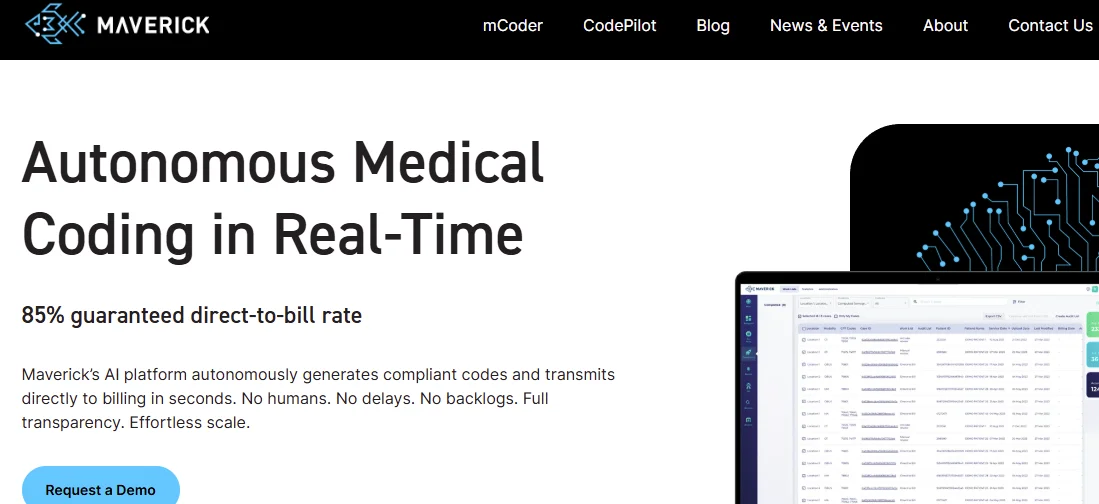
Maverick AI is a real-time, autonomous medical coding solution that specializes in point-of-care coding. The company's mCoder engine analyzes clinical reports in seconds and transmits compliant codes directly to billing systems.
The company also offers CodePilot, a point-of-care tool that checks documentation for coding gaps before providers sign off.
Here's how Maverick AI supports coding compliance:
Real-Time Code Assignment: mCoder assigns ICD-10 and CPT codes in seconds as reports are finalized, which eliminates coding backlogs and billing delays that increase denial risk.
Point-of-Care Documentation Intelligence: CodePilot flags missing or incomplete information within the physician's report at the time of creation, reducing the need for coding-related addenda after the fact.
High Direct-to-Bill Rate: Maverick reports an 85%+ direct-to-bill rate, with only true exceptions routed for human review, which maintains coding consistency across high-volume environments.
7. Commure
Commure is an AI-native healthcare technology company that connects ambient documentation, autonomous coding, and revenue cycle management on a single platform.
Commure’s Autonomous Coding solution generates CPT codes, ICD-10 diagnoses, and modifiers directly from clinical documentation.
Commure serves over 150 health systems and 2,000 sites of care. The company integrates with more than 60 EHR systems.
Here's how Commure supports coding compliance:
End-to-End Ambient-to-Billing Pipeline: Commure links its ambient AI documentation directly to autonomous coding and claims processing.
Secondary Diagnosis Capture: The solution surfaces secondary diagnoses and coding specificities that are frequently overlooked in manual practice, helping organizations avoid undercoding and improve revenue integrity.
Revenue Cycle Automation: Beyond coding, Commure extends into claims processing, denial resubmission, and patient collections. The extension provides revenue cycle teams with a broader view of compliance across the full billing lifecycle.
Each of these coding compliance solutions brings a unique approach. Your ideal choice depends on your volume, specialty mix, care settings, and how much automation you need.
Coding Compliance Software Implementation Best Practices
Since a strong tool needs a strong rollout plan, here are practical steps to protect your investment:
Start with a Small Pilot Group: Roll out the software to a small team of coders first. Measure accuracy rates, turnaround times, and user feedback before expanding to the full department.
Identify Your Baseline Metrics: What's your current denial rate, and how long does your average turnaround take? You must gather metrics like these before you go live because you'll need them later to prove that the tool was worth it.
Establish Your Compliance Rules: Customize the tool's edit checks, payer-specific rules, and confidence thresholds to match your specialty mix. Your team will have a much easier time during training when the software already reflects the workflows they know.
Train Your Team on Compliance Workflows: Teach your coders how medical coding tools handle edit checks, confidence scores, and flagged cases. Teams that understand these workflows will trust the tool enough to use it daily, which is key to reversing the trend of clinician burnout.
Review and Refine Monthly: Schedule monthly reviews of your accuracy, denial trends, and completeness of audit trails. Consistent reviews like these build stronger coding and revenue cycle management compliance over time by allowing your team to catch patterns before they become costly problems.

Frequently Asked Questions (FAQs)
Let’s wrap up with answers to the most common questions about coding compliance software:
How Does Coding Compliance Software Improve Revenue Cycle Management?
Your coding compliance software catches errors before claims leave your system, reducing denials and speeding reimbursement.
Clean claims move through the revenue cycle faster. You also see fewer reworks over time as your first-pass acceptance rate climbs.
Is Medical Coding Software Suitable for Small Practices?
Yes. Many vendors offer scalable plans for smaller teams. A practice with a few coders can benefit from automated edit checks and audit trails just as a large hospital does.
You can choose a solution with flexible pricing and clean healthcare system integrations to keep your overhead low.
How Does Coding Compliance Software Ensure Regulatory Compliance?
Your coding compliance tool automatically pulls in real-time updates to ICD-10, CPT, NCCI, and payer-specific rules.
The software validates every code against current guidelines before your claim goes out, and a complete audit trail logs each decision for defensible records during payer and government reviews.
What Is the Cost of Medical Coding Software?
The cost of medical coding software varies by features, volume, and vendor.
Reference-based tools typically use per-user subscription models, while enterprise AI solutions like DeliverHealth’s InstaCode price by case volume.
It’s best to request quotes from 2 or 3 vendors and compare them against your current rework expenses.
Does Medical Coding Software Support ICD-10 and CPT Codes?
Besides HCPCS codes, reputable coding compliance tools support ICD-10 and CPT code sets.
You must confirm that the tool covers the specific code sets and payer rules you use daily.
Conclusion
From edit checks and audit trails to autonomous AI and confidence-based routing, coding compliance software can reshape how your healthcare system handles its revenue cycle.
However, you need more than legacy reference tools, which don't offer the speed and accuracy of AI-driven solutions that code, verify, and bill in one pipeline.
DeliverHealth is a healthcare AI company that automates clinical documentation and coding workflows for healthcare organizations.
Our InstaCode solution delivers autonomous coding with SmartAudit, straight-to-bill workflows, and enterprise-grade security, trusted by 60,000+ providers.
Explore how DeliverHealth can transform your coding compliance process.
Stay Updated
Subscribe to our newsletter for the latest healthcare AI insights and company updates.