

6 Best DeepScribe Alternatives for Health System Leaders
DeepScribe is a strong ambient scribe for outpatient specialty care, but health systems evaluating a switch need more than note speed. This guide compares the leading alternatives on EHR integration depth, inpatient and operative coverage, pricing structure, and downstream coding accuracy, then explains how to measure results after go-live.
DeepScribe may work for the clinicians using it today. The harder question is whether it still works across the health system.
If pricing at scale, EHR integration depth, or specialty-specific configuration has you considering DeepScribe alternatives, the comparison needs to go beyond note generation. As a revenue cycle, HIM, or coding operations leader, you need to consider EHR integration, care setting and specialty coverage, and what the documentation means for downstream coding.
This guide compares six DeepScribe alternatives on those factors, along with pricing, integration, and overall fit for a health system.
TL;DR: The 6 Best DeepScribe Alternatives, Compared
These are six DeepScribe alternatives worth evaluating more closely:
DeliverHealth InstaNote
Abridge
Microsoft Dragon Copilot
Suki
Nabla
Ambience Healthcare
The right choice will depend on how well each platform fits your EHR environment, care settings, specialties, and existing documentation workflows.
Common Reasons Health Systems Replace DeepScribe
DeepScribe covers a wide range of care settings and specialties, so the decision to look at alternatives may come down to how well the platform fits the way your health system already works.
Let’s discuss the common reasons why:
Limited pricing transparency: DeepScribe doesn’t publish its pricing, so you’ll need a quote to understand what a larger rollout will cost. And beyond licensing, you’ll want to ask about implementation, EHR integration, and the cost of adding more providers or departments.
Greater focus on specialty care: DeepScribe has a strong focus on complex specialties such as oncology. If you need a platform for a wider mix of specialties and clinical workflows, compare how well it supports each area you plan to roll out.
Some customization requires additional support: DeepScribe offers self-service note customization, but more involved changes may still require help from its Customer Success team. This can add an extra step when adapting note formats across specialties.
EHR integration may vary by setup: DeepScribe offers native, two-way EHR integrations, including bidirectional Epic integration. However, the exact workflow can depend on your EHR setup, so confirm how the integration will work across the systems and configurations your organization uses.
These points show why you need to consider the operational cost of deploying the platform across your enterprise, rather than judging it only by how well it generates a note.

How to Evaluate a DeepScribe Alternative for Your Health System
If DeepScribe no longer fits all your requirements, the next step is to see how alternatives compare in the areas that matter to your health system. A simple scorecard helps you get past feature lists and see how each option would actually work across your health system.
Start with these three areas:
EHR Integration Depth and Write-Back Method
Your EHR integration determines how easily the technology fits into the clinician’s existing workflow. A native, bidirectional integration can pull information from the chart and write the completed note back, while other approaches may rely on a browser extension or copy-and-paste.
At a health system scale, you’ll want to know exactly what clinicians have to do to get from the encounter to a completed note in the EHR.
Ask:
Does information move both ways between the platform and your EHR?
What can it pull from the patient chart, and where does the completed note go?
Will it work with the EHR versions and configurations you already have?
Is the workflow the same on desktop and mobile?
Setting and Specialty Coverage
A platform that works well for outpatient visits may not work as well for inpatient stays, procedures, operative reports, or complex specialty visits. Look at which care settings the platform supports and whether clinicians can use it consistently as they move across those workflows.
Also consider how well the technology is trained for each specialty. In areas like oncology or cardiology, it may need to follow changes in medications, labs, imaging, diagnoses, and treatment plans across longer, more detailed visits.
Ask:
Can we use the platform across outpatient and inpatient care, including operative and procedural documentation?
How well does it handle the specialties we need to cover?
Can each specialty keep the note structure and templates its clinicians already use?
Can we test it with our more complex specialty visits before a wider rollout?
Coding Accuracy and Revenue Integrity
A note can look good at the point of care and still cause problems later. If it’s missing the specificity coders need, you may see more queries, code changes, and billing delays.
So don’t stop at clinician feedback. Look at what happens in the mid-revenue cycle and involve your coding and revenue cycle teams in the evaluation.
As you compare alternatives, look at how each platform supports your existing clinical documentation improvement and coding workflows once the note leaves the clinician.
Ask:
How often do AI-generated notes lead to coder queries?
How often are coding suggestions changed?
Does the documentation support the final code?
Can you track documentation and coding performance by specialty?
You’re looking for a note that works for the clinician and holds up once it reaches coding.
6 Best DeepScribe Alternatives for Health System Leaders
With these evaluation criteria, you'll have a clearer way to compare alternatives. Now, we’ll look at six platforms that take different approaches to clinical documentation, from ambient note creation to dictation, coding, orders, and broader clinical workflows.
Here’s how they compare at a glance:
Platform | Setting Coverage | EHR Integration |
|---|---|---|
DeliverHealth InstaNote | Inpatient, outpatient, ED, operative workflows, and specialties like cardiology, orthopedics, and gastroenterology | Integrates with major EHRs, including Epic, Oracle Health, and athenahealth |
Abridge | Outpatient, ED, and inpatient | Deep Epic integration plus other enterprise EHRs |
Microsoft Dragon Copilot | Broad clinical workflows across multiple roles | Embedded integrations available; standalone workflows also supported |
Suki | Ambulatory, inpatient, ED, urgent care, telehealth, and home health | Bidirectional integrations with major EHRs |
Nabla | Outpatient, inpatient, ED, and specialty care | Epic plus other major EHRs and API-based options |
Ambience Healthcare | Ambulatory, ED, and inpatient | Enterprise EHR integrations, including native Epic workflows |
Now let’s discuss each alternative in greater detail:
1. DeliverHealth InstaNote
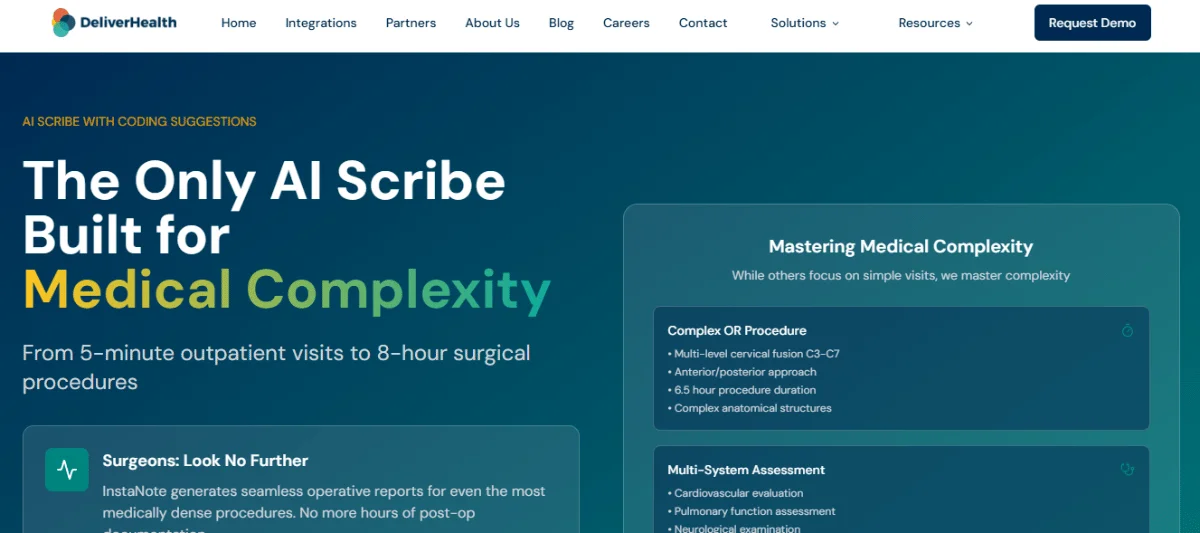
DeliverHealth InstaNote is part of DeliverHealth, a healthcare technology company focused on clinical documentation, medical coding, and revenue cycle workflows.
InstaNote is its AI-powered clinical documentation solution for creating structured clinical notes through ambient, dictation, or self-documentation workflows.
Key capabilities:
Flexible documentation: You can move between ambient, dictation, and self-documentation rather than having to use one documentation method.
Inpatient and outpatient support: InstaNote is designed for documentation across care settings and can also support lengthy surgical encounters and operative reports.
Structured, personalized notes: Note formats and templates can be set up around your organization’s and providers’ preferences rather than forcing everyone into the same structure.
Coding suggestions: InstaNote can surface coding suggestions within the documentation workflow once the note is complete.
Broader coding support: DeliverHealth also offers InstaCode for AI-assisted and autonomous coding across ICD-10-CM, CPT, HCPCS, and modifiers, along with coding and audit services for organizations looking at documentation and coding together.
Enterprise integration and security: InstaNote integrates with major EHRs, including Epic, Oracle Health, and athenahealth, and runs on the HITRUST i1-certified eSOne platform.
Language support: The solution supports more than 110 languages.
For organizations that want to connect documentation with downstream coding, InstaNote can also work with InstaCode as part of a connected documentation-to-coding workflow.
Schedule a demo to see how InstaNote can fit your clinical documentation workflows.
2. Abridge
Abridge is an enterprise clinical documentation platform for outpatient, emergency, and inpatient care.
Its platform is designed for health systems looking to use AI-generated clinical documentation across multiple specialties and care settings.
Key capabilities:
Ambient documentation: You can capture the encounter and turn it into a structured clinical note.
EHR integration: You can use two-way integration with Epic and several other enterprise EHRs.
Patient visit summaries: You can generate patient-facing summaries based on the visit.
Linked Evidence: Your clinicians can trace generated documentation back to the source conversation and check where information came from.
Coding support: You can get diagnosis and coding suggestions alongside the documentation.
Tradeoff: Abridge offers a broad set of capabilities, but what is available can vary by care setting and EHR setup. For a health system rollout, you’ll need to confirm which features and workflows are supported across the departments and EHR environments you plan to include.
3. Microsoft Dragon Copilot
Microsoft Dragon Copilot combines technology from Nuance’s Dragon Medical and DAX products in Microsoft’s current clinical AI offering.
It is built for healthcare organizations that want to use clinical AI across their teams.
Key capabilities:
Ambient and dictation: Your clinicians can capture conversations ambiently or continue using voice dictation.
EHR integration: You can use Dragon Copilot within supported EHRs, including Epic, although the workflow depends on how you deploy it.
Clinical documents: You can generate notes, after-visit summaries, referral letters, and other documentation from the encounter.
Coding suggestions: Your clinicians can receive coding suggestions based on the documentation.
Different clinical roles: You can use Dragon Copilot across physician, nursing, and radiology workflows.
Tradeoff: How much of the workflow stays inside your EHR depends on how you deploy Dragon Copilot. With Microsoft’s standalone web, desktop, and mobile applications, your clinicians may need to transfer finalized content into the EHR. You’ll also need to account for enterprise licensing and implementation.
4. Suki
Suki is an AI clinical assistant built to reduce the administrative work around patient care.
Its capabilities extend beyond note generation, covering different parts of the clinical workflow before, during, and after the visit.
Key capabilities:
Ambient and voice documentation: Suki captures the patient visit and drafts the note. Clinicians can also use voice commands to make changes or add details.
EHR integration: It works with major EHRs, so notes can move into the existing clinical workflow.
Order support: In supported EHRs, clinicians can create orders with Suki and stage them for review before they are submitted.
Coding support: Suki reviews the documentation and suggests ICD-10, CPT, HCC, and E/M codes for the clinician to review.
Multilingual patient instructions: Suki can generate patient instructions in 80 languages and at a fifth-grade reading level.
Tradeoff: Some of Suki’s broader capabilities depend on the EHR and integration available to your organization. If features such as order staging or other EHR-based workflows are important to your rollout, confirm how they work with your specific EHR setup.
5. Nabla
Nabla is an AI assistant for clinical documentation, focused on reducing the time clinicians spend on notes during and after patient visits.
The platform is used by individual clinicians as well as larger healthcare organizations.
Key capabilities:
Ambient documentation: You can capture encounters and turn them into structured clinical notes.
Multilingual support: Your clinicians can capture conversations in more than 35 languages.
EHR integration: You can connect Nabla with Epic and other major EHRs or use its APIs for additional integration options.
Coding assistance: You can get ICD-10 and HCC coding suggestions from the encounter.
Structured data: Your IT team can use Nabla’s APIs to bring structured clinical information into other workflows.
Tradeoff: The level of EHR integration you get can vary by system and implementation, and some workflows may require additional modules for structured write-back. You should also confirm BAA coverage, privacy terms, and product limits for the tier you’re considering.
6. Ambience Healthcare
Ambience Healthcare is a clinical AI platform developed for health systems and other large healthcare organizations.
Its products cover clinical documentation as well as other parts of the clinical and administrative workflow.
Key capabilities:
Ambient documentation: You can turn the clinical conversation into structured documentation.
Coding support: You can use ICD-10 and E/M coding tools alongside the documentation workflow.
EHR integration: You can connect Ambience with enterprise EHRs, including Epic.
Multiple care settings: You can use the platform across ambulatory, ED, and inpatient workflows.
Enterprise deployment: Ambience can be rolled out across different departments and specialties within a health system.
Tradeoff: Because Ambience combines documentation with coding capabilities, you’ll need to evaluate more than the quality of the generated note. Look at how the documentation performs once it reaches coding, including whether it provides the detail needed to support the final codes.
What Do DeepScribe and Its Alternatives Cost?
Pricing works differently from one vendor to the next, but you’ll generally see one of three models:
Per-provider pricing: You pay a set monthly or annual rate for each clinician.
Tiered enterprise contracts: Your rate changes based on the package, features, or size of your rollout.
Custom volume-based pricing: The vendor builds a quote around factors such as provider count, encounter volume, or usage.
Here’s what you can find publicly for the platforms on this list:
Platform | Public Pricing | Pricing Model |
|---|---|---|
DeliverHealth InstaNote | Starts at $99/month | Per-provider pricing |
DeepScribe | Not published | Custom/enterprise contract |
Abridge | Not published | Enterprise contract |
Microsoft Dragon Copilot | No standard all-in price published | Pre-user and usage-based options |
Suki | Not published | Enterprise contract; pricing may vary by agreement |
Nabla | Paid plans available; enterprise pricing varies | Pre-user subscription; enterprise options |
Ambience Healthcare | Not published | Custom/enterprise contract |
The quote also won’t always show you the full cost of a rollout. Before you compare vendors, check what you’ll pay for:
Implementation: Onboarding, training, and rollout support.
EHR integration: Interface work or configuration needed to connect with your existing EHR.
Template setup: Building or adjusting note templates for different specialties and clinicians.
These costs can add up quickly across a health system, so compare the total cost of deployment rather than the license price alone.

Metrics That Show How an Ambient AI Scribe Delivers Value
Before you pilot an ambient AI scribe, decide how you’ll measure whether it is actually improving documentation and whether those improvements carry through to coding and revenue.
Start with these five metrics:
Note turnaround: The time between the end of an encounter and when the draft note is ready for the clinician to review. A shorter turnaround means clinicians can start reviewing and completing documentation sooner.
Edit rate: How much clinicians change the AI-generated note before they sign it. Look at what they are changing too, such as incorrect details, formatting, or specialty-specific language.
Chart closure time: The time between the encounter and when the clinician completes and signs the note. Compare it with your baseline to see if clinicians are finishing their notes sooner.
Coding query volume: The number of queries coding or CDI teams send back to clinicians for missing or unclear information. Higher query volume can indicate that notes don't provide enough detail for coding.
Denial rate: The percentage of claims denied for documentation- or coding-related reasons. Tracking changes in these denials can show whether documentation issues are affecting reimbursement.
Ideally, establish your baseline for a few weeks before the pilot and break it out by specialty where possible. Continue tracking the same metrics during the pilot and, if you move forward with the platform, review them monthly after implementation.
Common Pitfalls in an Ambient AI Scribe Rollout
Even a well-planned rollout can run into problems if you overlook how the platform fits into day-to-day clinical workflows.
Watch for these common pitfalls during the pilot and as you expand adoption across the health system:
Testing only with volunteers: Clinicians who volunteer for a pilot are often more willing to try a new workflow. Once you roll it out more widely, you may see usage fall among clinicians who weren’t part of that early group.
Not accounting for existing dictation: Your clinicians may already have dictation workflows that work well for certain encounters. If you don’t decide where ambient clinical intelligence should replace, complement, or sit alongside dictation, you can end up with inconsistent use of both tools.
Using the same setup across specialties: Your cardiologists, surgeons, and primary care physicians don’t document the same way. If their templates aren’t set up for those differences, you may start seeing more note edits and lower usage in certain specialties.
For a wider rollout, include different types of clinicians in the pilot, map out where ambient and dictation will be used, and set up documentation for each specialty before adding more users.
Frequently Asked Questions (FAQs)
Here are answers to the questions health system buyers raise most often when they start comparing ambient documentation vendors:
Is DeepScribe HIPAA Compliant?
Yes. DeepScribe states that it is HIPAA-compliant and provides a BAA.
When comparing competitors, also check what the BAA covers, how PHI is stored and retained, and which security certifications apply to the specific product you’re evaluating.
Can an Ambient AI Scribe Replace a Human Medical Scribe?
It can replace some of the work a human scribe does, particularly capturing the visit and drafting the note.
But the clinician is still responsible for reviewing the note and correcting anything that’s inaccurate before signing it.
How Long Does an Ambient AI Scribe Implementation Take?
There isn’t one standard timeline.
A pilot can run for a few weeks or a few months, and a larger rollout usually takes longer, depending on your EHR setup, security review, training, and how many specialties or locations you’re bringing on.
What Happens to Existing Dictation Workflows After a Switch?
You don’t have to replace dictation everywhere at once.
Many organizations keep both during the transition and decide which workflows are better suited to ambient documentation and which still work better with dictation.
Which Clinical Specialties Benefit Most From Ambient AI Scribes?
Primary care and documentation-heavy specialties such as cardiology, oncology, orthopedics, and gastroenterology can benefit from ambient documentation.
The biggest opportunity is usually where clinicians handle high visit volumes, complex encounters, or heavy post-visit documentation.
Conclusion
When you compare DeepScribe alternatives, look beyond how well each tool generates a note. The bigger question is whether it supports care settings and documentation workflows across your organization, and whether better documentation also improves your coding process.
DeliverHealth brings ambient documentation, dictation, and self-documentation together in InstaNote. Clinicians can use it across inpatient, outpatient, ED, specialty, and operative settings.
For coding, DeliverHealth also offers InstaCode, which supports AI-assisted and autonomous coding for eligible workflows, with human coders in the loop.
Schedule a demo to walk through your documentation and coding workflows with our team.
Stay Updated
Subscribe to our newsletter for the latest healthcare AI insights and company updates.