

Heidi AI vs. Abridge - Find the Smarter AI Scribe
Selecting the right AI scribe requires comparing accuracy, workflow fit, and long-term value. Discover how Heidi AI and Abridge compare and how DeliverHealth approaches documentation differently.
Clinicians across the country lose hours every week to EHR tasks that pull them away from the exam room. Your team's paperwork burden keeps growing, and the wrong tool can make that problem worse.
Two platforms frequently come up in the conversation: Heidi AI and Abridge. When comparing Heidi AI vs Abridge, you must look beyond surface-level features to costs, impact on workflows, and how far each tool carries your documentation.
Let's break down what each platform delivers and whether a more connected approach might serve your organization better.
TL;DR - Heidi AI vs. Abridge (vs. DeliverHealth)
Here's a quick snapshot of both platforms, plus a third option worth your attention.
Platform/Solution Provider | Core Strengths |
|---|---|
Heidi AI (AI documentation tool for solo and small-practice clinicians) | Real-time ambient capture in 110+ languages ICD-10 and SNOMED code suggestions Deep template customization |
Abridge (Enterprise dictation and ambient AI platform for large health systems) | Linked Evidence for tracing notes to audio Contextual Reasoning Engine for prior authorization, Deep Epic EHR integration |
DeliverHealth (AI-powered clinical documentation and coding solution provider for enterprise healthcare) | Dual-mode for ambient and dictation capture through InstaNote Autonomous coding through InstaCode HITRUST i1 certified eSOne platform, Confidence-based routing across AI and human coders |
We'll cover each of these in the sections ahead.
What is Heidi AI? Core Features and Capabilities
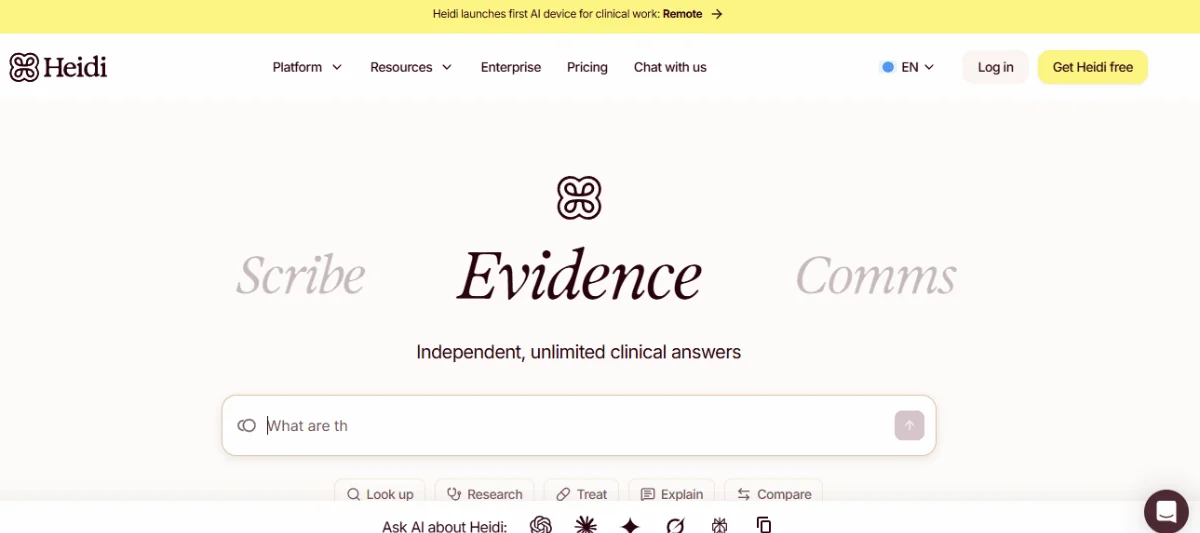
Heidi AI is an AI-powered medical scribe from Heidi Health, an Australian-founded company now active in 116 countries. Besides dictation, the platform also captures patient encounters through ambient listening and generates structured clinical notes in near real time.
Heidi supports 110+ languages and recently partnered with R1 RCM to expand its revenue cycle management capabilities.
You'll find Heidi AI designed around individual providers who want fast, flexible documentation without heavy input from their IT teams.
Key Heidi AI Features
Your day-to-day experience with Heidi centers around the following distinct capabilities.
Multi-Language Ambient Capture: Heidi records encounters in 110+ languages and generates professionally structured notes, with offline capability when your internet connectivity drops.
Heidi Evidence and Comms: Newer additions include clinical decision support through Heidi Evidence and patient outreach tools through Heidi Comms for calls, bookings, and follow-ups.
ICD-10 and SNOMED Code Suggestions: Heidi analyzes your notes and recommends relevant codes within the documentation process, which helps you cut down on manual code searches.
Template Customization: You can build note structures field by field, create shortcuts for frequent phrases, and fine-tune the AI's tone to match your preferred style over time.
Heidi AI Pricing Structure
Your Heidi AI price depends on the tier that best fits your practice. Here's a breakdown of the main pricing plans.
Free Plan: Unlimited basic notes per month. You get standard templates and basic support, which works best if you're an individual light-volume provider testing the platform.
Clinician ($110/User/Month): With this plan, you unlock unlimited advanced documentation, Ask Heidi, coding suggestions, patient and session linking, and document sharing. You also get full evidence features and EHR integration as an add-on.
Practice ($180/User/Month): This is a comprehensive option for teams or healthcare systems. You can expect shared documentation workflows, team templates, centralized billing, and clinical evidence standards in one plan.
Enterprise: The custom pricing Enterprise plan is ideal for larger healthcare organizations that require Single Sign-On, dedicated hosting, and custom terms.
Who Can Benefit Most from Heidi AI?
Let's say your practice has fewer than 10 healthcare providers and you want a tool you can start using the same day. You can try Heidi because of its self-serve model and low-risk entry point.
Larger health systems with complex inpatient workflows may find the platform limited for large-scale enterprise needs.
What is Abridge? Core Features and Capabilities
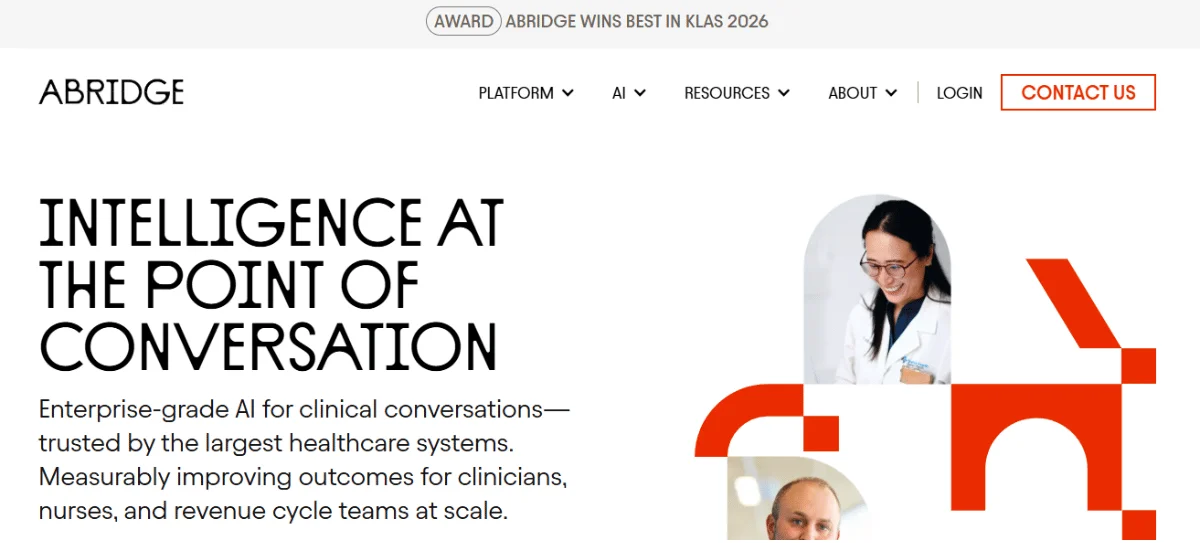
Abridge is an enterprise ambient AI platform designed for large health systems. Founded in 2018 by cardiologist Shiv Rao, the platform converts patient encounters into clinical notes, billing codes, and after-visit summaries through a proprietary Contextual Reasoning Engine.
Abridge is tailored for organizations that have the IT infrastructure and procurement timelines for a multi-month deployment.
Key Abridge Features
Here are the main capabilities Abridge brings to your enterprise environment:
Linked Evidence and Traceability: Every statement in your AI-generated note maps back to the exact conversation moment where the detail came up, which gives you a clear audit trail.
Contextual Reasoning Engine: The platform pulls data from previous visits, patient records, and health-system guidelines to generate contextually aware notes. A recent partnership with Availity also enables real-time prior authorization support.
Billing Code Automation: Abridge groups medical problems with language that aligns to appropriate billing codes, which helps your revenue cycle teams reduce manual effort.
Abridge Pricing Structure
Abridge doesn't publish pricing on its website, but multiple market sources give an idea of what it will cost you.
No Individual Plans: Every deal goes through enterprise sales, and the process typically takes 3 to 6 months from first conversation to go-live. You won't find a self-serve signup, a free tier, or a trial for individual clinicians.
Enterprise License (~$208/Month per Clinician): The base price works out to roughly $2,500 per clinician per year and covers the core ambient documentation features.
Full Deployment ($400 to $600/Provider/Month): You can expect higher costs once you add deep EHR integration, custom configuration, and multi-year contract terms.
Who Can Benefit Most from Abridge?
Abridge fits large health systems already on Epic that have the budget, IT resources, and procurement timelines for enterprise rollout.
If your organization operates more than a hundred providers across multiple care settings, the deep Epic integration and linked evidence deliver value at scale.
Solo practitioners, small practices, and organizations on non-Epic EHRs will find the platform difficult to access, given the absence of self-serve signup.
Clinical Documentation Accuracy - Heidi AI vs. Abridge
Accuracy determines whether your clinicians trust the notes an AI generates. The benefits of AI-driven documentation become clear when you compare the accuracy of two medical scribe systems.
Heidi AI's Note Accuracy: Heidi uses dictation and ambient capture with real-time speech recognition and produces structured notes in Subjective, Objective, Assessment, and Plan (SOAP) or custom formats. You can fine-tune templates, and the AI adapts to your documentation style over time.
Abridge's Verifiable Notes: Abridge's Linked Evidence connects every note statement to the corresponding audio timestamp, which makes clinical review faster. The Contextual Reasoning Engine enriches notes with data from previous encounters and patient records.
EHR Integration and Workflow Compatibility
Your documentation tool delivers real value much more effectively when it integrates with the systems your team already uses. Here's how each platform connects with various systems.
Heidi AI's EHR Connectivity: Heidi offers push-to-chart with athenahealth, Epic (via SmartSections), and eClinicalWorks (via Vim). Heidi Ai also has a browser extension that works with any web-based practice management system. The extent of connectivity may depend on the plan you use.
Abridge's Embedded Epic Experience: Abridge operates as Epic's first AI "Pal," embedded directly within Epic Haiku and Hyperdrive. For health systems on Epic, the depth of that integration is hard to match. For organizations on different EHRs, compatibility narrows considerably.

Platform Availability and Technical Requirements
Where and how your providers access a tool shapes daily adoption across your organization. You can expect the following from each platform:
Heidi AI's Device Flexibility: Heidi runs on iOS, Android, and desktop, with an offline mode for unreliable connections. Your providers can create accounts within minutes through self-serve signup.
Abridge's Enterprise Deployment: Abridge requires IT-driven deployment, SSO configuration, and organizational procurement. You'll need Epic infrastructure already in place, and setup timelines run 3 to 6 months.
Pricing and Value Comparison
Your budget plays a major role in which platform makes sense, but cost per provider tells only part of the story.
Heidi AI's Tiered Structure: You can start with the free plan or upgrade to the $30/month premium evidence access through Evidence Plus. You can also use the Clinician plan for $110/month to get full documentation, coding suggestions, and EHR integration. Enterprise tiers are tailored for larger organizations. As a solo clinician or small healthcare group, this range of entry points makes Heidi easier to test before you commit.
Abridge's Enterprise Contracts: You can expect to pay approximately $2,500/year per clinician, with deployment costs that can increase the figure depending on contract length and setup depth.
Where Your Budget Goes Farthest: Heidi offers more flexibility for smaller practices at a fraction of the cost of the Ambience-tier enterprise pricing. Abridge offers deeper integration and audit-ready linked evidence for organizations willing to invest at scale.
Neither platform, however, carries documentation through to autonomous coding in a connected workflow. When your denials keep mounting, the gap between note generation and revenue capture becomes a real problem.
Which AI Scribe Should You Choose?
Your decision comes down to practice size, EHR environment, and how far you want documentation to carry you.
Heidi gives solo clinicians and small groups a fast, affordable entry point with multilingual capability. Abridge gives large Epic health systems deep integration and linked evidence at scale.
But here's a question worth asking: do you want a tool that writes notes, or one that moves documentation all the way through coding and revenue capture?
When Should You Consider Alternatives?
Here's the thing about most ambient documentation tools: they help your doctors get notes done faster, and that's about it. Your coding team? They're still buried in the same pile of incomplete charts and manual reviews they had before.
Heidi and Abridge are both solid for note generation. But if you need documentation and coding working together in one place, or if you keep watching revenue slip away because your coding workflow has too many holes, those tools won't get you there.
If you're a health system with complex inpatient cases like operative reports or multi-specialty encounters, a general-purpose scribe really can't keep up. You want something that shapes each note to fit the specialty and gives your providers coding suggestions right when the note wraps.
How DeliverHealth Approaches Documentation and Coding Differently
Depending on the AI-powered solution you choose from DeliverHealth, you can experience clinical documentation and autonomous coding in a more connected workflow.
Our AI-powered documentation handles complex inpatient and outpatient settings alike. Here's what we bring to your organization.
Faster Revenue Capture through Autonomous Coding: Based on confidence thresholds, InstaCode assigns each case to the most suitable AI or human coder, and every chart goes through SmartAudit for quality and compliance checks.
Structured Clinical Notes from Every Encounter: InstaNote captures multi-speaker conversations or direct physician dictation and generates comprehensive, structured notes with coding suggestions the moment a note completes. Your documentation adapts to each specialty's preferred format, based on what your organization and providers request.
Enterprise-Grade Data Protection: The eSOne platform holds HITRUST i1 certification, the highest standard of healthcare data security, and provides 24/7 monitoring across your documentation environment.
Scalable Routing Across 60,000+ Providers: Our confidence-based engine assigns each case to the right resource, whether AI or human, based on encounter complexity.
When InstaNote’s operations flow into InstaCode, your documentation moves directly into coding to create an end-to-end AI-powered medical scribe and coding workflow.
InstaCode also works with clinical notes from other sources, which means that even before you adopt InstaNote, your coding teams can start seeing results right away.
Your clinicians save documentation time, while your coding teams benefit from SmartAudit quality checks and confidence-based routing for every case.
Find out how InstaNote and InstaCode work together for your health system.

Frequently Asked Questions (FAQs)
Let’s close with answers to the most frequently asked questions from clinicians and healthcare leaders about the 2 tools.
How Well Do Heidi AI and Abridge Handle Specialty-Specific Terminology?
Heidi covers 200+ specialties and lets you customize templates field by field. Abridge operates across 55+ specialties, including primary care, cardiology, oncology, and emergency medicine.
Both handle general medical terminology well, though Abridge's contextual engine gives it an edge for complex, multi-visit inpatient cases.
What Are the Main Differences in User Experience Between Heidi AI and Abridge?
Heidi lets you sign up, download the app, and start capturing encounters within minutes. You don't need IT approval or a procurement cycle.
Abridge is a different story because your team will go through months of enterprise onboarding. But once everybody's inside Epic, the experience feels like a natural part of the EHR.
How Do Heidi AI and Abridge Compare for Reducing After-Hours Charting?
Both platforms aim to reduce after-hours documentation time. Heidi users report saving 1 to 2 hours daily, and Abridge also reports comparable reductions across enterprise deployments.
If your documentation tool also needs to feed into coding workflows, you must evaluate whether note generation alone addresses your full after-hours burden.
Which Platform Offers a Smoother Learning Curve for New Users?
Heidi's free tier, self-serve model, and mobile-first design make it the easier platform to adopt fast. Your providers can capture encounters within minutes.
In a Heidi vs Abridge comparison on adoption speed, Heidi wins for individual clinicians. By embedding the Epic experience, Abridge minimizes challenges once your system goes live, though the 3-6 months needed to set it up delay the advantage.
Conclusion
You must ultimately consider each tool's flexibility and enterprise depth to choose correctly between Heidi AI and Abridge. Both platforms generate strong clinical notes for their intended audiences, but neither carries documentation through to autonomous coding.
Your organization deserves more than a note-generating tool. DeliverHealth’s InstaNote adapts to the unique requirements of each specialty when capturing notes across your inpatient and outpatient settings.
InstaCode's confidence-based routing and SmartAudit ensure accuracy and compliance at every step for your coding teams.
Your clinicians save documentation time, while the coding team gets accurate codes, and the revenue cycle experiences more approvals and payments.
Explore how DeliverHealth unites your clinical and revenue cycle workflows.
Stay Updated
Subscribe to our newsletter for the latest healthcare AI insights and company updates.