

Heidi AI vs. Freed AI - See Which One Delivers More?
Heidi AI vs. Freed AI: A complete comparison of features, pricing, integrations, and workflows to help you choose the right AI scribe for your practice.
According to an AMA time-and-motion study, physicians spend roughly 2 hours on EHR and administrative activities for every hour of direct patient care. Still, documentation of the day's patient encounters remains incomplete at the end of each shift.
The right documentation tool can reclaim those hours, but only if you choose one that truly fits your workflow.
If you're weighing Heidi AI vs Freed AI, you must understand what each brings to your clinical operations.
Let's compare their features, pricing, and fit, and also discuss an approach that goes beyond the AI scribe model.
TL;DR - Heidi AI vs. Freed AI (vs. DeliverHealth)
Here's a quick snapshot of the solutions covered in this article:
Platform | What Sets It Apart |
|---|---|
Heidi AI | 110+ language transcription, field-by-field custom templates, ICD-10-CM and SNOMED-CT code suggestions |
Freed AI | SOAP notes in ~40 seconds, pre-charting with visit summaries, one-click EHR push via Chrome |
DeliverHealth | End-to-end documentation-to-coding workflow, confidence-based routing, SmartAudit quality checks, HITRUST i1 certified |
We'll discuss each in detail below.
What Makes Heidi AI Stand Out?
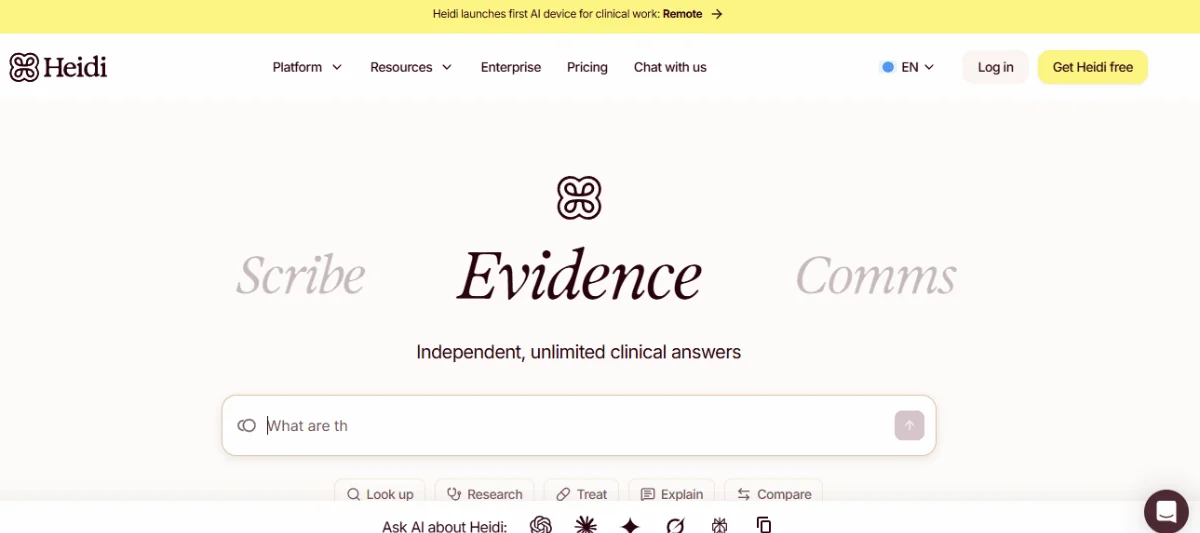
Heidi AI is a cloud-based AI scribe tool built by Heidi Health, an Australian company that has expanded into the U.S. and UK markets. If your team has multilingual practitioners and nurses, and you get similar clients, you can benefit from its transcription support for over 110 languages and field-by-field template customization.
You can share templates across teams through a community-driven library. The tool also provides real-time ICD-10-CM code suggestions during the documentation process.
The tool can process more than 2.4 million consultations every week.
Heidi AI differs from a typical AI scribe app in its deep localization for Australian Medicare, UK NHS, and U.S. clinical note formats. The localization gives you a scribe built for international reach with HIPAA compliance and a HIPAA-compliant BAA for U.S.-based practices.
What Makes Freed AI Stand Out?
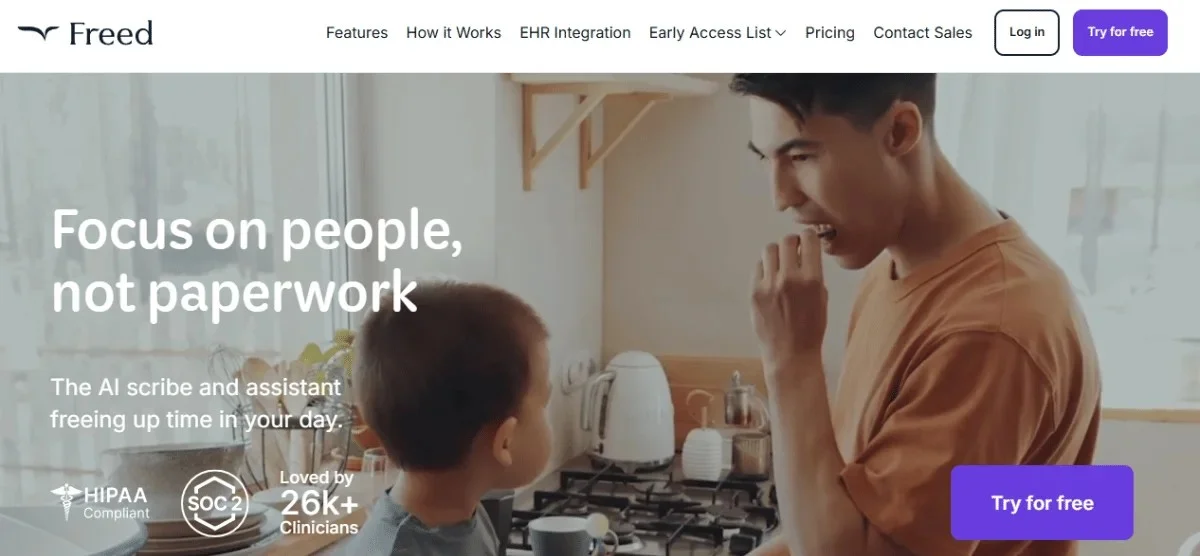
Freed AI is an ambient AI scribing software built for clinicians who want clean, structured notes with no complex setup. Founded in 2023, the tool serves over 25,000 clinicians and 1,000+ organizations.
Your providers can generate SOAP notes in roughly 40 seconds per patient encounter. Freed's templates learn preferences over time, and its pre-charting feature pulls in visit summaries before each appointment.
On the Premier plan, you get ICD-10 code suggestions and one-click EHR push through a Chrome extension.
According to Freed AI reviews, clinicians value the frictionless onboarding, going from download to a first-generated note in under 5 minutes.
The tool holds SOC 2 Type II certification, offers a HIPAA-compliant BAA, and stores zero patient recordings.
Feature-by-Feature Comparison - Heidi AI vs. Freed AI (vs. DeliverHealth)
Both Heidi AI and Freed AI tackle the same core problem through meaningfully different paths.
In this section, we’ll compare them with a solution built for enterprise-scale operations to provide helpful context for larger organisations.
Feature | Heidi AI | Freed AI | DeliverHealth |
|---|---|---|---|
Ambient Capture | Multi-speaker | Dual-speaker | Multi-speaker with ambient, also supports dictation |
Care Setting | Outpatient, inpatient, telehealth, and residential care | Primarily outpatient and ambulatory; built for small to mid-sized practices rather than large health systems | Both inpatient and outpatient, with particular strength in complex inpatient (hospital) workflows, including operative reports |
Note Generation Speed | Near real-time | ~40 seconds | Near real-time |
EHR Write-Back (structured data flows back into record fields) | Browser extension, limited U.S. bidirectional support | Chrome-based push, no native bidirectional support | Direct field mapping to the EHR system of record |
Template Customization | Field-by-field + community library | Learned templates, specialty-specific | Organization and specialty-level personalized formats |
Coding Suggestions | ICD-10-CM, SNOMED-CT | ICD-10 (Premier plan) | AI-generated coding suggestions upon note completion, which then feed into autonomous coding workflows |
Language Support | 110+ languages | English-primary | Multilingual clinical support, trained on 150,000 audio hours of medical vocabulary per month |
Security Certification | HIPAA, BAA | HIPAA, BAA, SOC 2 Type II | HIPAA, BAA, HITRUST i1 certified |
Autonomous Coding | No | No | Yes, with confidence-based routing |
The biggest gap between all 3 options is clear.
Both Heidi and Freed stop at code suggestions, which means your coding team picks up where the scribe leaves off.
DeliverHealth routes completed notes to autonomous coding engines, minimizing the manual handoff that introduces coding errors and slows reimbursement.
Freed AI vs. Heidi AI - Pricing Breakdown and Value Analysis
Coming back to the comparison, before you choose one over the other, you must consider each tool’s pricing. Your budget should reflect the full cost of ownership, including what each tier delivers and what it leaves out.
Here's how the numbers break down.
Heidi AI Monthly Cost: The free tier includes unlimited AI notes with limited features. For individuals, the Evidence Plus plan costs $30 per user per month, while the Clinician plan costs $110 per user per month. At the Clinician tier, your team still lacks deep bidirectional EHR write-back in the U.S. market. Enterprise pricing requires a custom quote.
Freed AI Monthly Cost: Freed charges $79 per clinician per month in the Core plan. The Premier plan at $119 per month adds EHR push and billing codes (in beta mode). The 7-day AI scribe free trial gives you room to test before you commit.
Value for Your Money: Both tools deliver 1 to 2 hours of time savings per provider per day. Your value equation shifts in terms of what happens after the note. Neither platform offers full end-to-end coding or autonomous revenue cycle management. Your team still relies on separate systems to move from documentation to billing, which may add costs, complexity, and risk for missed codes or delayed claims.
How to Pick the Right Tool for Your Practice
Your practice type, EHR environment, and revenue goals are critical when choosing the right medical documentation and coding solution.
Here are the 3 factors that matter most:
Practice Size and Scale: If you're a solo clinician or small group, Freed AI's lightweight setup may be enough. For multilingual or international practices, Heidi's localization features make it better. Hospitals and health systems with enterprise complexity will want a solution that addresses common mid-revenue cycle pains at scale, making Heidi AI the better choice.
EHR Write-Back Depth: Both Heidi and Freed rely on browser-based or clipboard methods to move notes into your record. If your organization requires structured data written directly into EHR fields, you'll want to evaluate solutions with deeper, bidirectional integration capabilities.
Beyond Notes to Codes: Here's the question most AI scribe companies overlook. Does your documentation feed directly into your revenue cycle? Both Heidi and Freed generate notes and suggest codes, but your coding team still handles the rest through a separate workflow. Organizations facing high denial rates that cost real revenue need a tighter connection between clinical documentation and bill-ready codes.

Final Verdict - Which AI Scribe Fits You Best?
Both Heidi AI and Freed AI are capable scribes that can cut documentation time for your providers.
If your practice operates across multiple languages or regions, go with Heidi AI. If you want the fastest path from setup to finished note, go with Freed AI.
But whichever tool you choose, you're still solving only half the problem, which is how you produce the note and its contents. The gap between that finished note and a clean, billable claim still costs most organizations time, revenue, and accuracy.
For health systems that want their documentation to flow directly into accurate, auditable, bill-ready records, let’s check out a fundamentally different approach.
How DeliverHealth Goes Beyond AI Scribes
The typical AI scribe category starts and stops at note generation and code suggestions. Our AI-powered solutions at DeliverHealth cover a fundamentally different scope, connecting clinical documentation directly to coding and revenue cycle workflows for both healthcare-level and enterprise-level organizations.
Unlike scribes, assistants, or bots, our LLMs have been trained on the largest available supply of medical notes, which ensures the broadest medical vocabulary of any comparable model.
Anchored on the eSOne platform, our solutions capture ambient conversations or dictation, create accurate clinical notes, and route those notes into the coding workflow with zero gaps between documentation and revenue recovery.
Two core solutions power this workflow: InstaNote for clinical documentation and InstaCode for autonomous coding.
InstaNote
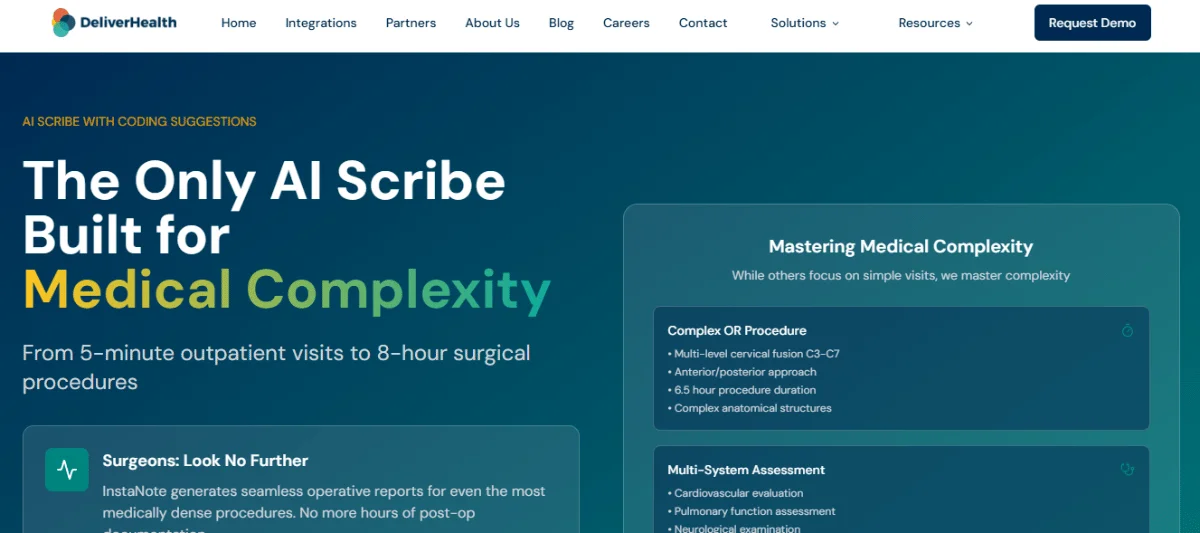
Our AI-powered documentation solution adapts to every specialty, from complex surgical procedures to primary care visits. Here’s how:
Enterprise-Grade Ambient and Dictation Capture: Your healthcare providers speak naturally during patient encounters. Our generative AI converts the conversations into structured, near-final notes in real-time. The model avoids anything the clinician didn't say, which ensures accuracy and means your records have fewer hallucinations.
Personalized Note Formats for Every Specialty: Your organization's templates and clinical preferences drive the output. One of our key differentiators is the flexibility to tailor note structures to match individual provider workflows, including inpatient, outpatient, and operative reports. You can learn more about evaluating these capabilities in our guide to ambient clinical intelligence documentation.
Coding Suggestions Upon Completion: Every near-final note surfaces relevant coding recommendations before the chart leaves our tool. These suggestions help clinicians verify accuracy before the chart moves forward. The documentation-to-billing timeline stays tight, which ensures you experience all the benefits of AI-driven documentation across your organization.
InstaCode
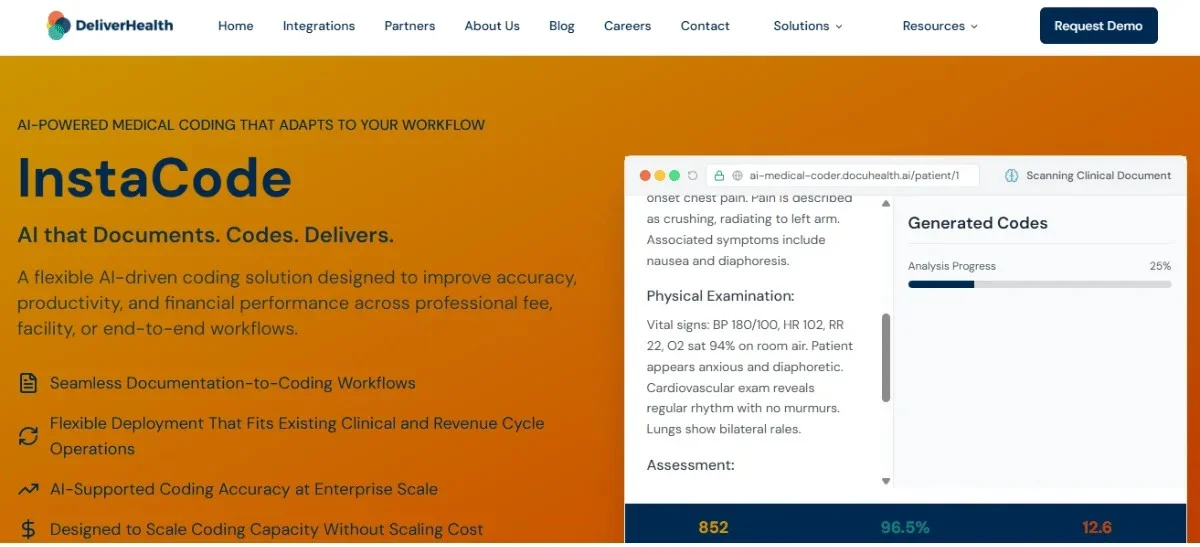
InstaCode is our AI-driven coding solution that autonomously routes, validates, and codes clinical encounters.
Here’s what you get:
Confidence-Based Routing for Every Case: InstaCode sends each clinician-patient encounter to the best-suited human coder or AI engine based on confidence levels. As such, your highest-complexity cases always receive expert review, while routine encounters move to bill-ready status automatically.
SmartAudit Quality Checks Built In: Every coded encounter passes through audit validation, which reduces denial rates and catches errors before they reach the payer.
HITRUST i1 Certified Security for Documentation: Your patient data stays protected under the highest healthcare data security standard. DeliverHealth and Google Cloud’s partnership powers industry-leading medical vocabulary for speech recognition while maintaining full HIPAA compliance.
The results we deliver are real. Children's Hospital, Minnesota, puts it plainly:
"Our health system made the purchase of InstaNote for a variety of reasons: provider burnout, less delay in signing documentation, and overall documentation efficiency…and the reality is each of these factors has gotten a lot better. We have a wait list of providers who want to join, and older, veteran, anti-tech providers are the providers pushing for more licenses. So far, this has been a game-changer."
When your documentation flows from InstaNote into InstaCode, your organization gets a complete pipeline from encounter to reimbursement.
You can use InstaCode as a standalone coding platform, or combine it with InstaNote for a real-time AI scribe and coding workflow.
Your providers save time while your coding teams gain confidence-based routing and SmartAudit quality checks for every case. These benefits are backed by HITRUST i1 security.
See how InstaCode and InstaNote can work for your organization and join the 60,000+ providers who already trust our AI-powered solutions.
Frequently Asked Questions (FAQs)
Let’s close with the most common questions clinicians ask when evaluating these tools:
Can You Switch Between Freed and Heidi After Starting?
Yes, both platforms allow you to cancel at the end of your billing cycle, and your clinical notes remain accessible for export. Keep in mind that Freed requires a 7-day notice on annual plans.
Heidi's annual plan locks you in for 12 months. You'll want to test each through a free trial before committing to a yearly agreement.
Do Both Platforms Work With All EHR Systems?
Neither platform offers full bidirectional write-back with every major U.S. EHR. Heidi connects through a browser extension across several web-based systems. Freed pushes notes through Chrome into browser-based EHRs.
For organizations that require structured data written directly into EHR fields, enterprise-grade solutions offer more robust connections to your system of record.
Which Platform Offers Better Customer Support?
Both platforms offer good customer support.
Heidi provides 24/7 chat and email support, along with a community help center and guided team onboarding. Freed offers email-based support and a help center, with response times that users describe as responsive.
If your organization needs dedicated customer success managers, enterprise-tier solutions offer more hands-on guidance.
Are There Any Hidden Fees With Either Platform?
No. However, Heidi's free tier limits advanced features, so you need to pay $110 per month to subscribe to the Clinician plan. You get unlimited notes with Freed AI's base tier, but you need to subscribe to the Premier plan at $119 per month to get EHR push and billing codes.
You can expect annual lock-ins for discounted rates, which means the current billing cycle's charge still happens even if you cancel early.
Conclusion
The Freed AI vs. Heidi AI debate comes down to streamlined simplicity and multilingual flexibility. Both tools capture conversations and create clinical notes, but they reach their ceiling at the scribe level, so you need a more in-depth tool.
DeliverHealth is an AI-powered clinical documentation and coding solution built for hospitals, health systems, and large physician groups. We go beyond standalone notes to provide a connected workflow where medical documentation flows into coded, auditable, bill-ready records.
With confidence-based routing, SmartAudit quality checks, and 95% physician satisfaction across 60,000+ providers, we've built the pipeline that closes the gap between clinical encounters and revenue recovery.
Find out how DeliverHealth connects documentation and coding for your team.
Stay Updated
Subscribe to our newsletter for the latest healthcare AI insights and company updates.