
Abridge vs Ambience: Ambient AI Compared
Abridge and Ambience both draft the note, but they diverge on EHR fit, coding support, and encounters with no conversation. See how the two compare and where a documentation-to-coding approach fits.
Picking between two ambient AI platforms can feel like choosing between two demos that promise the same thing. Abridge and Ambience both listen to the visit, draft the note, and sell well to large health systems.
The real differences show up later: how each tool writes into your EHR, how far it carries coding, and how it handles encounters with no conversation.
In this article, we compare Abridge vs Ambience on note quality, Epic integration, coding support, pricing, and implementation, so you can match the right tool to your EHR, your specialty mix, and your revenue cycle goals.
TL;DR: Abridge vs Ambience at a Glance
The short version, before the detail below:
Abridge: Enterprise ambient documentation with deep Epic integration and source-level traceability that maps note text back to the audio.
Ambience: Ambient documentation with coding-aware features and broad specialty coverage that surfaces coding and quality signals during the visit.
DeliverHealth: AI-powered documentation and coding that connect the note to the code, with clinician sign-off and credentialed human review on complex encounters.
How to Evaluate an Ambient AI Vendor
Before you compare any two tools, set the criteria that matter for your organization. A demo rarely shows how a tool behaves at scale, so anchor your evaluation on a few concrete axes.
These six axes separate a strong fit from a weak one:
Capture modes: Check whether the tool supports both ambient conversation and dictation, and whether it handles encounters with no patient conversation, such as operative and procedural notes.
EHR integration: Ask how the tool writes into your EHR, and whether it reaches discrete fields or only attaches a document.
Coding and revenue impact: Confirm whether documentation connects to coding and denial prevention or stops at the note. Many organizations feel that gap as mid-revenue cycle pains.
Note quality and auditability: Test whether a clinician can trace what the AI produced, and whether the system avoids adding anything the clinician did not say.
Governance and consent: Ambient recording raises patient consent questions. One JAMA Network Open study found patient consent to ambient documentation fell from 81.6 percent with basic information to about 55 percent once patients heard the full details of how the audio is used, so your consent process matters as much as the tool.
Specialty coverage: Match the model to your specialty mix, including your highest-acuity service lines.

Abridge at a Glance
Abridge is an enterprise ambient AI platform that captures the patient-clinician conversation and drafts structured, billable notes inside the EHR. Large health systems use it, and clinicians rate its note quality well, helped by a deep Epic relationship.
Key capabilities include:
Source traceability: Its Linked Evidence feature lets clinicians trace statements in the note back to the source transcript or audio, supporting review and auditing.
Epic depth: Abridge integrates closely with Epic through a co-development relationship, alongside integrations with other major EHRs.
Specialty and language range: The platform covers a wide range of specialties and supports documentation in many languages.
Billing support: It groups problems to support downstream billing, and the company continues to expand its coding capabilities.
Tradeoff: Abridge handles conversation-based documentation in the clinic well. Teams that need coding carried all the way to defensible, billable codes with credentialed human review, or documentation for encounters with no conversation to capture, should confirm how far the coding workflow reaches.
Ambience at a Glance
Ambience is an ambient AI platform that combines documentation with coding-aware features for health systems that want coding and quality signals during the visit. Ambience covers a broad set of specialties and reads the patient's longitudinal record to ground the note in clinical history.
Key capabilities include:
Chart-aware notes: The system reads prior notes, labs, imaging, and medications to produce notes grounded in the patient's history.
Coding-aware documentation: It surfaces coding and clinical documentation signals during the encounter, including risk adjustment and E/M prompts.
Specialty breadth: The platform covers a broad set of specialties, including complex sub-specialties.
EHR integration: It integrates with Epic and other major EHRs.
Tradeoff: Ambience brings coding awareness into the documentation moment, which suits organizations focused on risk adjustment and point-of-care coding. The software generates those coding signals, so teams that want credentialed coders to review complex and flagged encounters, plus native dictation for notes created after the visit, should confirm how it handles those pieces.
How DeliverHealth Compares
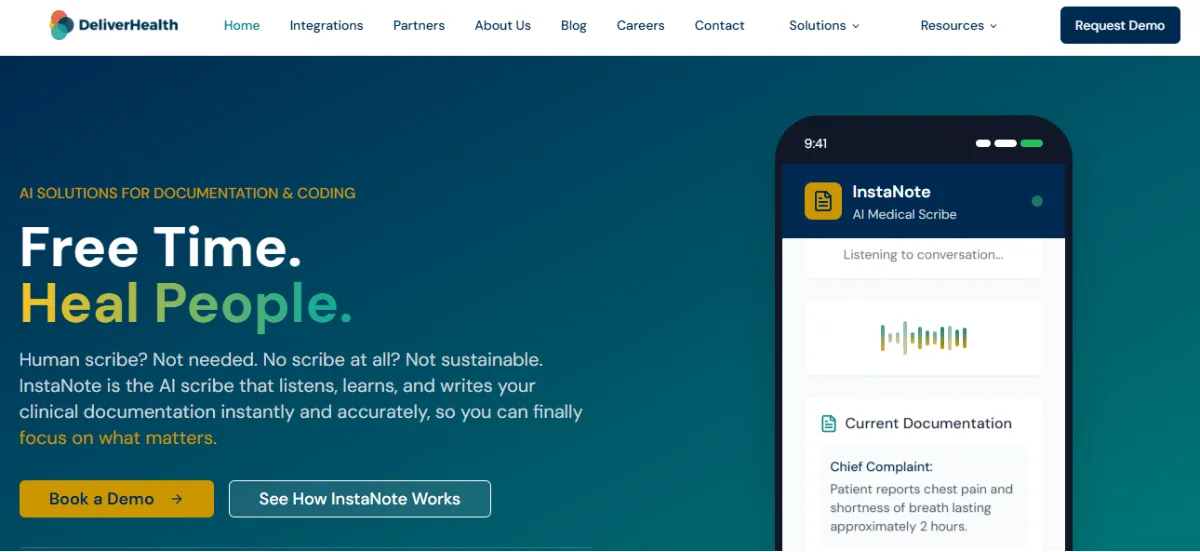
At DeliverHealth, we start from a different premise. The clinical note is where the revenue cycle starts, so we build documentation and coding to work as one chain.
On the same axes, our solutions work like this:
Ambient and dictation, both native: We capture the encounter through ambient conversation or dictation, across inpatient and outpatient care, including complex and surgical encounters where no conversation happens. Our speech recognition does not add anything the clinician did not say, and InstaNote returns a near-final note in about three minutes with coding suggestions the provider reviews before sign-off.
Documentation connected to coding: Our notes flow into AI-powered medical coding through InstaCode, which codes from InstaNote or any other documentation source and delivers billable codes with about 95 percent coding accuracy under human-in-the-loop review, typically within 24 hours. We extend the same approach to autonomous clinical documentation when a team wants it.
Credentialed humans on the exceptions: Our AAPC- or AHIMA-credentialed coders review complex and flagged encounters, and every coded encounter carries a built-in audit trail of AI output, human changes, and the reasons behind them.
Security and scale: InstaNote runs on our eSOne platform, which is HITRUST i1 certified, and supports more than 110 languages through multiple advanced models, including Gemini via our Google Cloud partnership. InstaNote is trusted by more than 40,000 healthcare providers across more than 550 healthcare organizations.
If that connected chain fits what your organization needs, here is how we can help.
At DeliverHealth, we provide AI-powered clinical documentation and coding solutions for health systems and physician groups, built to fit the workflows your providers already use. Our InstaNote captures ambient conversation and dictation, then returns a note with coding suggestions for the provider to review before sign-off, and our InstaCode turns that documentation into defensible codes.
We support ambient and dictation in one workflow, keep speech recognition from adding anything the clinician didn't say, and format each note to match your providers' preferences.
Book an InstaNote demo and watch our documentation workflow run on your specialty's sample notes.
Feature and Fit Comparison
The table below lines up the three on the axes that typically drive the choice:
Feature | Abridge | Ambience | DeliverHealth |
|---|---|---|---|
Capture modes | Ambient conversation | Ambient conversation | Ambient and dictation, inpatient and outpatient |
Coding connection | Billing support, coding expansion | Coding-aware signals at the visit | Documentation to coding via InstaCode, credentialed review |
Note traceability | Source-linked to the audio | Chart-aware from the record | Deliberate blanks, audit trail of AI and human changes |
EHR integration | Deep Epic plus others | Epic plus others | More than 50 EHRs, discrete fields where supported |
Human review | Clinician review | Clinician review | Clinician sign-off plus credentialed coders on exceptions |
How to Verify Each Vendor's Claims
Vendor demos and marketing numbers rarely tell the whole story, so test claims before you accept them.
A few checks protect your organization's revenue and compliance position:
Ask what an accuracy number measures. A high accuracy rate can hide inference errors, where the model supplies a detail the note did not state. Our piece on how to read accuracy claims walks through what to ask.
Separate autonomy from accountability. Confirm where a human reviews the output and who owns a code before it reaches a bill. Autonomous coding without credentialed review on complex encounters shifts risk to your team.
Check the coding method against the rules. AMA guidelines set E/M levels by medical decision-making or total time. The CMS National Correct Coding Initiative governs modifier use, so ask how a tool handles these rules rather than trusting one accuracy figure.
Request a traceable audit trail. For every AI-generated code or note element, you should be able to see what the AI produced, what a human changed, and why.
Confirm the demo against the pilot. A demo on sample notes shows the interface. Benchmarking against your own documentation and specialty mix happens in a pilot.
How to Roll Out and Pilot an Ambient AI Tool
The tool matters less than how it lands in your workflow, so plan the rollout and the pilot with the same care you give the selection.
Four steps keep the rollout and pilot on track:
Map the capture-to-EHR path. Decide how notes reach the EHR, which discrete fields you need populated, and which specialties go first.
Plan the consent conversation. Ambient recording depends on patient trust, and the consent discussion is the clinician's and organization's responsibility. Our piece on patient trust in ambient recording covers why disclosure changes patient comfort.
Name provider champions. Adoption rises when respected clinicians help their peers through the first weeks.
Run a real pilot. Use your own notes and specialty mix, measure note quality and coding accuracy against a baseline, and confirm the audit trail before you scale. Timelines depend on the specialty mix and the EHR work involved.

Frequently Asked Questions
A few questions come up most when teams weigh Abridge, Ambience, and a documentation-to-coding approach:
How Do These Tools Compare on Epic Integration?
Abridge maintains a close Epic relationship through a co-development program. Ambience integrates with Epic as well, and DeliverHealth works across more than 50 EHRs, including Epic, writing to discrete fields where the interface allows.
For an Epic-first system that wants the tightest native fit, Abridge is often the first look; for an EHR-agnostic footprint, breadth matters more.
Does Either Tool Handle Medical Coding?
Ambience surfaces coding-aware signals during the visit, and Abridge continues to expand its coding capabilities. DeliverHealth connects documentation to coding through InstaCode, which delivers billable codes with human-in-the-loop review on complex encounters.
Confirm with any vendor how far the coding workflow reaches and who reviews it.
What About Encounters With No Patient Conversation?
Ambient tools built around the patient conversation fit clinic visits well. Clinicians create operative reports, procedural notes, and many inpatient notes after the encounter, where dictation matters.
DeliverHealth supports ambient and dictation as first-class inputs for exactly these cases.
How Should We Compare Pricing?
Both Abridge and Ambience use custom enterprise contracts, so published figures are estimates rather than quotes.
Compare total cost against the workflow you are buying, including whether coding and revenue-cycle work are part of it, and ask each vendor for pricing on your own deployment.
Is Ambient Documentation Secure and Compliant?
HIPAA sets the legal baseline, and vendors sign a business associate agreement before handling patient data.
Certifications such as HITRUST i1 are voluntary and apply to specific platforms, so ask which system each claim covers. Our eSOne platform, which powers InstaNote, holds HITRUST i1 certification.
Which One is Right for Our Health System?
Your answer depends on your EHR, your specialty mix, and whether you need documentation alone or documentation connected to coding.
Define those first, then test each tool against them in a pilot.
Conclusion
Abridge and Ambience are both capable ambient AI platforms. The right choice depends on where your pressure sits: Epic-native documentation, point-of-care coding signals, specialty breadth, or the full path from note to paid claim.
Define your criteria, test against your own notes, and let the pilot settle it.
At DeliverHealth, our AI-powered documentation and coding solutions connect the clinical note to the code and the code to the claim, so documentation does not stop at a finished note.
Clinicians review and sign every note, our credentialed coders step in on complex and flagged encounters, and each coded encounter keeps an audit trail that shows the AI's output alongside every human change.
Schedule an InstaNote demo to see how we connect documentation and coding across your own encounters.


Stay Updated
Subscribe to our newsletter for the latest healthcare AI insights and company updates.