

7 Best Nuance DAX Alternatives for Healthcare Teams
Nuance DAX is now Microsoft Dragon Copilot. See how the credible alternatives compare on capture, EHR depth, coding, and human review, and how to choose one.
If Nuance DAX was on your shortlist, you have probably noticed it is not called that anymore. Microsoft rolled DAX ambient capture and Dragon Medical One dictation into one product, Dragon Copilot, and plenty of teams are using the moment to ask whether it is still the right fit.
In this article, we compare the credible Nuance DAX alternatives for outpatient and inpatient care, lay out the criteria that actually separate them, and walk through how to verify vendor claims, plan a rollout, and run a pilot.
TL;DR: Top 7 Nuance DAX Alternatives at a Glance
The Nuance DAX alternatives we compare below:
DeliverHealth InstaNote
Abridge
Ambience Healthcare
Suki
Nabla
Commure
DeepScribe, Heidi, and Freed
How Nuance DAX Became Dragon Copilot
Microsoft acquired Nuance and merged the DAX Copilot ambient product with Dragon Medical One dictation under one name, Dragon Copilot. A search for Nuance DAX now points to the same product line, which combines ambient capture, dictation, and generative artificial intelligence (AI).
Dragon Copilot integrates most deeply with Epic and has extended to athenahealth and Oracle Health, with outputs such as referral letters and after-visit summaries.
Buying it runs through enterprise sales and procurement rather than a self-serve signup. That model suits large health systems and gives smaller groups a longer path to a first note.
Documentation load is the reason this category exists. Physicians spend nearly two hours on the EHR and desk work for every hour of direct patient care, according to a time-and-motion study in Annals of Internal Medicine. Primary care physicians log about another 1.4 hours of EHR work a day outside clinic hours, pushing the workday toward 11.4 hours, per a workload study in Annals of Family Medicine.
Teams look past their first shortlist for practical reasons. Some want to capture more than the clinic conversation, including operative and inpatient notes dictated after the fact. Some want the note tied more directly to coding and revenue. Others want deployment that fits a physician group, or coverage across a wider EHR mix.
How to Evaluate a Nuance DAX Alternative
A useful comparison starts with the criteria, not the vendor names. Weigh each option against the parts of the workflow that decide whether it holds up at scale:
Capture modes: Ambient capture handles the clinic conversation. Dictation matters where there is no conversation to record, such as operative reports and inpatient notes. Tools that support both cover more of a health system's work.
Care setting: Outpatient and inpatient documentation differ. Name the setting each tool is built for, and check inpatient depth if you run hospital service lines.
EHR integration depth: Writing to discrete fields is different from attaching a document to the chart. Ask which EHRs a tool writes to, and how deeply.
The connection to coding and revenue: A note is where the revenue cycle starts. Ask whether the tool surfaces coding suggestions and how they connect to downstream coding and denials.
Human review and accountability: Ask who reviews low-confidence output, who signs the note, and where the record shows what the AI produced and what a person changed.
Security and compliance: Confirm HIPAA safeguards, a signed business associate agreement, and any certification such as HITRUST, and check which product each certification actually covers.
Personalization: Formats and templates should follow the organization's and the provider's requests, not a fixed house style.
Deployment and pricing model: Enterprise procurement, mid-market subscriptions, and self-serve signups suit different buyers. Match the model to your size and timeline.
The gap that trips up many buyers is capturing encounters with no conversation to record: the operative and procedural notes we cover in our guide to complex encounter documentation.
The Top 7 Nuance DAX Alternatives Compared
Here are the best alternatives:
1. DeliverHealth InstaNote
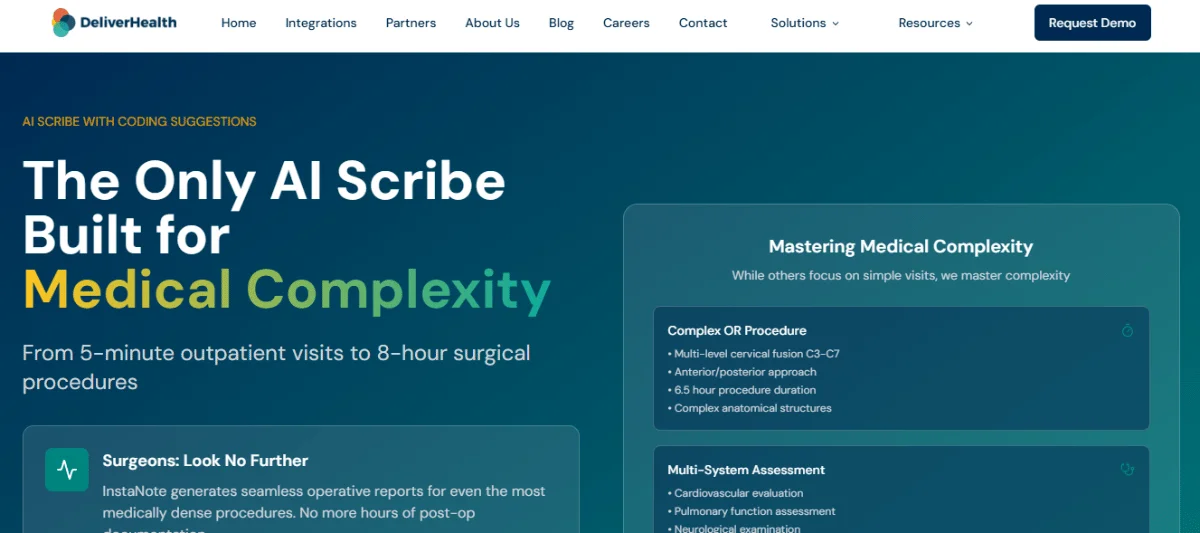
DeliverHealth provides AI-powered clinical documentation through InstaNote clinical documentation, which supports ambient conversation and dictation as first-class inputs across outpatient and inpatient care.
InstaNote returns a near-final, structured note in about three minutes and includes real-time coding suggestions the provider reviews and approves before sign-off.
Key capabilities:
Ambient and dictation capture in one encounter, including notes dictated after the patient leaves.
Real-time coding suggestions inside the documentation workflow, approved by the provider before sign-off.
Speech recognition designed not to add anything that wasn't said, leaving sections blank rather than filling them in by inference.
Formats and templates that follow the organization's and each provider's requests.
Runs on the eSOne platform, which is HITRUST i1 certified, with a business associate agreement in place before handling any patient data.
Works across more than 50 EHRs, including Epic, Cerner, MEDITECH, athenahealth, eClinicalWorks, and NextGen, with support for more than 110 languages.
Getting started runs through a guided pilot rather than an instant self-serve signup. The same model lets DeliverHealth serve small and mid-size practices as well as enterprise health systems, a range many alternatives do not cover, so a first note comes from a scoped evaluation instead of a credit-card trial.
DeliverHealth connects the note to the code. Its InstaCode brings AAPC- and AHIMA-credentialed coders into the workflow, applies human review to complex and flagged charts, and works from the documentation clinicians already produce. See how DeliverHealth turns strong documentation into defensible codes with InstaCode.
Weighing these options against your own service lines takes a conversation. Contact DeliverHealth’s team for a walkthrough of your EHR mix, specialties, and coding needs.
2. Abridge
Abridge is a physician-founded enterprise ambient AI built for large health systems, with deep Epic integration and a feature that maps AI-generated statements back to the source transcript and audio.
It has expanded into coding, prior authorization, and nursing documentation.
Key capabilities:
Enterprise ambient documentation with strong Epic integration.
Evidence linking that traces note statements to the underlying transcript.
Growing coding and prior authorization features.
Tradeoff: Ambient capture is the core strength, so teams with heavy operative, procedural, or inpatient dictation should confirm depth for encounters with no patient conversation.
3. Ambience Healthcare
Ambience Healthcare offers ambient AI with deep specialty adaptation and coding-aware documentation, integrated with Epic and expanding into inpatient and nursing workflows.
Key capabilities:
Specialty-adaptive ambient documentation.
Coding-aware suggestions, including evaluation and management (E/M) and diagnosis coding.
Epic integration with expansion into inpatient and nursing documentation.
Tradeoff: Capture centers on the patient conversation, so confirm support for documentation dictated after the encounter.
4. Suki
Suki is voice AI with ambient, dictation, and voice-command modes, integrated with major EHRs, and it powers an EHR vendor's own ambient notes.
Key capabilities:
Ambient, dictation, and voice-command input.
Integration with major EHRs.
Tradeoff: For complex, high-acuity documentation, confirm the depth of human validation behind the output and the connection to coding.
5. Nabla
Nabla is ambient documentation known for speed and clinician satisfaction, strong in ambulatory, community, and academic settings, with multilingual support.
Key capabilities:
Fast ambient documentation.
Multilingual support.
Strength in ambulatory and community settings.
Tradeoff: Complex service lines such as surgical and inpatient documentation, and the revenue side, sit outside its core focus.
6. Commure
Commure is a broad clinical-to-cash platform spanning ambient documentation, a dictation product, coding, and revenue cycle, with tiers that include human documentation specialists for high-acuity settings.
Key capabilities:
Ambient and dictation documentation on one platform.
Coding and revenue cycle capabilities under one vendor.
Human documentation specialist tiers for high-acuity work.
Tradeoff: A single broad platform means scoping each module against your priority service lines rather than assuming equal depth everywhere.
7. DeepScribe, Heidi, and Freed
DeepScribe, Heidi, and Freed are ambient tools aimed at individual clinicians and smaller practices, with fast setup and self-serve pricing.
DeepScribe also serves specialty groups, and Heidi offers broad language support.
Key capabilities:
Fast, self-serve ambient documentation.
Individual-clinician and small-practice fit.
Broad language support (Heidi) and specialty-group reach (DeepScribe).
Tradeoff: These fit a different buyer than a health system, so larger organizations look elsewhere for enterprise deployment, inpatient dictation, deep EHR integration, and coding connections.
How to Verify a Vendor's Documentation and Coding Claims
Vendor marketing rarely lies outright, but it often measures something different from what a buyer assumes.
A short diligence list protects your revenue and compliance position:
Separate accuracy from automation: A high accuracy figure and a high automation rate are not the same claim. Ask what was measured, on which encounters, and with what human review. We walk through the difference in our piece on how to evaluate accuracy claims.
Ask where the human stays: Who signs the final note, and who handles the charts the AI flags as uncertain. Confirm the workflow keeps a person accountable for what reaches the chart.
Check how the tool handles what was not said: Ambient models can infer. Ask whether a section stays blank when the clinician did not state something, rather than being filled in by inference.
Plan the consent conversation: In a JAMA Network Open study of 103 patients and 18 clinicians, patient comfort with ambient documentation turned on trust in the clinician and understanding of the tool, and fuller disclosure reduced some patients' willingness to share sensitive information. Patient consent for ambient recording is a clinician and organization responsibility that varies by state, a point we examine in our post on patient consent for ambient recording.
Confirm the security scope: HIPAA is law; HITRUST is a voluntary certification. Ask for a signed business associate agreement, and check which product a certification actually covers.
Insist on a real evaluation: A demo uses sample notes aligned to your specialty; benchmarking against your own data belongs in a pilot.
We are direct on the human question. "We need to have humans in the loop, and I think that's a value. I don't think it's a detriment," says our VP of Product and AI.
What Implementation Requires
Adoption is mostly an organizational question, not a technical one.
Plan for the parts that decide whether clinicians keep using the tool after go-live:
EHR integration: Confirm how the tool writes to your EHR, including discrete fields, and the time to tailor that integration.
Provider champions: Identify clinicians who will model the workflow for peers, especially in surgical and specialty groups.
Templates and formats: Set these to the organization's and each provider's preferences before go-live.
Realistic timelines: Ask for a range, not a fixed date, and confirm what a first chart-ready note depends on.
Change management: Meet enthusiastic, skeptical, and reasonably cautious clinicians where they are. We cover why ambient AI adoption is mostly organizational.
How to Run a Pilot
A pilot is where marketing claims meet your own encounters. Structure it so the results transfer to a full rollout.
Use your own documentation: Benchmark against your real notes and specialty mix, not a vendor demo set.
Define success up front: Agree on the measures that matter, such as note completeness, edit time, and coding accuracy with human review, which we break down in our look at the full ROI chain.
Scope it to a service line: Start with one or two specialties, then widen.
Keep humans in the loop: Confirm who reviews output and how exceptions are handled during the pilot.

Frequently Asked Questions
Common questions from teams comparing options after the Dragon Copilot rebrand:
Is Nuance DAX the Same as Dragon Copilot?
Yes. Microsoft merged the DAX Copilot ambient product with Dragon Medical One dictation into Dragon Copilot.
A search for Nuance DAX now points to that product line.
Which Nuance DAX Alternative is Right for a Physician Group?
Start with the criteria, not the brand. Weigh capture modes, care-setting coverage, EHR depth, the connection to coding, human review, and security, then shortlist the two or three that fit your size and specialties.
Do These Alternatives Integrate With Epic?
Most enterprise options integrate with Epic, and many support additional EHRs.
Confirm whether a tool writes to discrete fields and how deeply, since integration depth varies by EHR.
What Do Ambient AI Documentation Tools Cost?
Pricing ranges widely. Enterprise tools are quoted through sales and procurement, mid-market tools use subscriptions, and self-serve tools publish per-clinician rates.
Match the model to your size and evaluation timeline.
Can an Ambient Tool Handle Operative and Inpatient Notes?
Ambient capture suits the clinic conversation.
For operative reports and inpatient notes created after the encounter, dictation is often the better input, so confirm a tool supports both across outpatient and inpatient care.
How Do These Tools Connect to Medical Coding?
Some documentation tools surface coding suggestions for the provider to review, and some connect to a downstream coding step.
Ask how suggestions are generated, who reviews them, and how the workflow supports accurate, defensible codes.
How to Choose the Right Nuance DAX Alternative
The right alternative fits how your clinicians document and how your organization turns notes into paid claims. A tool that stands out in a demo can still stall at go-live if it misses a service line's dictation needs or disconnects coding. The shortlist that survives contact with a pilot is usually short.
We're DeliverHealth, and more than 60,000 providers use our InstaNote for clinical documentation. Our InstaNote captures ambient conversation and dictation across outpatient and inpatient care, surfaces coding suggestions the provider approves before sign-off, and runs on our HITRUST i1-certified eSOne platform.
See how we can reduce documentation time in your workflow with a DeliverHealth InstaNote demo.
Stay Updated
Subscribe to our newsletter for the latest healthcare AI insights and company updates.