

Best AI Scribe for Emergency Medicine: 7 Options Compared
Emergency documentation breaks the clinic-visit assumptions most AI scribes were built on. We compare seven options on the ED realities that decide whether a tool gets used on a real shift.
At 2 a.m., an emergency physician is closing a laceration in bay six while a septic patient waits for a re-evaluation, and a chest pain chart sits half-finished. An AI scribe for emergency medicine has to work inside that shift, with constant interruptions, many voices, and procedures documented after the conversation ends.
Many tools started with the scheduled clinic visit, so the right choice depends on how a tool handles your department's hardest encounters.
In this article, we compare seven options, the criteria that matter in the ED, and how to verify vendor claims and run a fair pilot.
TL;DR: AI Scribe Options for Emergency Medicine at a Glance
These are the seven options we compare in the main section:
DeliverHealth InstaNote
Abridge
Microsoft Dragon Copilot
Ambience Healthcare
Commure
Heidi
Suki
How Emergency Documentation Differs From a Clinic Visit
A clinic note usually comes from one conversation in one room. An emergency department (ED) note builds across the whole visit, from triage through workup, re-evaluations, consults, procedures, and disposition.
Four patterns shape what an ED needs from AI documentation:
A heavy data-entry load: In a time-motion study at a community hospital ED, physicians spent about 43% of their time on data entry and 28% on direct patient care.
Thousands of clicks per shift: The same study found mouse clicks approaching 4,000 in a busy 10-hour shift.
Uneven ambient adoption: In a study of 8,740 ED encounters in Annals of Emergency Medicine, physicians chose an ambient AI scribe for 11.2% of encounters, mostly lower-acuity visits without an interpreter.
Real savings when physicians use it: In that study, median on-shift documentation time fell from 3 minutes 50 seconds to 2 minutes 45 seconds, about 28% less. A single-center ED cohort in JMIR AI found about 73 seconds saved per encounter, roughly 24 minutes across 20 encounters in an 8-hour shift.
The takeaway for buyers is practical. Ambient clinical documentation that saves a minute on an ankle sprain but sits unused during a trauma activation leaves your heaviest documentation where it started.
What to Look for in an AI Scribe for the ED
Seven criteria separate tools that hold up across a full shift from tools that shine in a quiet demo room.
Use these criteria to score every option in the next section:
Capture That Survives Interruptions
Emergency physicians start a history, leave for a code, and return 20 minutes later.
Look for a tool that lets you pause and resume one patient's capture, work several patients at once, and keep every recording tied to the right chart.
Dictation for Procedures and Re-Evaluations
Many ED notes have no patient conversation behind them, such as a procedure note after an intubation, a re-evaluation entered between rooms, or a medical decision-making (MDM) summary written at disposition. A tool with native dictation alongside ambient capture covers those moments without a second product.
Departments that already rely on medical dictation software can keep that habit for procedures and add ambient capture for histories.
MDM in the Physician's Own Reasoning
ED evaluation and management (E/M) visits, Current Procedural Terminology (CPT) codes 99281 to 99285, rest on medical decision-making alone, and you cannot use total time to choose the level. Your note has to show the problems addressed, the data reviewed and analyzed, and the risk of the management decisions.
A summary that captures the conversation but drops the reasoning behind a CT decision leaves the level unsupported. Payer audit practices vary, so confirm level-selection policies with your compliance team.
Multi-Speaker Handling
Trauma bays and resuscitations put emergency medical services (EMS) crews, nurses, family members, and consultants into the same recording.
Ask how the tool attributes speakers and what it does with cross-talk from the next bed.
A Clear Line Between Said and Inferred
An invented exam finding or a diagnosis the physician never stated is a medicolegal problem in an ED chart.
Ask whether the model may infer diagnoses and whether it leaves a section blank when nothing was said.
Human Review of the Codes
The ED note is the source for every code billed for the visit. Ask whether coding suggestions appear before sign-off and who reviews complex or flagged encounters afterward.
Consent and Privacy in Shared Spaces
Hallway beds and curtained bays make ambient recording harder to explain and harder to contain. Consent practices vary by organization and state, so confirm how the tool supports your consent workflow and what happens when a patient declines or cannot respond.
Ambient recording can also affect patient candor during ambient recording, which puts the consent conversation, and the trust behind it, in the physician's hands.
AI Scribe Options for Emergency Medicine Compared
The seven tools take different routes into the ED, from Epic-embedded workflows to EHR-agnostic platforms and dictation-native capture. Scoring each one against the criteria above shows where it fits your department's shifts, EHR, and coding model.
Each entry covers what the tool does in the ED and the capabilities that matter most to emergency teams:
1. DeliverHealth InstaNote
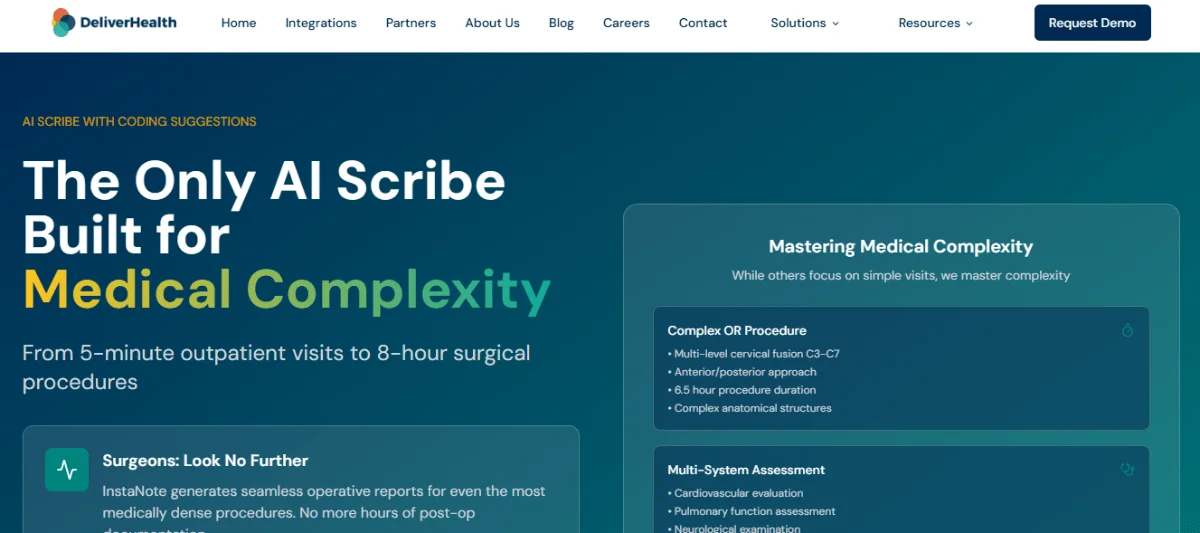
InstaNote is DeliverHealth's AI clinical documentation solution, built for complex inpatient and outpatient encounters, including emergency medicine. DeliverHealth describes it as more than a scribe, because every note connects directly to coding.
Ambient capture and dictation are both native, so physicians can capture the history ambiently and dictate the procedure note or re-evaluation after leaving the room. InstaNote returns a near-final, structured note in about three minutes, formatted to each organization's and provider's requested templates.
Every note includes coding suggestions the provider reviews and approves before signing off. InstaNote's speech recognition is designed not to add anything that wasn't said, and DeliverHealth does not allow the model to infer a diagnosis.
Garrett Dunne, who leads InstaNote implementations at DeliverHealth, explains the blank sections physicians sometimes see: "If you don't state it, here's the section that's going to be blank, and understanding why it's blank. We're doing that on purpose to protect you and to protect the patient."
Those safeguards sit alongside the capabilities that matter most to emergency teams:
Ambient and dictation in one encounter: Physicians can switch modes mid-visit, capture through the mobile app, web app, or phone, and insert templates by voice.
Coding suggestions before sign-off: Suggestions sit inside the documentation workflow, and the provider approves them before the note is final.
EHR integration: InstaNote works across more than 50 EHRs, including Epic, Cerner, MEDITECH, athenahealth, eClinicalWorks, and NextGen, and writes to discrete fields where the interface allows.
Security: InstaNote runs on DeliverHealth's eSOne platform, which is HITRUST i1 certified, and DeliverHealth signs a business associate agreement before handling any patient data.
Language support: InstaNote supports more than 110 languages.
A path to coding: InstaCode codes from InstaNote or any other documentation source, and DeliverHealth's AAPC- or AHIMA-credentialed coders review complex and flagged encounters. The same model supports coding for freestanding emergency departments, where commercial payer revenue makes every preventable denial costly.
Providers see 58% more encounters on InstaNote than with traditional documentation methods, and 9 of 10 would recommend it to a colleague.
DeliverHealth provides AI-powered clinical documentation and coding solutions, with InstaNote for the structured note and InstaCode for accurate, defensible codes reviewed by credentialed coders. For EDs, that means ambient and dictation capture in one tool, unstated sections left blank, and an enterprise-level deployment that typically takes two to three weeks.
Emergency medicine leaders can schedule an InstaNote demo to see DeliverHealth turn sample ED encounters into structured notes, and then benchmark InstaNote against their own charts in a pilot.
2. Abridge
Abridge is a physician-founded ambient AI company focused on large health systems, with deep Epic integration and Linked Evidence that maps AI-generated statements back to the source conversation. Abridge developed its emergency product, Abridge Inside for Emergency Medicine, through Epic's Workshop program.
Clinicians can select a patient from the department's Track Board and start recording in Epic Haiku. Emory Healthcare, Johns Hopkins Medicine, and UChicago Medicine are among the health systems that have used it in emergency care.
Key capabilities for emergency teams include:
Epic-embedded ED workflow: The tool works with Epic's ASAP module in Haiku and Hyperspace.
Speaker and language detection: Its speech models detect specialty, language, and multiple speakers without manual setup.
Traceability: Linked Evidence ties note content back to what was said in the encounter.
Tradeoff: The ED workflow described publicly is built around Epic, so departments on other EHRs should confirm how ED capture and note drafting work in their system.
3. Microsoft Dragon Copilot
Dragon Copilot combines Dragon Medical One dictation and DAX ambient listening with generative AI in one clinical assistant. Microsoft positions it for inpatient, ambulatory, and emergency settings.
For EDs where physicians already dictate in Dragon, ambient capture arrives inside a familiar tool. Clinicians keep their dictation habits for procedures while adding ambient capture for histories.
Key capabilities for emergency teams include:
Dictation and ambient together: Clinicians can move between voice dictation, ambient capture, and natural language editing.
Personalized formatting: Notes follow personalized formatting and specialty-specific structure.
Task support: Dragon Copilot drafts referral letters, clinical summaries, and after-visit notes.
Enterprise security: The assistant is built on Microsoft Cloud for Healthcare.
Tradeoff: Its broad scope makes configuration important, so ask how ED templates, interrupted encounters, and EHR write-back are set up for your department before you commit.
4. Ambience Healthcare
Ambience offers ambient AI with coding-aware documentation and deep specialty adaptation. Clinicians can launch it from Epic Haiku in outpatient, emergency, and inpatient settings.
Epic added Ambience to its Toolbox program for ambient tools, which signals an integration aligned with Epic's recommended practices. The platform supports documentation, clinical documentation integrity, and point-of-care coding.
Key capabilities for emergency teams include:
Haiku launch across settings: ED physicians can start capture from the same mobile app they use elsewhere in Epic.
Coding-aware notes: Ambience produces documentation and code suggestions together at the point of care.
Specialty depth: The platform adapts its output to a wide range of specialties and subspecialties.
Tradeoff: The ED workflow reported publicly runs inside Epic, so departments on other EHRs should confirm integration depth. Ask how complex or flagged encounters reach a credentialed human coder after the point-of-care suggestions.
5. Commure
Commure, which now includes Augmedix, offers a broad clinical-to-cash platform that spans ambient documentation and revenue cycle work. With HCA Healthcare, Commure co-developed an EHR-agnostic ambient platform designed for emergency department, hospitalist, and ambulatory workflows.
Augmedix designed its earlier ED product to capture multiple, nonsequential interactions with the same patient, a common pattern on any ED shift.
Key capabilities for emergency teams include:
EHR-agnostic design: Commure built the platform to work across EHRs.
Nonsequential capture: The tool captures multiple, separate interactions with the same patient across a visit.
Large-system ED input: HCA Healthcare's physicians and care transformation team helped design the workflow.
Tradeoff: Commure's platform covers much more than documentation, so scope which components your ED needs and how they fit with the coding and revenue cycle tools you already run.
6. Heidi
Heidi is an ambient AI documentation tool used by individual clinicians and health services, with fast setup and broad language support. Cabrini Health in Melbourne moved Heidi into its emergency department and ED-led short stay unit after a pilot in which clinicians used it for more than half of their consultations.
Cambridge Memorial Hospital in Ontario has also trialed Heidi in its emergency department, asking patients for permission before each use.
Key capabilities for emergency teams include:
Quick start: Individual clinicians can sign up and begin without a long implementation.
ED trial experience: Emergency departments in Australia and Canada have run structured pilots.
ED and short stay coverage: Cabrini extended use to its ED-led short stay unit.
Tradeoff: The ED deployments reported publicly are mostly outside the U.S., so U.S. departments should confirm EHR integration depth and how notes reach the chart in their system.
7. Suki
Suki provides a voice AI assistant that turns the audio of a patient conversation into clinical notes and fills EHR fields. Suki was the first to fully integrate ambient documentation into MEDITECH Expanse, giving more than 20 enterprise health systems on that EHR an embedded workflow.
The company also integrates with Epic, Cerner, and athenahealth, which gives EDs on several EHRs a path to ambient documentation.
Key capabilities for emergency teams include:
MEDITECH Expanse integration: Ambient documentation runs inside Expanse for hospitals on that EHR.
Broad EHR reach: Integrations cover Epic, Cerner, athenahealth, and MEDITECH.
Reviewable suggestions: Providers can accept, reject, or edit suggested diagnoses and chart content before the note is sent.
Tradeoff: Detail on Suki's ED-specific workflows is limited, so test interrupted encounters, multi-speaker rooms, and procedure documentation in your own pilot.
How to Verify Vendor Claims Before You Sign
Vendors often measure results on their strongest encounters.
Ask these questions to protect your department's revenue and compliance position:
Encounters behind the numbers: Ask whether time savings came from fast-track visits or from high-acuity, interpreted, and procedural encounters, since ED adoption tends to skew toward easier visits.
What happens with silence: Ask whether unstated findings stay blank or get inferred, and request examples from real ED charts.
Physician review: Confirm that the physician signs every note and that the tool logs every edit.
Who checks the codes: Ask whether credentialed coders review complex or flagged encounters and whether every AI and human change is auditable.
Where the audio goes: Ask where the vendor stores recordings, for how long, who can access them, and whether it signs a business associate agreement before any patient data moves.
What is live today: Ask which ED features are generally available and which are still in development.
Pricing for most enterprise options is on request, so compare total cost per clinician, including implementation and EHR integration work.
How to Roll Out and Pilot an AI Scribe in the ED
A fair pilot tests the encounters that matter most, with measures agreed before the first recording.
Follow these five steps to keep the comparison honest:
Define the Encounters You Will Test
Include fast-track visits, high-acuity workups, procedures, interpreted encounters, and boarding re-evaluations. A pilot built on low-acuity visits will overstate the benefit for your department.
Pick Champions Across Shifts and Zones
Choose physicians and advanced practice providers who work nights, fast track, and the main department. Include at least one reasonable skeptic, since their objections show where the workflow breaks.
Champions matter because most of the work in ambient AI adoption is organizational, from shift habits to consent scripts.
Set Consent and Privacy Rules First
Agree on patient scripts, a fallback for patients who cannot consent, and rules for hallway beds. Confirm the business associate agreement and data retention terms before any recording starts.
Measure What Matters
Track the same measures for pilot users and a comparison group, starting with these:
On-shift documentation time: Pull it from EHR audit logs, since self-reports drift.
After-shift time: Count charting completed after the physician leaves the department.
Adoption by acuity: Track use by triage level to see whether the tool reaches high-acuity encounters.
Edit burden: Measure how much physicians change each draft before signing.
Coding outcomes: Track level accuracy and coding queries on pilot charts.
Clinician experience: Survey satisfaction at the start, middle, and end.
Review Coding Before You Scale
Have credentialed coders audit a sample of pilot charts for MDM support and level selection.
Compare their findings with your baseline before you expand to more physicians.
Frequently Asked Questions
Emergency medicine leaders who evaluate AI documentation often raise these questions:
Can an AI Scribe Handle Procedure Notes in the ED?
Yes, when it supports dictation or structured procedure templates.
Physicians often complete procedure notes after the conversation ends, so ambient capture alone may miss them.
Does Ambient AI Work in a Loud Emergency Department?
Performance depends on microphone placement, cross-talk, and speaker attribution, all of which vary by department.
Test in your busiest zone during peak hours, since a quiet demo room tells you little.
How Should an AI Scribe Support ED E/M Coding?
ED E/M levels rest on medical decision-making, so the note must show the problems addressed, the data reviewed, and the risk of management.
Coding suggestions help most when the physician confirms them before sign-off and credentialed coders review complex encounters.
Do Patients Need to Consent to Ambient Recording in the ED?
Consent rules and practices vary by state and organization, so follow your legal and compliance teams' guidance.
Plan ahead for patients who cannot consent, such as those who are unconscious or in acute distress.
How Long Does It Take to Roll Out an AI Scribe in an ED?
Timelines depend on EHR integration, consent planning, and how many zones you include. For InstaNote, our typical deployment runs two to three weeks.
Choose the Tool That Fits Your Hardest Shifts
An AI scribe earns its place in the ED on the nights when the board is full, and every note has an interruption in it. Test each option on procedures, re-evaluations, and high-acuity workups, and keep the physician and a credentialed coder in the loop.
That last step is where we focus at DeliverHealth, because the clinical note is where the revenue cycle starts.
We provide AI-powered clinical documentation and coding solutions. InstaNote gives your physicians a structured note with coding suggestions they approve, and InstaCode turns that documentation into accurate, defensible codes.
We pair AI with AAPC- or AHIMA-credentialed coders to deliver 95% coding accuracy with human-in-the-loop review, with billable codes typically ready within about 24 hours. InstaNote runs on our eSOne platform, which is HITRUST i1 certified.
Book an InstaNote demo to watch a full ED encounter, from history to disposition, become a structured note, then test it on your own charts in a pilot.
Stay Updated
Subscribe to our newsletter for the latest healthcare AI insights and company updates.