

Sully vs Abridge: Choose the Right Fit for Your System
Sully vs Abridge comes down to scope, care-setting coverage, and what happens to the note after it is signed. Compare both fairly, then verify claims and pilot on your own documentation.
A revenue cycle leader lines up two ambient AI documentation vendors, compares note accuracy and languages, and picks the one with the stronger demo. That is how a Sully vs. Abridge decision usually gets made, and it skips the questions that matter most six months after go-live.
Sully.ai and Abridge both draft a note from the visit conversation capably; they differ in scope, care setting, and what happens after the note is signed.
In this article: how to evaluate a vendor, where Sully.ai and Abridge each fit, and how to verify claims and run a pilot.
TL;DR: Sully vs Abridge at a Glance
Sully.ai, Abridge, and DeliverHealth compared in brief:
Sully.ai and Abridge both convert patient conversations into draft clinical notes. They differ most in scope and care-setting coverage.
Abridge is built for large health systems, with deep Epic integration and evidence-linking that maps AI statements back to the transcript.
Sully.ai markets a broader set of task-specific agents that go beyond the note and target ambulatory practices.
Neither is built primarily for encounters with no patient conversation, such as operative reports. Confirm that coverage for your specialty mix.
The question most comparisons skip is whether the documentation connects to coding and the rest of the revenue cycle.
How to Evaluate an Ambient AI Documentation Vendor
Start with the criteria before the product names. Features that look good in a demo rarely decide whether a rollout holds up, so a fair evaluation sets the measuring stick first. Grounding how an ambient AI scribe works before comparing vendors keeps the shortlist honest.
Five criteria carry most of the decision:
Capture mode: Whether the vendor supports ambient conversation capture only, or also dictation for encounters with no conversation to record. The answer changes which care settings it can serve.
Care setting: Outpatient clinic visits, inpatient rounds, and operative or procedural notes place different demands on a documentation system. Name the settings you need covered.
EHR integration depth: Writing to discrete fields in your EHR is different from pasting a block of text. Ask what the integration actually writes and where.
The downstream connection: A finished note feeds coding, denials, and prior authorization. A vendor that stops at the note leaves that work to separate tools.
Human control and governance: Where a clinician reviews and signs, what the system flags, and whether there is a record of what the AI produced and what a human changed.
Those criteria matter because documentation burden is real and measurable. A time-and-motion study in Annals of Internal Medicine found that physicians spend nearly two hours on EHR and desk work for every hour of direct patient care, a burden these tools exist to reduce.
The right tool depends on which part of that burden your organization feels most. A closer look at AI scribes for physicians can help structure the shortlist.

Where Sully.ai Fits
Sully.ai is a venture-backed AI healthcare vendor that markets a set of task-specific agents rather than a single documentation product. Alongside clinical documentation, it positions coding support, front-desk and scheduling, and triage as separate agents that a practice can adopt and expand over time.
Its go-to-market leans toward ambulatory practices, including small and mid-sized groups.
Key capabilities:
Ambient documentation that drafts a structured note from the visit conversation.
A modular set of agents beyond the note, so a practice can add functions incrementally.
Integration with major EHRs used in ambulatory settings.
Tradeoff: Breadth across several agents is the pitch, so verify depth in any one workflow for your setting. Groups with heavy operative, procedural, or inpatient documentation should confirm coverage for encounters that don't center on a patient conversation. Buyers consolidating multiple agents on one vendor should also confirm each agent's maturity independently rather than assuming the whole suite is equally proven.
Where Abridge Fits
Abridge is a physician-founded ambient AI documentation company built for large health systems.
The company is known for deep Epic integration and for evidence-linking that maps AI-generated statements back to the underlying transcript and audio, giving reviewers a way to check the note against what was actually said. Abridge has expanded beyond notes into coding and prior authorization.
Key capabilities:
Enterprise ambient documentation with strong Epic integration.
Evidence-linking that traces note content back to the transcript.
Governance and security features aimed at health-system deployment.
Tradeoff: The core strength is the ambient clinic conversation, so organizations with substantial operative, procedural, or inpatient dictation should confirm how the documentation is captured when there is no conversation to record. As with any vendor moving into coding, ask what the coding output is, who reviews it, and how it reaches your billing workflow.
Where DeliverHealth Fits
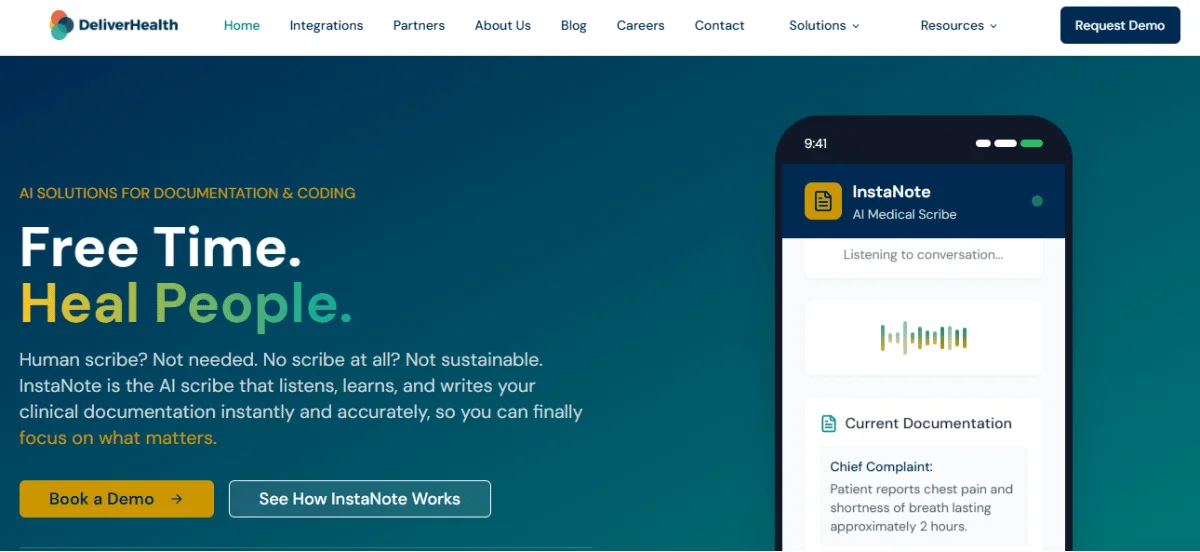
DeliverHealth provides AI-powered clinical documentation and coding solutions for health systems, hospitals, and physician groups, and appears here as a third option worth considering.
Our InstaNote is an AI clinical documentation tool that supports both ambient conversation capture and traditional dictation as first-class inputs, which matters for operative reports, procedural reads, and inpatient notes where there may be no patient conversation to capture.
Our speech recognition is designed not to add anything that wasn't said, and our templates follow the organization's and each provider's requests. InstaNote also surfaces coding suggestions inside the documentation workflow, which the provider reviews and approves before sign-off. InstaNote is trusted by more than 60,000 healthcare providers.
Key capabilities:
Ambient and dictation capture across inpatient and outpatient care, with a near-final, structured note returned in about five minutes.
Coding suggestions in the note, then coding through InstaCode at 95% coding accuracy with human-in-the-loop review, and billable codes typically within 48 hours.
Our AAPC- or AHIMA-credentialed coders handle complex and flagged encounters, and we maintain an audit trail of every AI output and human change.
Integration across more than 50 EHRs, running on our eSOne platform, which is HITRUST i1 certified.
At DeliverHealth, we connect the note to coding and the revenue cycle's upstream problem: documentation quality shows up as clean claims. InstaCode codes at 95% accuracy with human-in-the-loop review, returns billable codes typically within 48 hours, and keeps our credentialed coders on the complex encounters.
See how coding connects to the note once documentation is complete. Explore InstaCode.
How to Verify a Vendor's Accuracy and Automation Claims
Accuracy numbers are the easiest thing to publish and the hardest to compare, because vendors measure them differently.
A stated accuracy figure means little without knowing what it counts and whether a human reviewed the output, so treat the number as the start of a conversation. A practical guide to reading accuracy claims explains why the headline percentage often hides the errors that matter.
Ask each vendor a short set of diligence questions:
What does your accuracy figure measure, on what sample, and was a human in the loop?
Can a reviewer trace a statement in the note back to the transcript or audio?
Where does a clinician review and sign, and what does the system flag for a second look?
What is recorded about what the AI produced and what a human changed?
How do you handle patient consent for ambient recording, and what disclosure do you recommend?
Ask about transparency too. Federal transparency rules for certified health IT give clinicians a baseline set of information about the predictive algorithms built into it, so expect vendors to explain how they built, validated, and monitored their models.
That patient-consent question is not a formality. In a JAMA Network Open study of 103 patients and 18 clinicians, patients said they were more likely to hold back when discussing mental health (35.0%), sexual health (40.8%), or illicit activity (51.5%) if the visit was recorded.
The technology captured the conversation accurately; the gap was what the patient chose not to say. Consent practices belong to the clinician and the organization, and they vary by state, so ask how a vendor supports that conversation rather than assuming a single rule applies everywhere.
Human review is where we draw the line, and we treat it as a feature.
"We need to have humans in the loop, and I think that's a value. I don't think it's a detriment," said Percy Bhathena, our VP of Product and AI. A vendor should be able to tell you exactly where its humans stay.
How to Prepare for Implementation
Adoption depends less on the model and more on the rollout. Whether an ambient tool sticks depends on integration, training, and the clinicians who champion it, which is why so much of the work of ambient AI adoption is organizational rather than technical.
A workable implementation plan covers a few concrete things:
Confirm what the EHR integration writes and where, including whether it populates discrete fields or drops in free text.
Line up provider champions in the specialties that will use the tool first.
Set expectations for the first week, when the model is learning each provider's edits and templates.
Decide who owns configuration when a note needs a format change.
Name the care settings up front, since an ambient-first tool behaves differently in an operative suite than in a clinic room.
How to Run a Pilot
A pilot is where marketing claims meet your notes. Demos usually walk through sample notes aligned to a specialty; benchmarking against your own documentation and your own baseline happens in the pilot, so structure it to answer the questions a demo cannot.
Design the pilot to reflect real conditions:
Use your own specialties and highest-volume note types rather than a curated sample.
Include the encounters that stress the system, such as operative, procedural, or inpatient notes if those apply to you.
Measure against your current baseline for note turnaround, edit time, and clinician satisfaction.
Bring coders and revenue cycle staff in early, so you can see whether the documentation supports clean coding downstream.
Track what gets flagged for human review and how often, rather than the headline accuracy alone.
The result you want is evidence about your workflow, gathered under conditions you will actually operate in.

Frequently Asked Questions
A few questions that come up when teams compare these tools:
What is the Main Difference Between Sully.ai and Abridge?
Abridge is an enterprise ambient documentation company built for large health systems, with deep Epic integration and evidence-linking back to the transcript.
Sully.ai markets a broader set of task-specific agents beyond the note, aimed at ambulatory practices. The choice turns on whether you want proven documentation depth for the clinic conversation or a wider set of functions from one vendor.
Is Abridge Only for Large Health Systems?
Its strength and much of its track record sit with large health systems, especially on Epic.
Smaller groups can evaluate it, but should weigh whether an enterprise-oriented tool matches their size and budget against options built for ambulatory practices.
Do Sully.ai or Abridge Handle Operative or Inpatient Notes?
Both are strongest for ambient clinic conversations.
Operative reports, procedural reads, and many inpatient notes are created after or without a patient conversation and rely on dictation, so confirm that coverage directly for your specialty mix before you commit.
Can Either Tool Code the Encounter?
Abridge has expanded into coding, and Sully.ai positions a coding agent. If coding matters to your decision, ask what the coding output is, on what documentation it is based, who reviews it, and how it reaches your billing workflow.
Treat coding as its own evaluation rather than a bundled assumption.
How Long Does an Ambient AI Documentation Rollout Take?
Timelines vary by EHR, specialty, and how much template tailoring you need. Plan for integration work, provider training, and a first week where the tool learns each clinician's edits.
Ask each vendor for a specific plan tied to your EHR rather than a general range.
What Should a Documentation Pilot Measure?
Note turnaround, clinician edit time, and satisfaction against your current baseline, plus how well the documentation supports downstream coding.
Include the harder encounters and involve coders early, so the pilot reflects the work you actually do.
Choose the Right Fit for Your Setting
Sully.ai and Abridge solve the same starting problem differently, and the better choice depends on your care settings, your EHR, and how far past the note you need the documentation to go. Set your criteria first, verify the claims that will shape the decision, and let a pilot on your own notes settle it.
At DeliverHealth, we build AI clinical documentation that captures both the conversation and the dictation behind operative and inpatient notes, returns a near-final note in about five minutes, and carries coding suggestions the provider approves before sign-off. If the connection from documentation to coding is part of what you are weighing, test it in the same pilot rather than after the contract.
See how our clinical documentation fits your workflow. Request a demo.
Stay Updated
Subscribe to our newsletter for the latest healthcare AI insights and company updates.