
Best AI Scribe for Gastroenterology: 6 Tools to Compare
An AI scribe for gastroenterology has to cover clinic conversations and procedure reports dictated between cases. Compare six tools against GI-specific criteria and learn how to test them before you commit.
Your gastroenterologists start the day in the endoscopy suite with colonoscopies and upper endoscopies, then walk to the clinic for reflux, Crohn's disease, and cirrhosis follow-ups. Between cases, every procedure report needs prep quality, cecal landmarks, findings, and a recall interval.
Any AI scribe for gastroenterology on your shortlist has to cover both halves of that day. The tool needs to follow a clinic conversation, take clean dictation after each case, and leave a value blank when nobody stated it.
In this article, we explain what these tools do, set gastroenterology criteria, compare six tools, and cover verification and piloting.
TL;DR: AI Scribes for Gastroenterology at a Glance
The six tools covered in this guide:
DeliverHealth InstaNote
DeepScribe
Abridge
Microsoft Dragon Copilot
Ambience Healthcare
Suki
What an AI Scribe for Gastroenterology Does
An AI scribe for gastroenterology turns gastrointestinal (GI) encounters into structured notes for clinicians to review and sign. How a tool captures those encounters determines how well it fits a specialty that splits its day between clinic and the endoscopy suite.
Tools in this category fall into three broad groups:
Ambient-first tools: These capture the patient conversation in clinic and draft the note, which suits consults, follow-ups, and chronic disease visits.
Dictation-led tools: These turn a clinician's dictation into structured text, which suits procedure reports where no patient conversation exists.
Hybrid tools: These support ambient capture and dictation as native inputs, so one tool covers clinic and the endoscopy suite.
Some tools in each group also connect the note to coding. GI teams feel that connection directly, since the wording of a colonoscopy report decides how the procedure is coded.
How to Judge an AI Scribe for GI Work
Generic feature lists rarely show how a tool handles a full GI day. The four criteria below come from the daily mechanics of gastroenterology, and you can test each one before you commit.
Start with these criteria:
Dictation for Procedure Reports
An endoscopy report has no patient conversation to capture. The endoscopist dictates findings, interventions, specimens, and recommendations after the case, so the tool has to treat dictation as a first-class input with its own templates.
Teams comparing medical dictation software for GI should dictate a full colonoscopy report and an upper endoscopy report during evaluation. If your unit already documents procedures in a dedicated reporting system, ask how the tool fits alongside it so no case gets documented twice.
Colonoscopy Quality Language
Quality programs measure colonoscopy performance from the report itself. The current ACG and ASGE quality indicators for colonoscopy set a target adenoma detection rate of at least 35% for patients 45 and older, and a minimum average withdrawal time of 8 minutes in normal colonoscopies.
The same position statement sets a 90% target for adequate bowel preparation and counts a case toward it when the report states that prep was adequate and gives an appropriate interval for the next colonoscopy. Each of those values has to come from the endoscopist's own words, since an inferred "adequate prep" creates a quality record nobody attested to.
Our Director of Product Implementation, Garrett Dunne, describes how we handle unstated content: "If you don't state it, here's the section that's going to be blank and understanding why it's blank. We're doing that on purpose to protect you and to protect the patient."
Ambient Capture and Consent in Clinic
GI clinic visits move between bowel habits, diet, medication response, and surveillance planning, and hepatology visits often turn to alcohol and drug use. In a study of ambient documentation consent published in JAMA Network Open, 51.5% of 103 surveyed patients said they would be more likely to self-censor about illicit activity when a visit was recorded.
Those findings on patient candor during recorded visits point to the clinician-patient conversation. Consent practices vary by organization and state, so look for a tool that lets your clinicians pause ambient capture and dictate a summary afterward.
Coding That Follows the Note
Our VP of Business Operations, Gautam Kumar, puts it simply: "Documentation quality should be viewed as the 1st and most important revenue cycle control point." GI coding shows why, since the same colonoscopy can carry different codes depending on what the report says.
Three report details drive many GI coding decisions:
Screening intent and findings: Under the current ICD-10-CM Official Guidelines, a screening code may be listed first when the visit is specifically for screening, and a condition found during the screening may be added as an additional diagnosis.
Follow-on and therapeutic colonoscopies: For a Medicare screening colonoscopy after a positive stool-based test, the AGA's guidance on colonoscopy modifiers calls for modifier KX on the screening code and modifier PT on the procedure code when polyps are removed. Commercial payers set their own rules, so check each payer's policy.
Removal technique for each lesion: The method the endoscopist used, such as biopsy forceps or snare, determines which colonoscopy procedure code applies.
6 AI Scribes for Gastroenterology to Compare
The six tools below span ambient-first and hybrid approaches, and several connect documentation to coding. DeliverHealth's InstaNote appears first, and the remaining entries follow in no ranked order.
Each entry covers a snapshot, key capabilities, and a tradeoff to test where one applies:
1. DeliverHealth InstaNote
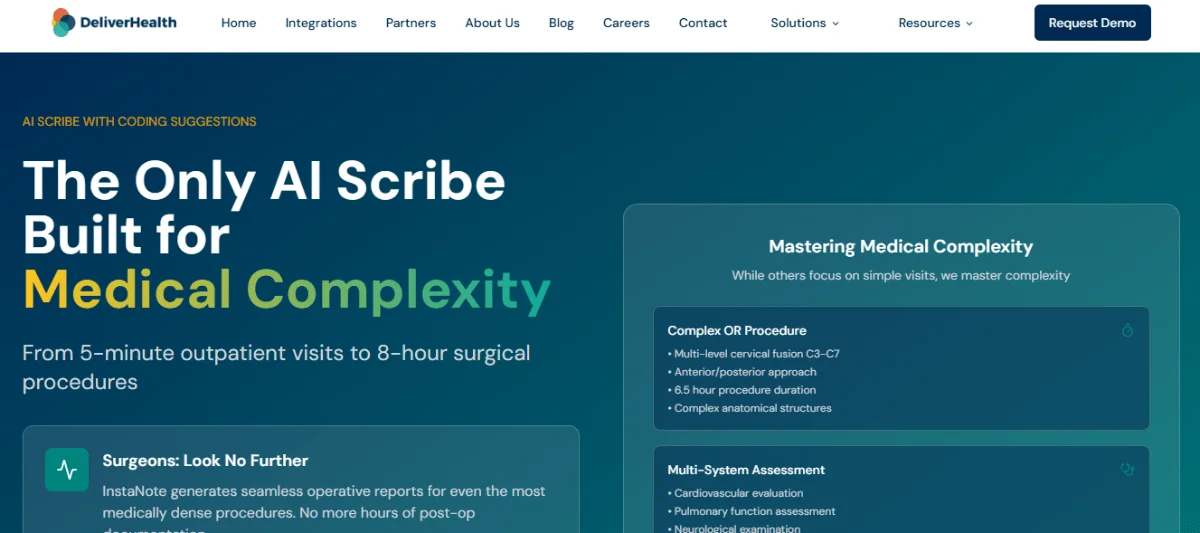
DeliverHealth's InstaNote is AI clinical documentation that supports ambient conversation capture and dictation as native inputs, across inpatient and outpatient care. InstaNote includes coding suggestions that providers review and approve before sign-off.
Key capabilities:
Ambient and dictation in one encounter: Clinicians can switch modes within a visit, so an endoscopist can dictate a procedure report after the case and a clinic note can capture the conversation.
Restraint with unstated content: InstaNote's speech recognition is designed not to add anything that wasn't said, and the model is not allowed to infer a diagnosis, so unstated sections stay blank for review.
Templates on request: Note formats follow the organization's and each provider's requests, and voice commands can insert a template mid-dictation.
EHR reach: InstaNote works across more than 50 EHRs, including Epic, Cerner, MEDITECH, athenahealth, eClinicalWorks, and NextGen.
Security: InstaNote runs on DeliverHealth's eSOne platform, which is HITRUST i1 certified.
Connected coding: DeliverHealth's InstaCode codes from InstaNote notes, dictation, operative reports, or existing EHR notes, with 95% coding accuracy delivered with human-in-the-loop review, according to DeliverHealth.
GI groups that want one documentation partner for the endoscopy suite and the clinic can start with DeliverHealth. The company provides AI-powered clinical documentation and coding solutions, with InstaNote for documentation and InstaCode for professional coding with AAPC- or AHIMA-credentialed coders on complex and flagged encounters.
InstaNote returns a near-final, structured note in about three minutes, typically deploys in two to three weeks, and is trusted by more than 40,000 healthcare providers.
Book an InstaNote demo to walk through sample gastroenterology notes, from a dictated colonoscopy report to an IBD follow-up.
2. DeepScribe
DeepScribe offers ambient AI documentation built on specialty-specific models, with its deepest footprint in oncology. Its specialty coverage also includes gastroenterology, cardiology, urology, and orthopedics.
Key capabilities:
Specialty models: Note generation is tuned to the terminology and structure of each supported specialty.
Visit context: Notes can draw in prior history, procedures, and lab trends relevant to the visit.
EHR integrations: DeepScribe connects with Epic, athenahealth, eClinicalWorks, and several specialty EHRs.
Clinician customization: Each clinician can adjust templates, structure, and phrasing.
Tradeoff: DeepScribe's public focus is ambient capture of ambulatory specialty visits, so confirm how it handles endoscopy reports dictated after the case and inpatient consults. A broader look at DeepScribe alternatives covers other options for specialty groups.
3. Abridge
Abridge is enterprise ambient AI built for large health systems, with deep Epic integration. The company is expanding from documentation into coding and prior authorization work.
Key capabilities:
Linked Evidence: Statements in the AI-generated note map back to the source transcript and audio, so clinicians can verify the output.
Epic integration: Abridge was the first ambient AI tool in Epic's Pal program and runs inside Epic workflows.
Downstream workflows: Abridge is working with payers and networks on prior authorization at the point of care.
Tradeoff: Abridge's deepest fit is large, Epic-based health systems, so independent GI groups on other EHRs should confirm integration depth and the rollout model.
4. Microsoft Dragon Copilot
Microsoft Dragon Copilot combines Dragon Medical One's dictation capabilities with DAX Copilot's ambient listening and generative AI. The solution is part of Microsoft for Healthcare.
Key capabilities:
Dictation and ambient together: Clinicians can move between voice dictation, ambient capture, and natural language prompts in one workspace.
Task automation: The tool can draft referral letters, note summaries, and post-visit summaries.
Long dictation heritage: Dragon Medical One dictation carries over into the unified product.
Tradeoff: The workspace spans many roles and care settings, so plan time to configure GI templates for endoscopy reports and to train providers on when to use each mode.
5. Ambience Healthcare
Ambience Healthcare offers ambient AI with coding-aware documentation, including point-of-care coding and clinical documentation integrity support. The company takes part in Epic's Toolbox program.
Key capabilities:
Coding-aware notes: Documentation includes point-of-care coding support for the clinician.
Chart context: Notes can draw on prior notes and diagnostics from the patient's chart.
Epic integration: Ambience integrates with Epic's ambient module and mobile workflows.
Tradeoff: Ambience centers on ambient capture of the patient conversation, so test how it handles endoscopy reports dictated after the case. A side-by-side Abridge vs Ambience comparison covers how the two differ for health systems.
6. Suki
Suki is a voice AI assistant that combines ambient note generation, dictation, and voice commands. Its integrations run bidirectionally with several major EHRs.
Key capabilities:
Three voice modes: Clinicians can use ambient capture, dictation, or spoken commands in one solution.
Voice commands: Clinicians can handle charting tasks and chart questions by voice.
EHR integrations: Suki integrates with Epic, Oracle Health, athenahealth, and MEDITECH.
Tradeoff: Suki's deepest integrations center on those four EHRs, so GI groups on specialty or smaller EHRs should confirm fit before a pilot.
How to Verify Vendor Claims for GI Documentation
Accuracy and time-savings figures vary by specialty, setting, and sample. Ask each vendor how a figure was measured, then test it on the encounters that strain GI documentation most.
Use these scenarios as your test set:
GI Scenario | What to Test | What a Strong Result Looks Like |
|---|---|---|
Screening colonoscopy with polyp removal | A dictated report with prep grade, cecal landmarks, withdrawal time, lesions, and recall interval | Every stated value lands in its field, in your template |
Colonoscopy with a value left out on purpose | Omit withdrawal time from the dictation | The field stays blank and the tool routes the note for review before signature |
Upper endoscopy for reflux symptoms | Dictated findings, biopsies, and plan | Findings, specimens, and recommendations are structured correctly |
IBD follow-up visit | Ambient capture of symptoms, therapy response, and lab review | Each problem has its own assessment and plan |
Hepatology visit with sensitive history | Pause ambient capture, then dictate a summary | The switch between modes is smooth within one encounter |
Inpatient GI consult | A consult note dictated on the hospital floor | The note reaches the right fields in the hospital's EHR |
Beyond the test set, confirm these points with every vendor:
EHR integration: Find out whether the tool writes to discrete fields in your EHR and how long integration tailoring takes.
Template control: Check that you can set GI templates at the organization level and let each provider adjust their own.
Coding review: Ask who reviews coding suggestions before a note is signed and whether coded encounters carry an audit trail.
Security scope: Identify which platform holds patient data, which certifications cover that platform, and require a business associate agreement (BAA) before sharing any patient data.
Market fit: Confirm the vendor supports organizations of your size, from a single-specialty GI group to a health system GI department.
How to Roll Out and Pilot an AI Scribe in GI
Demos use sample notes, so a pilot is where you see performance on your own encounters. Plan it with your coding and quality leads from the first week.
Four steps keep a GI pilot useful:
Choose a balanced group: Include endoscopists with heavy procedure days and clinic-focused providers, and name one champion to gather feedback.
Cover your real encounter mix: Run screening and surveillance colonoscopies, upper endoscopies, IBD and liver follow-ups, and inpatient consults if your team covers the hospital.
Measure what matters: Track edits per note, quality fields completed or left blank, coder questions sent back, and time from encounter to signature.
Review with coding and quality leads: Check whether reports support clean coding and whether quality data reads the way your report cards expect.
Plan for the people side as carefully as the technology. Most ambient AI adoption challenges are organizational, and a named champion gives your providers one place to raise them.

Frequently Asked Questions
GI leaders and practice managers often raise these questions during evaluation:
Can an AI Scribe Document a Colonoscopy Report?
Yes, when it supports dictation as a native input.
The endoscopist dictates findings and recommendations after the case; the tool then structures them into the report template, and the endoscopist reviews and signs the note.
Will an AI Scribe Record Withdrawal Time or Prep Quality on Its Own?
A well-designed tool records these values from what the endoscopist states.
Any field the endoscopist did not address should stay blank, and the tool should flag it for review before signature.
How Should a GI Clinic Handle Patient Consent for Ambient Capture?
Consent practices vary by organization and state, so your organization sets the policy, and your clinicians carry it out.
A brief explanation at the start of each visit, plus an option to pause capture for sensitive topics, gives patients a clear choice.
Does an AI Scribe Work for Inpatient GI Consults?
Yes, if the tool supports dictation and integrates with the hospital's EHR.
InstaNote supports ambient and dictation workflows across inpatient and outpatient care, and our team tailors EHR integration during implementation.
Which AI Scribe Fits a Small GI Practice?
Look for a vendor that supports your EHR, offers GI templates you can adjust, and has a rollout model sized for a smaller group.
We serve small and mid-size practices through large health systems, and typical InstaNote deployment runs two to three weeks.
Choose a Tool Built for Both Halves of the GI Day
The right GI documentation tool proves itself on the busiest procedure day, when every report is complete at signature, and nothing is guessed. Judge each option by the colonoscopy report your quality team will audit and the clinic note your coders will read.
If that standard fits your organization's needs, we can help you test it against your workflow.
Our team at DeliverHealth builds AI-powered clinical documentation and coding solutions for small and mid-size practices through enterprise-level health systems. InstaNote captures ambient clinic conversations and dictated procedure reports, and your providers approve coding suggestions before sign-off.
When documentation moves to coding, InstaCode's credentialed coders handle complex and flagged encounters, and every AI output and human change stays on an audit trail.
Schedule an InstaNote demo to review sample GI notes with our team and map out a pilot around your endoscopy and clinic schedule.
Stay Updated
Subscribe to our newsletter for the latest healthcare AI insights and company updates.