
Best AI Scribe for Surgical Specialties and Operative Notes
An AI scribe for surgical specialties has to cover the clinic visit and the operative report, two notes that rarely come from the same kind of capture. We compare seven options on dictation, specialty fit, coding connection, and EHR reach, then show how to verify claims and pilot with your surgeons.
Surgical groups tend to judge an AI documentation pilot on clinic days, when new-patient consults and post-op checks give an ambient tool a conversation to work with. The operating day adds a second test, because your surgeons dictate the operative report with no patient conversation to capture.
Choosing an AI scribe for surgical specialties means planning for both days, plus the coder who turns each note into a claim.
In this article, we cover what surgical documentation demands, compare seven options, and show how to verify claims and run a pilot.
TL;DR: AI Scribes for Surgical Specialties at a Glance
The seven options compared in this guide:
DeliverHealth InstaNote
Microsoft Dragon Copilot
Abridge
Ambience Healthcare
Suki
DeepScribe
Commure
What Surgical Specialties Need From an AI Scribe
A surgical practice documents the clinic visit that leads to a decision for surgery, the procedure itself, and the follow-up care inside the global period. Each stage produces a different note, and each note feeds the claim.
A general documentation tool can handle the first stage well and still leave gaps in the other two.
Four requirements set a surgical-ready tool apart from a general one:
Support for the Operative Report
The operative report rarely comes from a conversation. Your surgeons dictate it after the case, often between procedures, so a tool built on ambient audio alone leaves the most important surgical note to another system.
A dedicated dictation mode closes that gap, since medical dictation software lets the surgeon speak the note directly in the words they want on the record.
Timing matters too. Under Medicare's hospital surgical services rules, the surgeon must write or dictate an operative report describing techniques, findings, and tissues removed or altered immediately after surgery and sign it.
When the full report isn't in the record yet, a progress note must include, at minimum, the surgeon and assistants, the procedures performed, findings, estimated blood loss, specimens removed, and the postoperative diagnosis. A tool that returns a structured draft quickly helps your surgeons meet that expectation.
Notes That Support Global Surgery Coding
Under Medicare's rules, the global surgical package bundles related care before, during, and after a procedure, with a 10-day or 90-day post-operative period for most procedures. The package applies in hospitals, ambulatory surgical centers (ASCs), and physician offices alike.
The note has to show where each visit sits in that package. Bill a first evaluation that leads to the decision for major surgery separately with modifier 57; an unrelated visit during the post-operative period uses modifier 24 with documentation supporting the unrelated service; and an unplanned return to the operating room uses modifier 78.
Commercial payers set their own policies, so confirm the rules for each contract. Modifier choices shift by procedure family, and general surgery coding shows how much the operative detail drives each one.
The table below maps common surgical note types to the capture mode that usually fits and what your coders need from each:
Note type | Capture mode that usually fits | What the note has to carry |
|---|---|---|
New-patient consult | Ambient conversation | History, exam, imaging review, and a clear decision for surgery, which supports modifier 57 for major procedures under Medicare |
Operative report | Dictation after the case | Procedures performed, findings, estimated blood loss, specimens, assistants, laterality, and the postoperative diagnosis |
Immediate post-op note | Short dictation or typed entry | The minimum elements the Joint Commission expects when the full report is not yet in the record |
Post-op visit in the global period | Ambient or dictation | Whether the visit relates to the surgery, since an unrelated visit needs modifier 24 and supporting documentation |
Unplanned return to the OR | Dictation | The link to the original procedure that supports modifier 78 |
Specialty Templates and Laterality
Orthopedics, spine, hand, urology, and general surgery each structure notes differently, and surgeons within one group often want their own formats. A tool should follow the templates your organization and each surgeon request, and let a surgeon pull in a procedure template without stopping to type.
Laterality deserves its own test. Right and left, bilateral procedures, and digit or level detail drive orthopedic coding, so check that every draft keeps each side and site the surgeon stated.
Human Review Before Sign-Off
Every AI-drafted surgical note needs a clear review step before your surgeon signs. Safer tools leave a section blank when the surgeon didn't state something, so reviewers can see the gap and fill it in from the surgeon's own account.
Coding suggestions belong in the same review, as a guide to note quality. When suggestions appear inside the documentation workflow, they show your surgeons what the note supports while the case is fresh, so your coding team receives a more complete note.

How AI Scribes Capture Surgical Notes
Vendors in this category differ most in how they capture the note. Capture mode decides how well a tool covers the operating day.
Most tools fall into one of three groups:
Ambient-first: The tool records the patient-clinician conversation and drafts the note, which fits consults and post-operative visits where the dialogue carries the clinical detail.
Dictation-first: The surgeon speaks the note directly, which fits operative and procedural reports where no conversation exists to capture.
Combined ambient and dictation: Both modes run in one workflow, so a surgeon can capture a clinic visit ambiently and dictate the operative report in the same solution.
Several vendors now offer both modes, sometimes as separate products. Ask how the two connect inside your EHR before you assume they behave as one workflow.
Top AI Scribe Options for Surgical Specialties
Each entry covers what the tool does and the capabilities that matter for surgical documentation, with a tradeoff to weigh for each alternative. Capabilities reflect public information at the time of writing, so confirm current features during evaluation.
The seven options below start with DeliverHealth's solution, followed by six alternatives in no ranked order:
1. DeliverHealth InstaNote
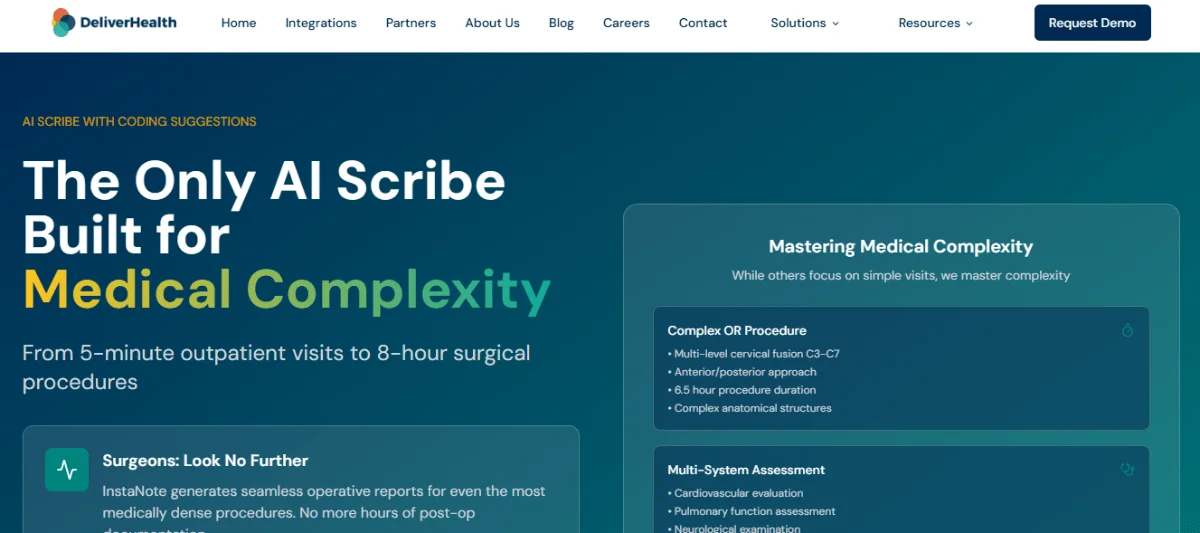
InstaNote, from DeliverHealth, is AI clinical documentation that supports ambient and dictation workflows as native modes across inpatient and outpatient care. A surgeon can capture a clinic consult ambiently, then dictate the operative report after the case, and InstaNote returns a near-final, structured note in about three minutes.
Key capabilities for surgical teams:
Two native capture modes: Ambient conversation and dictation both run in InstaNote, including for operative and procedural notes with no patient conversation behind them.
Speech recognition built for review: InstaNote's speech recognition is designed not to add anything that wasn't said, and the model leaves a section blank when the clinician did not state it.
Templates on request: Formats and templates follow the organization's and each provider's requests, and voice commands can insert a specialty template during dictation.
Coding suggestions for a stronger note: Real-time coding suggestions based on the note help the provider spot missing detail before signing, and credentialed coders approve the final codes.
A connected path to coding: InstaCode, DeliverHealth's surgical coding software, codes from operative reports and other documentation with modifier, laterality, and global period logic. AAPC- or AHIMA-credentialed DeliverHealth coders review complex and flagged encounters.
EHR reach and security: InstaNote works across more than 50 EHRs, including Epic, Cerner, MEDITECH, athenahealth, eClinicalWorks, and NextGen. InstaNote runs on DeliverHealth's eSOne platform, which is HITRUST i1 certified.
For surgical groups comparing options, DeliverHealth offers AI-powered clinical documentation and coding solutions: InstaNote for notes and InstaCode for coding. DeliverHealth serves small and mid-size practices through enterprise-level health systems, and more than 40,000 healthcare providers trust InstaNote.
Book an InstaNote demo to watch a dictated operative report and an ambient clinic visit become structured drafts, using sample notes aligned to your surgical specialty.
2. Microsoft Dragon Copilot
Microsoft Dragon Copilot brings Dragon Medical One's speech recognition and DAX ambient capture into one clinical assistant. Clinicians can switch between dictation and ambient capture in the same experience, across office and mobile settings.
Key capabilities for surgical teams:
Dictation and ambient together: A surgeon can dictate an operative note and use ambient capture in clinic within one product.
Custom vocabularies: Organizations can add custom vocabularies to support specialty and procedure terminology.
Enterprise cloud safeguards: Dragon Copilot runs on Microsoft Cloud for Healthcare's healthcare safeguards.
The tradeoff to weigh is scope. Dragon Copilot focuses on documentation, clinical information, and task automation, so organizations that want credentialed coders to review each surgical note will run coding as a separate workflow.
3. Abridge
Abridge provides enterprise ambient AI documentation with deep Epic integration for large health systems. Linked Evidence, an Abridge feature, maps statements in the AI-generated note back to the source transcript and audio.
Key capabilities for surgical teams:
Traceable notes: Linked Evidence lets clinicians check any part of the draft against the source audio before signing.
Inpatient workflows in Epic: Abridge co-developed an inpatient documentation tool with Epic that maps generated notes into note types such as progress notes and consult notes.
Nursing documentation: Abridge offers ambient documentation for nurses inside Epic inpatient workflows.
The tradeoff to weigh is capture mode and EHR fit. Abridge works ambient-first and integrates most deeply with Epic, so groups on other EHRs, or surgeons who dictate operative reports after the case, should confirm how those workflows run.
4. Ambience Healthcare
Ambience Healthcare builds coding-aware ambient documentation that supports more than 100 specialties across outpatient, emergency, and inpatient settings. For inpatient care, Ambience added an ICD-10 documentation integrity assistant in which every suggested code carries its clinical rationale and supporting references.
Key capabilities for surgical teams:
Coding-aware notes: Ambience shapes documentation around coding requirements at the point of care.
Specialty breadth: Coverage spans more than 100 specialties, including complex areas such as oncology and emergency medicine.
Direct EHR integration: Ambience integrates directly into the EHR, so drafted notes reach the chart without a separate copy step.
The tradeoff to weigh is the operative report. Ambience centers on ambient capture of the clinical conversation, so surgical groups should confirm how operative and procedural notes dictated without a patient conversation fit its workflow.
5. Suki
Suki offers ambient documentation, dictation, and voice commands from one company. Suki Dictation is built natively inside Epic and MEDITECH and can run on its own or alongside Suki's ambient documentation.
Key capabilities for surgical teams:
Flexible capture: Organizations can deploy dictation and ambient documentation separately or together, which suits groups that want dictation for procedures and ambient capture in clinic.
Voice commands: Clinicians can complete workflow tasks by voice, such as retrieving patient information and drafting referrals.
Code recommendations: Suki's ambient tool recommends billing codes alongside the drafted note.
The tradeoff to weigh is EHR dictation coverage. Suki announced native dictation for Epic and MEDITECH, so groups on other EHRs should check how dictated surgical notes reach their record.
6. DeepScribe
DeepScribe provides ambient AI documentation with specialty-tuned models and a strong presence in oncology. In spine and orthopedics, DeepScribe partnered with Commons Clinic, a musculoskeletal specialty group, on AI documentation for procedural and clinical notes.
Key capabilities for surgical teams:
Specialty tuning: DeepScribe builds specialty-specific documentation workflows, including for musculoskeletal care.
Procedural and clinical notes: The Commons Clinic partnership covers procedural notes and clinic notes for spine and orthopedic care.
Personalized output: Clinicians can tailor note structure and style to their preferences.
The tradeoff to weigh is the care setting. DeepScribe's public focus leans toward outpatient specialty visits, so inpatient surgical teams should confirm coverage for hospital workflows.
7. Commure
Commure offers a broad suite that spans ambient documentation, automated dictation, billing, and workflow automation. Commure also acquired ambient documentation company Augmedix, expanding its documentation offering.
Key capabilities for surgical teams:
Ambient and dictation in one vendor: Commure's suite includes ambient documentation and automated dictation.
Billing alongside documentation: Revenue cycle tools sit in the same suite as documentation.
Workflow tools: The suite also covers patient engagement and workflow automation.
The tradeoff to weigh is module mapping. Commure's suite covers many workflows beyond documentation, so surgical groups should confirm which products a pilot includes and how operative notes move from capture to coding.
How to Verify Vendor Claims for Surgical Documentation
Vendor materials in this category read alike, so the real evaluation has to happen on your own documentation. A short, structured test protects your surgeons' time and your revenue integrity.
Use these checks with every vendor on your shortlist:
Test on dictated operative reports: Give each vendor sample operative reports dictated after a case. Check procedure details, laterality, findings, and specimens against what the surgeon said.
Check how the tool handles silence: Ask what the draft shows when the surgeon did not state something. A blank section that prompts review keeps the record faithful to the case.
Trace every coding suggestion: Ask who reviews codes before encounters leave the system and whether the system records AI output, human changes, and the reasons behind them. A coder's view of the complex surgical encounter shows why each detail matters at audit.
Confirm the EHR write path: Ask whether notes land in discrete fields in your EHR or arrive as a block of text your staff must sort.
Separate demos from pilots: Expect demos to run on sample notes aligned to your specialty. Benchmarks against your own operative reports belong in a pilot.
Request the security paperwork: Require a business associate agreement before any patient data moves, and ask which platform any HITRUST certification covers.
How to Pilot an AI Scribe With Your Surgical Teams
A pilot is where personalization and benchmarking happen, since demos run on sample notes. A well-designed surgical pilot tests the clinic day and the operating day with the same group of surgeons.
Four steps shape a pilot that gives you a clear answer:
Choose a Representative Case Mix
Include new-patient consults, post-operative visits inside the global period, and operative reports dictated after real cases. Add inpatient rounding notes if your surgeons cover hospital patients, so the pilot reflects both care settings.
Pick at least one high-volume procedure and one complex case per specialty. Complex cases expose gaps that routine visits can hide.
Name a Provider Champion
Surgeons give a new tool little room for error, and our Director of Product Implementation, Garrett Dunne, puts the risk plainly.
"Someone's going to use it once, and if it fails, that's the end of it," he says.
A respected surgeon who tests the tool early, shares templates, and answers peers' questions changes those odds. "Key to this is a provider champion," Garrett says of surgical groups.
"I think that's more so than in any other specialty."
Set Consent Steps for Clinic Visits
Ambient capture in surgical clinics records patients, and consent practices vary by organization and by state. Your organization and clinicians own that process, so agree on the script, the opt-out path, and how staff document consent before the pilot starts.
Patient comfort depends on more than the form. A JAMA Network Open consent study of 103 patients and 18 clinicians found that patient comfort varied with trust in the clinician and understanding of the tool, and the authors recommended approaches that include opt-out options.
The same study found that patients were more likely to self-censor on topics such as mental and sexual health. Those findings raise practical questions about patient disclosure during ambient recording that your clinic leaders should plan for.
Measure What the Coder Receives
Time saved per note is a useful start, and the coder's view tells you whether the documentation holds up. Track how often operative reports arrive complete, how often coders query surgeons, and whether notes support the modifiers and global period context each claim needs.
Compare the time from case end to signed operative report before and during the pilot. A shorter gap supports the Joint Commission expectation described earlier and gets encounters to coding sooner.
Frequently Asked Questions
Surgical practice leaders and revenue cycle teams often raise these questions during evaluation:
Can an AI Scribe Write an Operative Report?
Yes, when the tool supports dictation, since the surgeon usually dictates an operative report after the case.
Your surgeon reviews and signs the draft, and the tool should keep every stated detail without adding any.
Should Surgical Practices Use Ambient Capture or Dictation?
Most surgical practices need both.
Ambient capture suits consults and follow-up visits, and dictation suits operative and procedural notes, so a tool that runs both modes in one workflow spares your surgeons from switching systems.
How Does AI Documentation Affect Global Surgery Billing?
The note supplies the facts coders use to place each visit inside or outside the global package, such as a decision for surgery or an unrelated problem during follow-up.
The CMS booklet cited earlier lays out Medicare's rules, and commercial payers set their own, so credentialed coders should confirm modifiers before encounters leave the system.
Do Patients Need to Consent to Ambient Recording in Surgical Clinics?
Consent expectations depend on your organization's policies and on state law, which varies.
Work with your compliance and legal teams to set a clear script and opt-out path before recording any visit.
Can a Vendor Demo Use Our Own Operative Reports?
Demos usually run on sample notes aligned to your specialty.
Testing on your own operative reports and benchmarking against your data belong in a pilot, under a signed business associate agreement.
Will AI Documentation Replace Surgical Coders?
No, and the stronger approach builds coders into the process.
AI handles volume and repetitive work, while credentialed coders handle exceptions, complex cases, compliance checks, and judgment calls.
Choose a Tool Built for the Operating Day
Clinic visits show how well a tool listens to a conversation. Operative reports show whether it can take a surgeon's dictation, keep every stated detail, and give your coders a note that supports the claim.
Weigh each option against the operating day as carefully as the clinic day, and let a pilot on your own case mix settle the decision.
That pilot is where we can help. At DeliverHealth, we provide AI-powered clinical documentation and coding solutions that carry the surgical note from capture to code, starting with InstaNote coding suggestions that help your providers hand off a more complete note.
InstaCode's AAPC- or AHIMA-credentialed coders review complex and flagged encounters, and every coded encounter stays auditable, with AI output, human changes, and the reasons behind them on record. InstaNote runs on our eSOne platform, which is HITRUST i1 certified.
Schedule an InstaNote demo to see how our documentation fits your surgeons' clinic and operating days, using sample notes aligned to your specialty.
Stay Updated
Subscribe to our newsletter for the latest healthcare AI insights and company updates.