

Heidi AI vs. Deepscribe - Pricing and Value Analysis
Heidi AI and Deepscribe are transforming clinical documentation with AI-powered workflows. Compare features, pricing, and efficiency to find the right solution for your practice.
Physicians spend 34 to 55 per cent of their workday creating and reviewing clinical documentation in EHRs. Besides pulling time directly from patient care, it's one of the main causes of clinician burnout across healthcare organizations today.
That's where AI-powered clinical documentation and coding tools, like Heidi AI and Deepscribe, come in.
When considering Heidi AI vs. Deepscribe, you'll want to prioritize the ability to capture accurate clinical notes and surface the right billing codes. The tool must also integrate seamlessly into your providers' daily workflow.
In this article, we'll explore what each tool delivers, how they compare on pricing and time savings, and whether a more unified approach better serves your organization.
TL;DR: Heidi AI vs. Deepscribe (vs. DeliverHealth)
Here's a quick look at how these tools compare before we go into the details:
Solution | Key Features |
|---|---|
Heidi AI | Adaptive voice recognition across 200+ specialties, including allied health, general practice, and mental health; ICD-10 and SNOMED-CT code suggestions; Customizable note templates and community library |
Deepscribe | Specialty-tuned ambient AI for oncology, cardiology, urology, and more; Automated E/M, ICD-10, and HCC coding; Contextual notes with prior patient history |
DeliverHealth | Autonomous coding with confidence-based routing; SmartAudit for quality oversight; Ambient and dictation notes with code suggestions across surgical, orthopedics, emergency medicine, primary care, and radiology specialties; HITRUST i1-certified enterprise security |
We'll walk through each one below, including workflows, pricing, time savings, and a closer look at how DeliverHealth approaches the full documentation-to-coding challenge differently.
What Is Heidi AI? Core Features & Capabilities
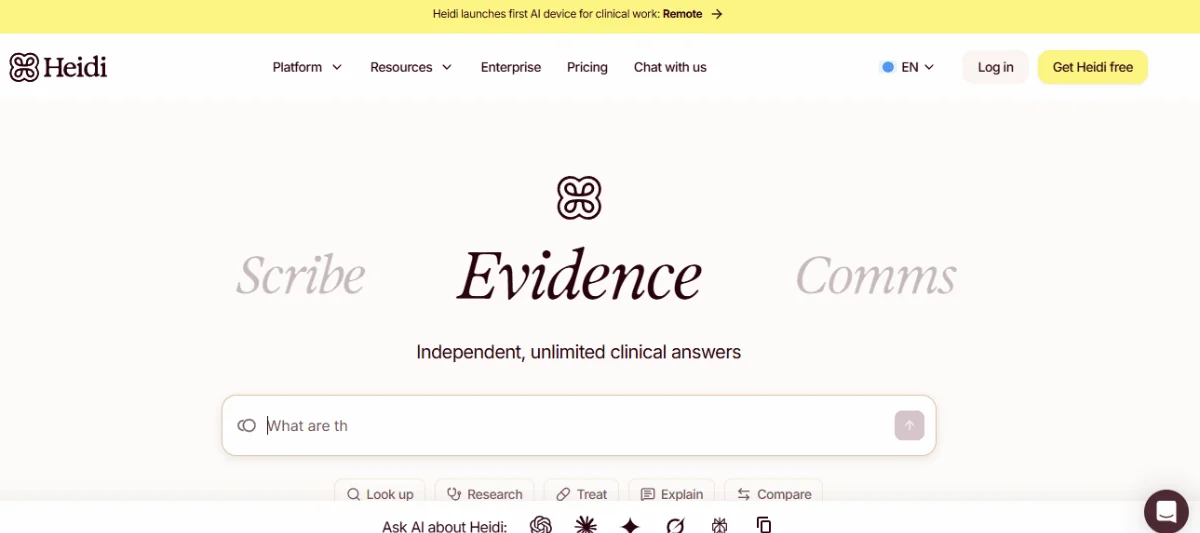
Heidi AI is an AI-powered clinical documentation tool that captures patient-clinician conversations and turns them into structured medical notes. Your providers can access Heidi through a web app, mobile app, or Chrome extension across more than 200 specialties.
Heidi also surfaces ICD-10 and SNOMED-CT code suggestions within your notes, which helps move your billing workflows forward. A recent $65 million Series B and the acquisition of AutoMedica signal a broader push into AI medical coding and clinical decision support.
Key Strengths of Heidi AI
If you choose Heidi AI, your team gains access to a few capabilities that can help streamline daily documentation and billing.
Here's what stands out:
Real-Time ICD-10 and SNOMED-CT Codes: After each encounter, such as a primary care consultation or a mental health session, Heidi surfaces relevant billing codes in a sidebar panel. The tool ranks these by clinical relevance, giving you a one-click review before you finalise your notes.
Adaptive Voice Recognition: Heidi's speech engine adapts to individual clinician styles and handles medical terminology, regional accents, and multilingual encounters in 110+ languages. The tool's accuracy improves over time as providers use the tool.
Customizable Templates with a Community Library: You can create your own note structures, save them for repeated use, and share them through a public template community that covers every major medical specialty.
Evidence-Based Clinical Answers: Heidi Evidence delivers ad-free, citation-backed answers to clinical questions from trusted guidelines and peer-reviewed research directly within your workflow.
With Heidi AI, you get a well-rounded documentation companion, especially if your practice runs a high volume of general or allied health encounters.
Heidi AI Limitations
You might want to consider the following design trade-offs:
Enterprise Depth Falls Short: Heidi works well for individual clinicians and smaller practices, but hospitals and health systems may find its infrastructure and EHR reach limited compared to enterprise-grade solutions.
Mobile App Stability Concerns: Multiple users on the Google Play Store have reported bugs and glitches in the mobile app, including black screens and sync failures. These can disrupt your workflow on busy clinic days.
Code Suggestions Require Full Manual Review: Heidi's billing codes are suggestions only. The tool doesn't auto-submit or finalize codes, which means your team still carries the full review burden for every encounter.
Your experience will vary depending on your practice size and the level of coding control you require.
What Is Deepscribe? Core Features & Capabilities
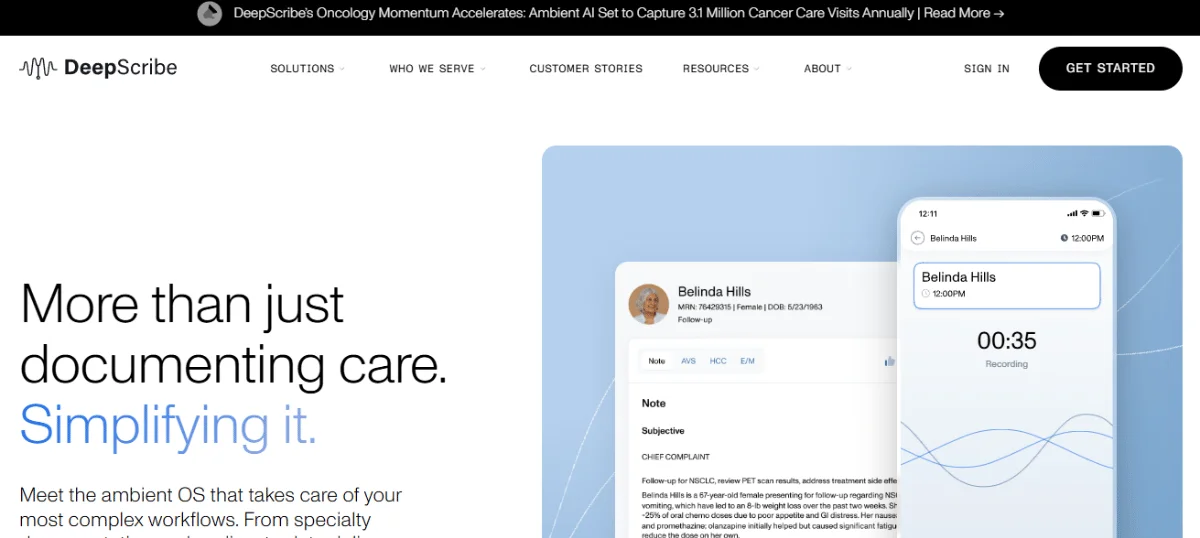
Deepscribe is an ambient clinical documentation tool designed for specialty and chronic care workflows. Founded in 2017, Deepscribe serves more than 1,500 healthcare organizations across the U.S.
The tool supports HCC, ICD-10, and E/M coding as part of its ambient workflow.
Key Strengths of Deepscribe
Deepscribe focuses on specialty-specific documentation and coding. Here's what your team can expect:
Full-Spectrum Coding Intelligence: Deepscribe recommends E/M, ICD-10, and HCC codes in real time during the ambient scribing process, with Clinical Documentation Integrity checks that support accurate billing.
Specialty-Tuned AI Models: Deepscribe trains its AI for complex specialties like oncology, cardiology, urology, orthopedics, and neurology. Each field has built-in terminology-aware templates.
Contextual Notes with Patient History: The AI pulls relevant labs, diagnostics, and prior documentation into each note, which gives users a longitudinal, clinically coherent record they can trust.
Per-Provider Customization: Deepscribe learns each clinician's unique documentation style from day 1 and allows granular preference adjustments at the individual level for maximum adoption.
If specialty depth matters most to your organization, Deepscribe brings strong clinical awareness to each encounter.
Deepscribe Limitations
However, your team should weigh the following factors before committing:
No Public Pricing or Free Trial: Deepscribe requires your organization to go through a sales consultation before you can see pricing or access the tool. There is no self-serve sign-up or trial period, which can slow down evaluation for teams that want to test the tool in their clinical environment before committing.
Narrow Focus Beyond Specialty Care: Deepscribe excels in complex specialty workflows, but health organizations that focus on general primary care may find its depth unnecessary and the cost difficult to justify.
Complex Onboarding and Setup: Full EHR integration often requires IT coordination, sales consultations, and contracts, which means a longer ramp-up time before your team sees measurable results.
With Deepscribe, the gains in speciality precision may come at the expense of breadth and accessibility.
How Heidi AI Works in a Clinical Workflow
Understanding the daily workflow is just as important as the feature set. Let's see what a typical encounter with Heidi AI looks like:
Your clinician logs in to the Heidi AI app in a web browser on a mobile device or desktop and starts a session before the patient visit.
Heidi listens to the encounter in the background using ambient AI, then generates a structured clinical note once the conversation ends.
You can review the note, make edits, and confirm or replace the suggested ICD-10 and SNOMED-CT codes in a sidebar panel.
From there, you push the finalized note into your EHR.
The entire process runs within a single screen, and most clinicians report minimal disruption to their natural consultation flow.

How Deepscribe Works in a Clinical Workflow
Here's what a typical encounter with Deepscribe looks like from start to finish:
Your provider opens the Deepscribe mobile app at the start of a visit and selects a patient from the synced schedule.
The ambient AI records and analyzes the conversation in real-time while your provider speaks naturally with the patient.
Once the encounter ends, Deepscribe generates a structured clinical note tailored to the provider's specialty and documentation preferences, then syncs it to your EHR within seconds.
Your healthcare provider reviews the note, confirms the suggested E/M and ICD-10 codes, and signs off.
Most clinicians describe the daily experience as minimal effort. They only tap a button, talk, and walk out with a ready note.
Deepscribe vs. Heidi AI Pricing and Value Comparison
Cost plays a major role when you evaluate any AI documentation tool.
Here's how the 2 tools compare in terms of pricing and overall value:
Heidi AI Monthly Cost: Under its Teams and Enterprise plans, Heidi charges $30 per provider per month for the Evidence Team tier and $180 per user per month for the Practice tier. The tool offers a free tier for basic transcription, while enterprise teams must request a custom quote. Volume discounts may apply under various requirements, but the limited enterprise features may push your team toward paid add-ons.
Deepscribe Monthly Cost: Based on user feedback and reports, Deepscribe ranges from $350 to $750 per provider per month, depending on your specialty requirements, EHR integration needs, and the size of your practice or organization. Full integration can add more costs per provider on top of the base fee.
Value Per Dollar: With Heidi AI, you get a lower entry point with solid documentation features. With Deepscribe, you get greater coding intelligence and specialty depth at a premium. You must decide whether your healthcare system values broad affordability or deep specialty.
Which Tool Saves More Time for Doctors?
Time saved per day determines whether your providers actually adopt the tool long term. Let's see how the numbers compare:
Heidi AI Time Savings: Clinicians who use Heidi report an average of 1.5 hours saved per day on documentation, based on user feedback across general practice and allied health settings.
Deepscribe Time Savings: Deepscribe generally achieves an average chart closure time of 1.6 minutes and claims up to a 75% reduction in documentation time, making it one of the faster options for specialty-heavy practices.
Your providers won't stick with a tool that adds friction to their day. The tool that returns the most time to patient care earns the strongest long-term adoption from your clinical teams.
What About DeliverHealth?
Both Heidi AI and Deepscribe center on ambient note capture with coding suggestions layered on top.
DeliverHealth takes a different path. We offer comprehensive AI-powered clinical documentation and medical coding automation solutions that connect both workflows for enterprise healthcare.
You can see the difference when you understand how our AI-powered ambient and dictation documentation compares to standard tools.
Here's how we do it:
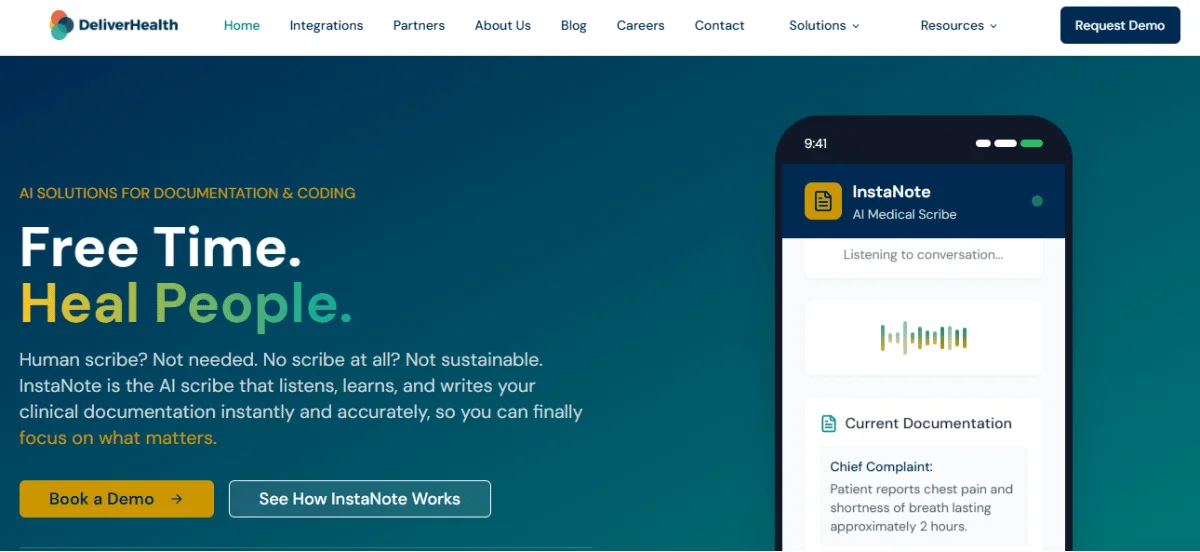
InstaNote: Documentation That Goes Beyond Ambient Capture
InstaNote is a purpose-built AI solution with extensive medical vocabulary refined over years of deep specialization in clinical documentation across dozens of medical specialties and care settings.
InstaNote captures your ambient or dictated encounter and generates structured, accurate notes customized to your organization's templates.
Once the note is complete, the tool surfaces relevant code suggestions to move your billing workflow forward.
Our advanced medical speech recognition focuses on capturing only what your provider actually said, which means fewer hallucinations and cleaner records that keep your real-time AI scribe and coding workflows accurate from the start.
Your providers save up to 2.5 hours per day, and your organization can see $50,000+ in annual savings per physician.
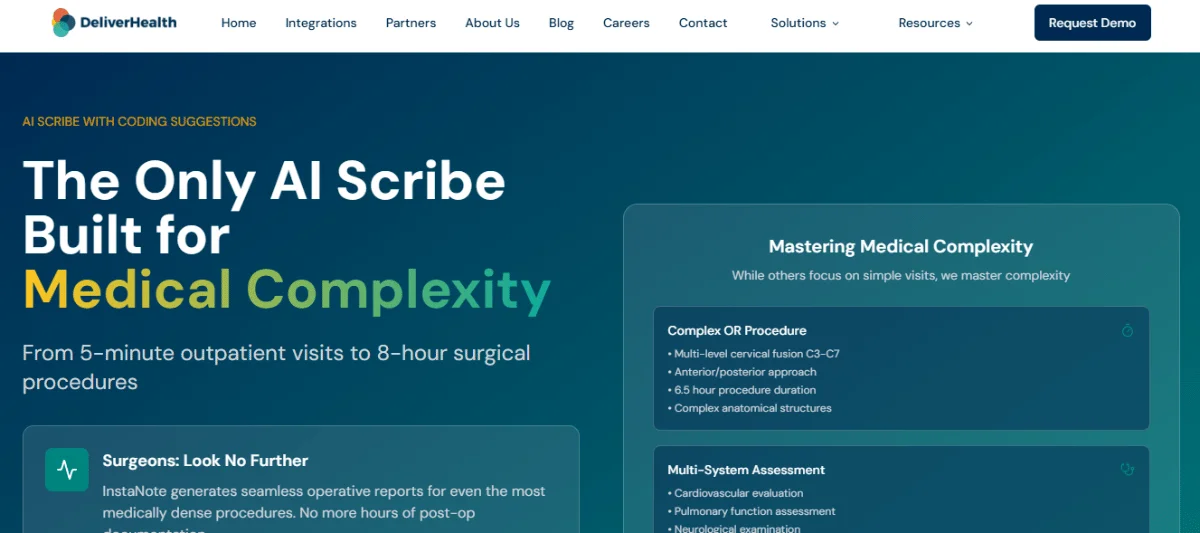
InstaNote supports both inpatient and outpatient workflows. Your providers can use it for complex operative reports and primary care visits, delivering the kind of benefits of AI-driven documentation beyond ambient capture alone.
Your clinicians keep their familiar speech and voice commands while our AI handles note formatting behind the scenes, which means your team can start in days with minimal disruption.
InstaNote runs on our eSOne platform, which is protected by HITRUST i1 certification. This is the highest healthcare data security standard, which includes 24/7 monitoring across infrastructure, threats, and vulnerabilities.
InstaCode: Autonomous Coding with Confidence-Based Routing
Where Heidi AI suggests codes for manual clinician review and Deepscribe layers coding onto its specialty scribe, we go further.
InstaCode routes each case to the best-suited AI engine or human coder based on confidence thresholds. You get faster billing, reduced costs, and consistent quality across every record.
Every coded record also passes through integrated SmartAudit checks that verify accuracy and compliance before your team submits the claim, helping you tackle the denials that cost you money before they reach a payer.
Why Organizations Trust DeliverHealth
Our partnership with Google Cloud combines Google's Gemini model with our repository of 150,000 human-curated audio hours per month for unmatched accuracy.
We serve 800+ health systems and 60,000+ providers, and we handle more than 1 million clinical notes every month.
These results are already real for organizations that have made the switch. Here’s what LaShanda Smith, the Operations Manager at DCH Health System, had to say:
"The results of the InstaNote implementation truly speak for themselves. These outcomes include, but are not limited to, improved documentation compliance and reduced turnaround time for report completion. A huge thank you to DeliverHealth for their incredible collaboration with our team in achieving high-quality results!”
If you're ready to reduce physician burnout while improving revenue cycle performance, check out how DeliverHealth can improve your clinical documentation and coding workflow.
Frequently Asked Questions (FAQs)
Here are answers to common questions about Heidi AI and Deepscribe, including how they handle clinical documentation:
Does Heidi AI or Deepscribe Support SOAP Note Generation?
Yes, both tools can generate SOAP-formatted notes. Heidi AI allows you to create custom SOAP templates and save them to a personal library so you can use them across repeat encounters.
Deepscribe also produces SOAP-structured notes, but its real strength lies in specialty-specific formats tailored to fields like oncology and cardiology.
How Do Heidi AI and Deepscribe Compare for Note Quality?
Both tools produce structured, EHR-ready clinical notes, but they get there in different ways.
Heidi AI generates notes using customizable templates and produces generally high-quality output for general practice and allied health encounters. Its accuracy gets better over time as the tool adapts to the documentation style of each healthcare provider. However, your team may need more manual edits for complex specialty cases.
Deepscribe pulls in prior patient history, labs, and diagnostics to create contextual notes with deeper clinical detail, especially for complex specialty encounters.
Which AI Scribe Is More Accurate?
The accuracy of the scribe depends on your use case.
Deepscribe trains specialty-specific AI models for fields like oncology and cardiology, which helps it capture complex terminology and clinical nuance with fewer errors in those areas.
Heidi AI delivers strong general-purpose accuracy across 200+ specialties, but your team may need more manual edits for highly specialized encounters.
Your results will depend on how closely each tool's AI matches your clinical workflows.
Can I Switch from Deepscribe to Heidi AI (or Vice Versa)?
You can switch from Deepscribe and Heidi AI and vice versa, but the process requires planning.
Your team will need to reconfigure EHR integrations, retrain providers on a new workflow, and rebuild custom templates.
InstaNote onboards more smoothly because it adapts to the templates and voice commands you already use.
Conclusion
Both Heidi AI and Deepscribe handle ambient AI documentation well, and each one also has coding capabilities that help your team manage medical coding with fewer manual steps.
However, both tools still require your team to manually review and finalize every code.
DeliverHealth goes further with InstaCode, which autonomously routes each case to the best-suited AI engine or human coder based on confidence thresholds.
InstaNote complements that with accurate documentation through both ambient and dictation workflows.
Your providers save time while your coding team gains confidence-based routing and SmartAudit quality checks for every case, backed by HITRUST i1 security and 60,000+ providers who already trust our tools.
Explore how DeliverHealth connects your documentation and coding workflows.
Stay Updated
Subscribe to our newsletter for the latest healthcare AI insights and company updates.