
Sully vs DeepScribe: Agent Breadth or Specialty Depth
Sully vs. DeepScribe is a choice between a broad team of AI agents and ambient documentation built deep for oncology. This comparison sets the criteria, profiles both vendors fairly, and shows how to test their claims on your own notes.
Sully vs. DeepScribe is a choice between two ways of putting AI to work around the patient visit. Sully spreads a team of AI agents across the front desk, the visit, and the coding queue, and DeepScribe goes deep on oncology with pre-visit summaries and suggested evaluation and management (E/M) codes.
The right fit depends on how much work you want one vendor to own and how specialized your documentation is.
In this article, we set the evaluation criteria, profile both vendors fairly, and show how to verify claims and pilot either tool on your own notes.
TL;DR: Sully vs DeepScribe at a Glance
The comparison in brief:
Core difference: Sully markets a team of AI agents across scheduling, intake, documentation, coding, and follow-up. DeepScribe builds ambient documentation, pre-visit summaries, and coding with a deep focus on oncology.
Specialty fit: DeepScribe's newest work is built for cancer care first. Sully suits organizations that want one vendor across several front-office and clinical tasks.
Coding: Both vendors market coding features, so ask what each one codes, who approves the codes, and how they reach billing.
Governance: Sully's agents act across more of the workflow, so your review steps, audit logs, and business associate agreement need to cover each one. DeepScribe keeps its work inside one ambient system, which focuses that review on documentation, pre-visit summaries, and coding.

Sully vs DeepScribe Side by Side
Sully and DeepScribe both start from ambient capture of the visit conversation. Each extends that capture in a different direction, as the summary below shows.
The main differences side by side:
Criterion | Sully | DeepScribe |
|---|---|---|
Core approach | A team of task-specific AI agents | Ambient documentation built for specialty care |
Specialty emphasis | Broad, across clinic and hospital operations | Oncology first, plus other complex specialties |
Work beyond the note | Agents for scheduling, intake, coding, and follow-up | Pre-visit summaries and coding inside one ambient system |
Coding scope | A coding agent; confirm code sets and review steps | E/M, ICD-10, and HCC coding features |
Human review | Clinicians stay in charge; a human reviews cases where models disagree | Confirm who reviews drafts and who approves codes |
Each vendor approaches documentation and coding in its own way:
Sully's Agent-Based Approach
Sully (Sully.ai) is a venture-backed company that frames its product as a team of AI agents for healthcare organizations. Its founders describe agents for the work around each visit, including scheduling, intake, documentation, coding, and follow-up.
Sully states that doctors remain in charge and that a human reviews each case when its models disagree. That design gives a practice one vendor for several front-office and clinical tasks.
The agent model reads differently against an enterprise documentation vendor, as the Sully vs Abridge comparison shows.
Key capabilities:
Ambient documentation: A scribe agent drafts the clinical note from the visit conversation.
Agents beyond the note: Separate agents handle work such as intake, scheduling, triage, and coding, so a practice can add functions over time.
EHR connection: Sully markets integrations with major electronic health record (EHR) systems, including Epic and athenahealth.
Human escalation: According to the company, cases where its models disagree go to a human reviewer.
Tradeoff: A wider set of agents widens what your team must validate, since each agent operates with its own logic and level of maturity. Ask for the review step and the audit record behind every agent you plan to switch on.
DeepScribe's Specialty-Focused Approach
DeepScribe builds ambient AI documentation for specialty and chronic care, and its recent product work centers on oncology. Its ambient system combines documentation, pre-visit summaries, and coding in one workflow.
Community oncology groups form its core market, and a partnership with Flatiron Health brings its oncology documentation to OncoEMR users. Teams that want a wider field can also review DeepScribe alternatives across documentation vendors.
Key capabilities:
Specialty ambient documentation: Notes built for the detail of oncology visits, along with other specialty and chronic care workflows.
Pre-visit intelligence: SmartPrep gathers and summarizes relevant clinical information before each encounter for oncology customers.
Coding features: Real-time E/M code recommendations from the visit conversation, plus ICD-10 and Hierarchical Condition Category (HCC) coding support.
Customization: A customization studio for tailoring how notes are structured.
Tradeoff: DeepScribe launches its newest features, such as SmartPrep, for oncology customers first. Multi-specialty groups and hospitals should confirm how far its configuration reaches in the specialties and care settings they need beyond cancer care.
DeliverHealth's Documentation and Coding Approach
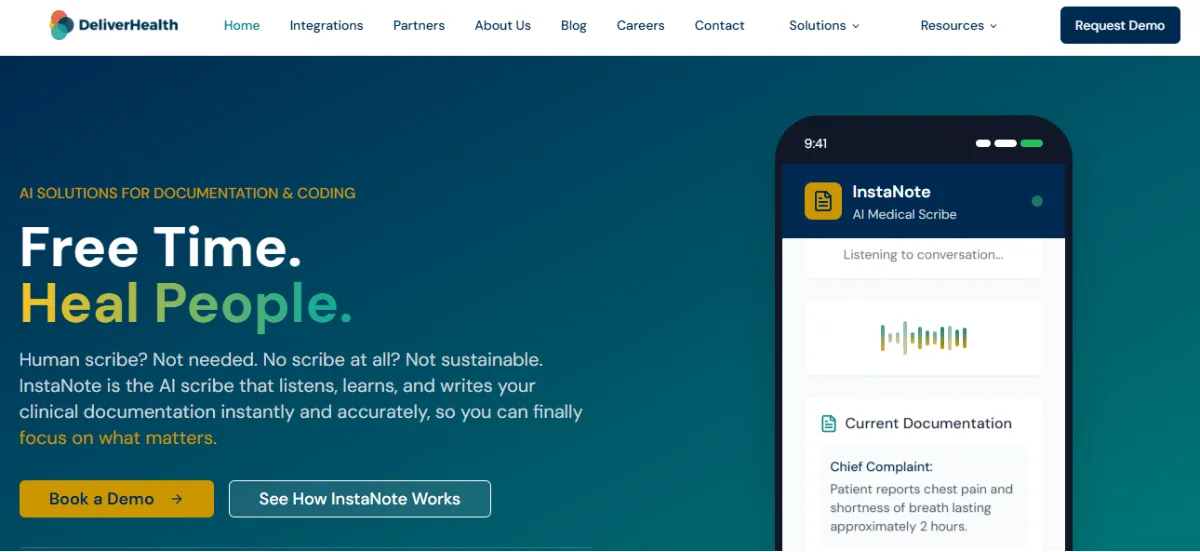
DeliverHealth provides AI-powered clinical documentation and coding solutions for organizations from small and mid-size practices to large health systems. We build on one idea: the clinical note is where the revenue cycle starts.
InstaNote AI clinical documentation supports ambient capture and traditional dictation as native inputs, across inpatient and outpatient care. InstaNote's speech recognition is designed not to add anything that wasn't said, and our templates follow your organization's and each provider's requests.
InstaNote includes coding suggestions based on the note, which the provider reviews before sign-off so the documentation hands off cleanly. Coders then approve the final codes.
Our VP of Business Operations, Gautam Kumar, puts the stakes in one line: "Documentation quality should be viewed as the 1st and most important revenue cycle control point."
Key capabilities:
Two capture modes: Ambient and dictation in one solution, including operative, procedural, and inpatient notes created after the patient conversation ends.
Structured notes: A near-final, structured note in about three minutes, written to discrete EHR fields where the interface allows, across more than 50 EHRs.
Deliberate blanks: Our model is designed not to allow inferring a diagnosis, so a section stays blank when the clinician did not state it.
Coding with credentialed review: InstaCode delivers 95% coding accuracy with human-in-the-loop review, and billable codes typically arrive within about 24 hours. Our AAPC- or AHIMA-credentialed coders stay in the loop and approve the codes, and every coded encounter keeps a record of the AI's output, each human change, and the reason behind it.
Security: InstaNote runs on our eSOne platform, which is HITRUST i1 certified, and we sign a business associate agreement (BAA) before handling any patient data.
If your shortlist needs documentation that holds up beyond the clinic room, test that requirement with every vendor early.
DeliverHealth provides AI-powered clinical documentation through InstaNote and AI-powered medical coding through InstaCode, with agentic revenue cycle management (RCM) extending that work downstream. We deliver enterprise-level deployments for health systems and serve small and mid-size practices with the same care.
Three things set our documentation apart in a comparison like this one:
Both capture modes: Ambient and dictation run natively in one solution across inpatient and outpatient care.
Your formats: Templates follow your organization's standards and each provider's preferences.
Practical timelines: InstaNote deployment typically takes two to three weeks.
Book an InstaNote demo to see a sample note in your specialty move from capture to coding suggestions, then plan a pilot on your own documentation.
Evaluation Criteria for Sully vs DeepScribe
A fair decision rests on your own measures. Set it before the demos, so you measure each vendor against your workflow.
The upside of getting the choice right is measurable. When The Permanente Medical Group gave ambient AI to 7,260 physicians across more than 2.5 million encounters, the AMA's summary of the Permanente analysis reported an estimated 15,791 hours of documentation time saved, or 1,794 eight-hour workdays.
Adoption was uneven, and the reasons are instructive. Physicians who used the tool rarely or not at all cited weak integration with their note templates and felt editing AI drafts took longer than typing.
Five criteria carry most of a Sully vs DeepScribe decision:
Scope of work: Decide whether you need help with the note alone or with the tasks around it, such as intake, scheduling, and coding. A broader scope widens the group of leaders who must approve the rollout.
Specialty depth: Name the specialties that will use the tool first and how complex their notes run. A tool tuned for one specialty may need more configuration in others.
Template fit: Ask how the note follows your organization's formats and each provider's preferences. Template gaps were a leading reason for low use in the Permanente analysis.
Coding output and review: Ask which codes the tool produces, who confirms them, and what record remains of every change.
Capture mode and care setting: Confirm support for dictation alongside ambient capture if your teams document operative, procedural, or inpatient work.
How to Verify Each Vendor's Claims
Vendor claims are easiest to test before the contract, when every answer can still change your shortlist. Coding claims deserve the closest look.
Medicare's E/M services booklet says most E/M visit levels rest on medical decision making (MDM) or time. CMS also tells practitioners that documentation must support the level billed and that the volume of documentation should not decide the level.
That rule matters for ambient tools, which can produce long notes quickly. Ask how each vendor ties its E/M recommendation to the decision-making recorded in the note.
Ask how any accuracy figure was measured, and read why headline coding accuracy figures can hide the errors that matter most.
Agent breadth also changes your privacy review. HHS guidance on business associates says a covered entity needs a written contract that establishes what the business associate was engaged to do.
With a multi-agent vendor, your compliance team should confirm that the agreement covers every function you plan to switch on, from intake to coding.
Bring these questions to both vendors:
Coding basis: Which code sets does the tool produce, and does it select E/M levels from MDM, time, or both?
Code approval: Who confirms each code before billing, and does a credentialed coder see the encounter?
Audit record: What does the system keep about the AI's output and every human change?
Escalation: Which cases route to a human, how quickly, and who owns the queue?
Data use: Where are recordings stored, how long are they kept, and is patient data used for any other purpose?
How to Roll Out and Pilot Either Vendor
A pilot is where vendor claims meet your own documentation. Build it around the encounters that matter most to your revenue cycle.
Rollout results depend as much on people as on software, which is why the organizational side of ambient AI adoption deserves its own plan.
Build the pilot around these steps:
Representative encounters: Include your highest-volume visit types along with your hardest ones, such as complex specialty visits or inpatient and operative notes.
Clinical champions: Recruit a champion in each pilot specialty and give them a direct line to the vendor's implementation team.
Baselines: Record current note completion time, edit time, and clinician satisfaction before go-live, so results have a comparison point.
Early coder review: Have your coding team review pilot encounters to see whether the documentation supports clean, defensible codes.
Escalation tracking: Log how often the tool routes work to a human and why, for documentation and coding alike.
Run both vendors against the same encounter mix if you can. Matched samples make a Sully vs DeepScribe decision far easier to defend to finance and compliance leaders.

Frequently Asked Questions (FAQs)
These questions come up often when teams compare the two vendors:
Is DeepScribe a Good Fit Outside Oncology?
DeepScribe serves specialty and chronic care beyond cancer care, and it launches its newest features for oncology customers first.
Ask for references in your own specialties, and test those note types during the pilot.
Can Sully and DeepScribe Assign Billing Codes?
Both vendors market coding features. Sully offers a coding agent, and DeepScribe offers E/M, ICD-10, and HCC coding support.
Confirm who approves each code and how it reaches your billing system, since that step shapes your audit exposure.
Do Ambient AI Tools Handle Operative and Inpatient Notes?
Many operative reports, procedural reads, and inpatient notes are created after the patient conversation ends, so they depend on dictation. Teams weighing options for those notes can compare how medical dictation software fits alongside ambient capture.
InstaNote supports both modes in one solution, across inpatient and outpatient care.
Which Teams Should Join an Ambient AI Evaluation?
Bring clinical leadership, revenue cycle and coding leaders, IT, and compliance into the evaluation from the start.
Each group tests a different risk, from note quality to code accuracy to data handling.
What Should a Business Associate Agreement Cover for an AI Vendor?
At minimum, it should state what the vendor was engaged to do and require HIPAA safeguards for protected health information, as the HHS guidance cited earlier explains.
Your compliance team and counsel should review the scope, since a vendor with several agents may touch more patient data than a documentation tool alone.
Final Thoughts on Choosing Between Sully and DeepScribe
The note your clinicians sign today becomes the code, the claim, and the payment your finance team tracks next month. Choose the vendor whose work you can trace from that note forward, with a person accountable at each step.
That traceability is the standard we hold our own solutions to.
DeliverHealth provides AI-powered clinical documentation and coding solutions, and InstaNote is trusted by more than 40,000 healthcare providers. InstaNote's coding suggestions help providers hand off a stronger note, and InstaCode adds 95% coding accuracy with human-in-the-loop review from our credentialed coders.
InstaNote runs on our eSOne platform, which is HITRUST i1 certified, and every encounter coded through InstaCode keeps a full audit trail of AI output, human changes, and the reasoning behind them.
Schedule an InstaNote demo to walk through a specialty-matched sample note and the coding handoff behind it.
Stay Updated
Subscribe to our newsletter for the latest healthcare AI insights and company updates.